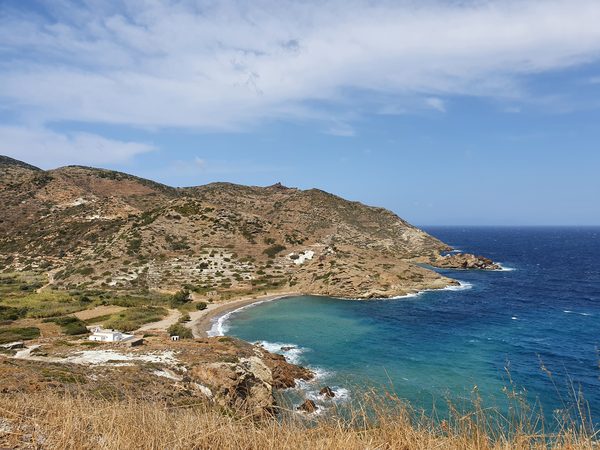
Kimolos sits barely a mile off the north-east tip of Milos, yet almost nobody who visits Milos ever sets foot on it. Around 900 people live here, nearly all of them in one hilltop village called Chorio. There is no bus, no resort strip and no queue for anything. This guide covers what the island is, what to see, and why it deserves longer than an afternoon.
In this guide
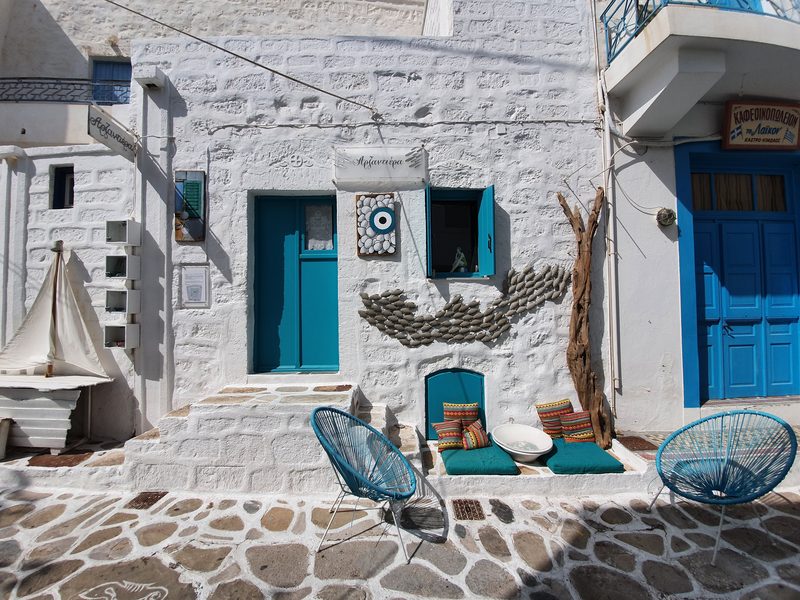
Tradition gives the island two possible namesakes: a founder called Kimolos, and the chalk the place is made of. Kimolia is still the Greek word for chalk, and it covers the fine kaolin-bearing clay dug out of these hills and shipped across the ancient Mediterranean for its medicinal and cleaning properties. That trade made a small island unexpectedly wealthy. The pale volcanic rock is streaked with the reds and ochres of bentonite, perlite and barite.
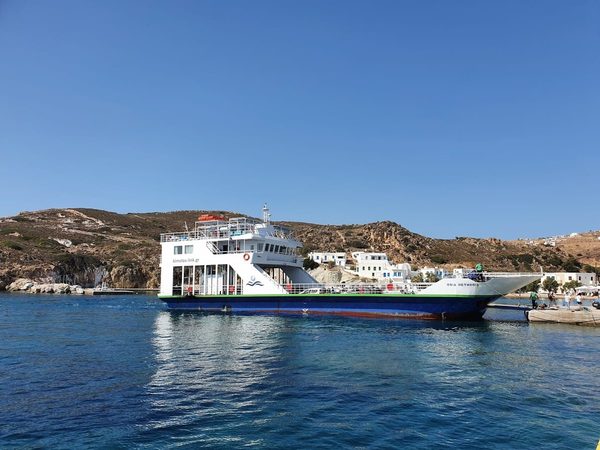
Everything here is close together. The ferry lands at Psathi, a small harbour with a few tavernas and a sandy beach; Chorio is a couple of kilometres inland and uphill, ten to fifteen minutes on foot. The highest point, Paliokastro, reaches 365 metres, and you can cross the whole island in a morning.
I have been over twice, in June and again in late September, and September is the one I would repeat. The island empties out, the light softens and the walking becomes comfortable.
How Do You Get to Kimolos?
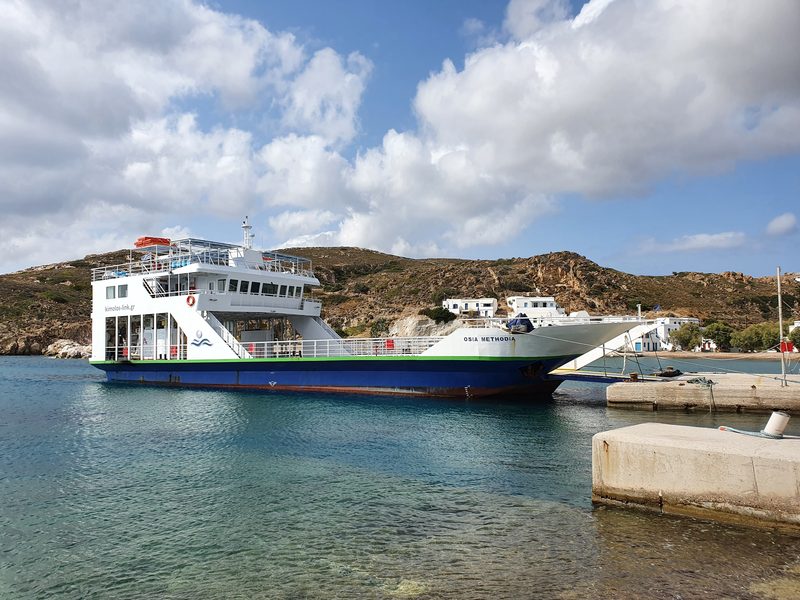
The standard approach is the under-half-an-hour crossing from Pollonia on the north-east coast of Milos, on a small local ferry running several times a day in season. Timetables, tickets and the one-day plan are covered in the Milos to Kimolos day trip guide, and Pollonia is the obvious base if you want the earliest boat.
Kimolos is also a stop on some slower conventional ferries on the western Cyclades line out of Piraeus, so you can arrive without touching Milos, though sailings are infrequent and seasonal; check current operator schedules before relying on this route.
There is a bus, run by a single local operator, linking Psathi with Chorio and the main beaches through high summer. Treat it as a useful bonus rather than the spine of your day: the published timetable covers the peak weeks, the operator says its own times move, and what runs either side of that is unclear. Walking covers most of the island, and a taxi or scooter covers the rest.
Chorio and the Kastro
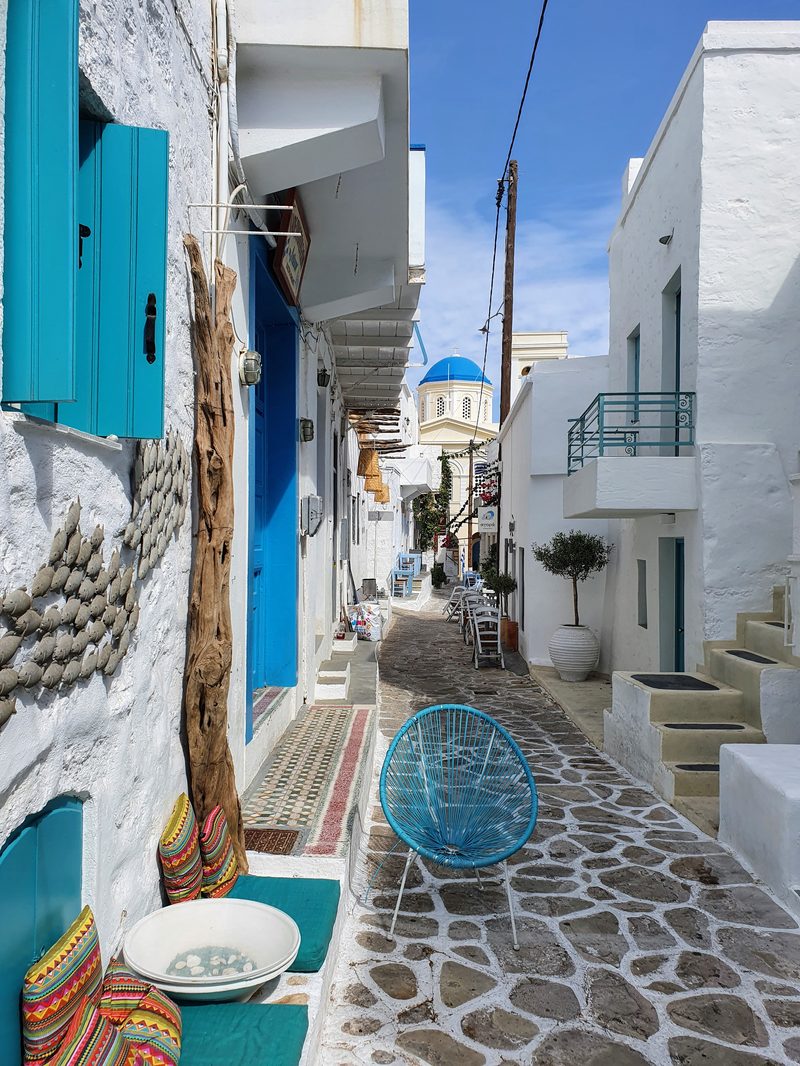
Chorio is the reason to come. The name simply means "village", which is unusual in itself: most Cycladic islands call their main settlement Chora. This is not an abandoned old capital but where nearly everyone on Kimolos lives, all year, and that changes the feel of the place completely.
The layout is a tangle of lanes barely wide enough for two people, and instead of one big square there are several small ones ringed by tavernas, cafes, minimarkets and bakeries. The proportions are the giveaway: the people outside are mostly locals, and the shops exist because the village needs them. Two hours covers the lot, and you will still walk the same alleys four or five times.
The Kastro
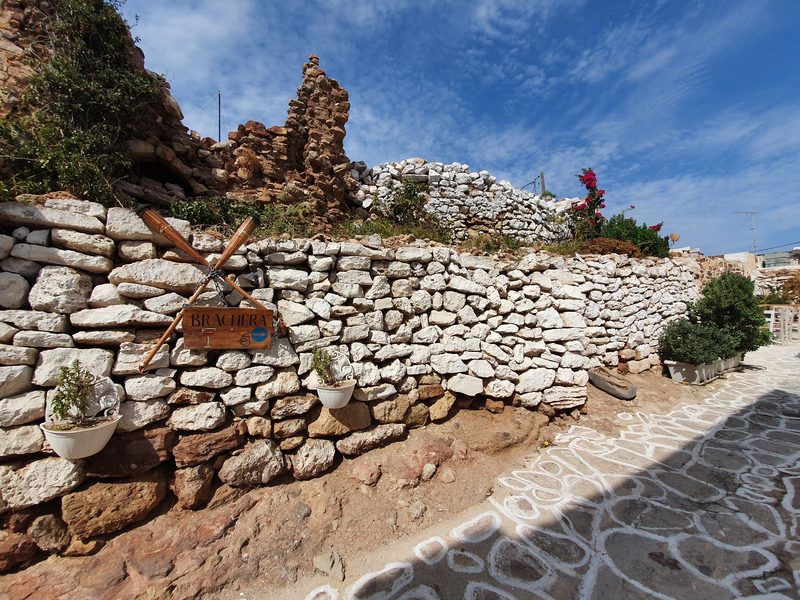
It helps to know what you are looking at, because visitors often stand at the edge waiting for a castle to appear. There is no keep and no battlement. Defence here was architectural: the dwellings on the perimeter present nothing but blank back walls to the outside, no door, no window, packed tight enough that the housing itself becomes a continuous shell around everything inside. It went up between the 14th and 16th centuries in two groups: Mesa Kastro, the houses within, and Exo Kastro, the ring that did the defending. Houses were added over time and the village spread beyond, but the rule holds: the nearer a building stands to the old wall line, the older it is.
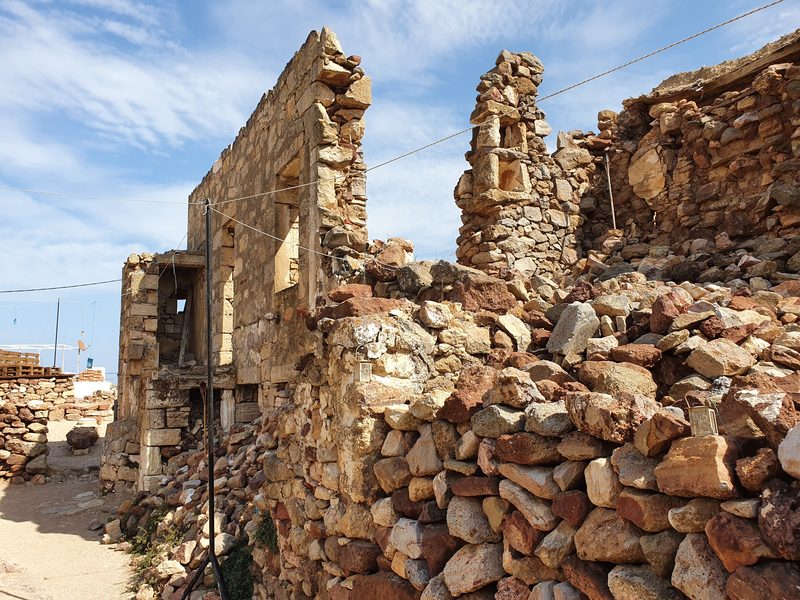
Much of it is roofless now and the first impression is of an abandoned shell. Walk in anyway. There are occupied houses, rooms to let, a bar, a church of 1592 dedicated to the Birth of Christ, and the Folk and Maritime Museum. Ruin and daily life sit side by side.
Go in twice, once in daylight and once after dark. The lit lanes running between the broken walls at night are the best thing on the island.
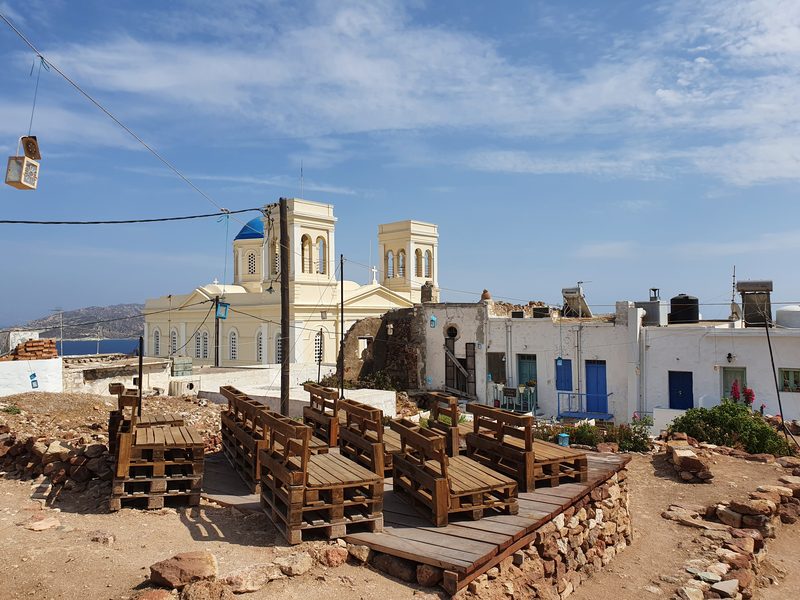
On summer evenings the Kimolistes, a local volunteer group, run Cine Kalisperitis, a free open-air cinema that has drawn international attention for the setting alone. Screenings run June to September, moving between church courtyards and beaches around the island, and relocate into the Kastro itself whenever the wind picks up. Nothing is programmed far in advance: posters go up in the village, and asking in a cafe is the normal way to find out.
The two museums
The Archaeological Museum stands opposite Panagia Odigitria church. It is small, spans the late Neolithic to the Roman period, and its strongest material comes from the Ellinika cemetery, 8th to 7th century BC: proof that this island was doing serious business long before anyone thought of it as a quiet corner. Allow time for the video in the basement, which explains more than the labels.
The Folk and Maritime Museum sits inside the Kastro, in the house where its founder, the doctor Manolis Christoulakis, once lived. The collection is domestic: tools, looms, clothes, pottery from Sifnos, plates carried home by sailors, photographs. Twenty minutes, and the best short course in how the island lived before tourism.
The Archaeological Museum, as of 2026, keeps official summer hours of 08:30 to 15:30, closed Tuesdays. The Folk and Maritime Museum's hours are looser and worth checking locally, or with the Kastro's own noticeboard, before you plan around them.
The churches
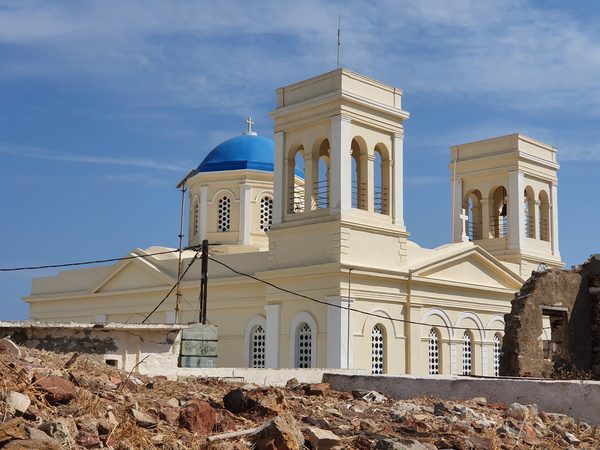
Kimolos has more than 80 churches and chapels for its 900 residents, most of them in or around Chorio. Panagia Odigitria dominates: built between 1867 and 1875, holding a 15th-century icon of the Virgin, feast day 21 November. Pantokratoras, out on the ridge, is about the view over the Aegean rather than the building.
Skiadi Rock
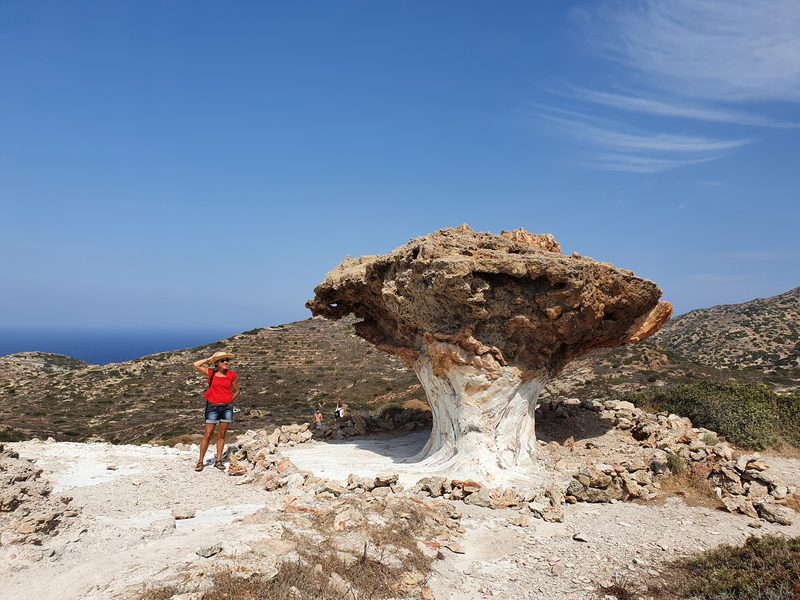
Skiadi is the island's geological signature, a mushroom of rock standing alone on high ground in the west. Wind has scoured away the softer stratum at its base while the harder cap has barely moved, leaving a broad slab balanced on a narrow stem. It is listed in the Atlas of Geological Monuments of the Aegean, and Kimolians are proud of it in a way that catches you off guard.
You can walk there from Chorio, or drive a dirt road most of the way and finish on foot in 20 to 30 minutes. Signage is good and the going is easy underfoot, which is not something I would say of many walks in the Cyclades. The wind is severe, so take sunglasses against the dust. The views west are the payoff, and you can carry on downhill to the beaches rather than turning back.
What Else Is Worth Seeing?
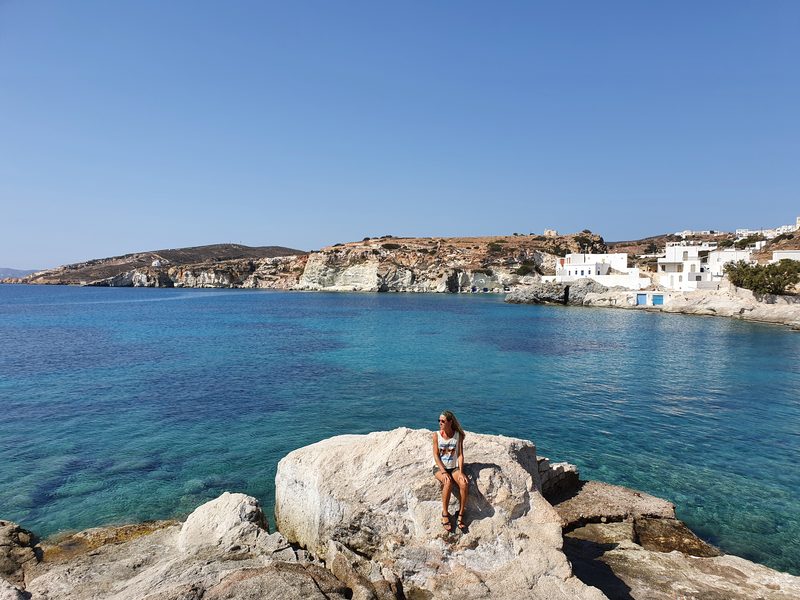
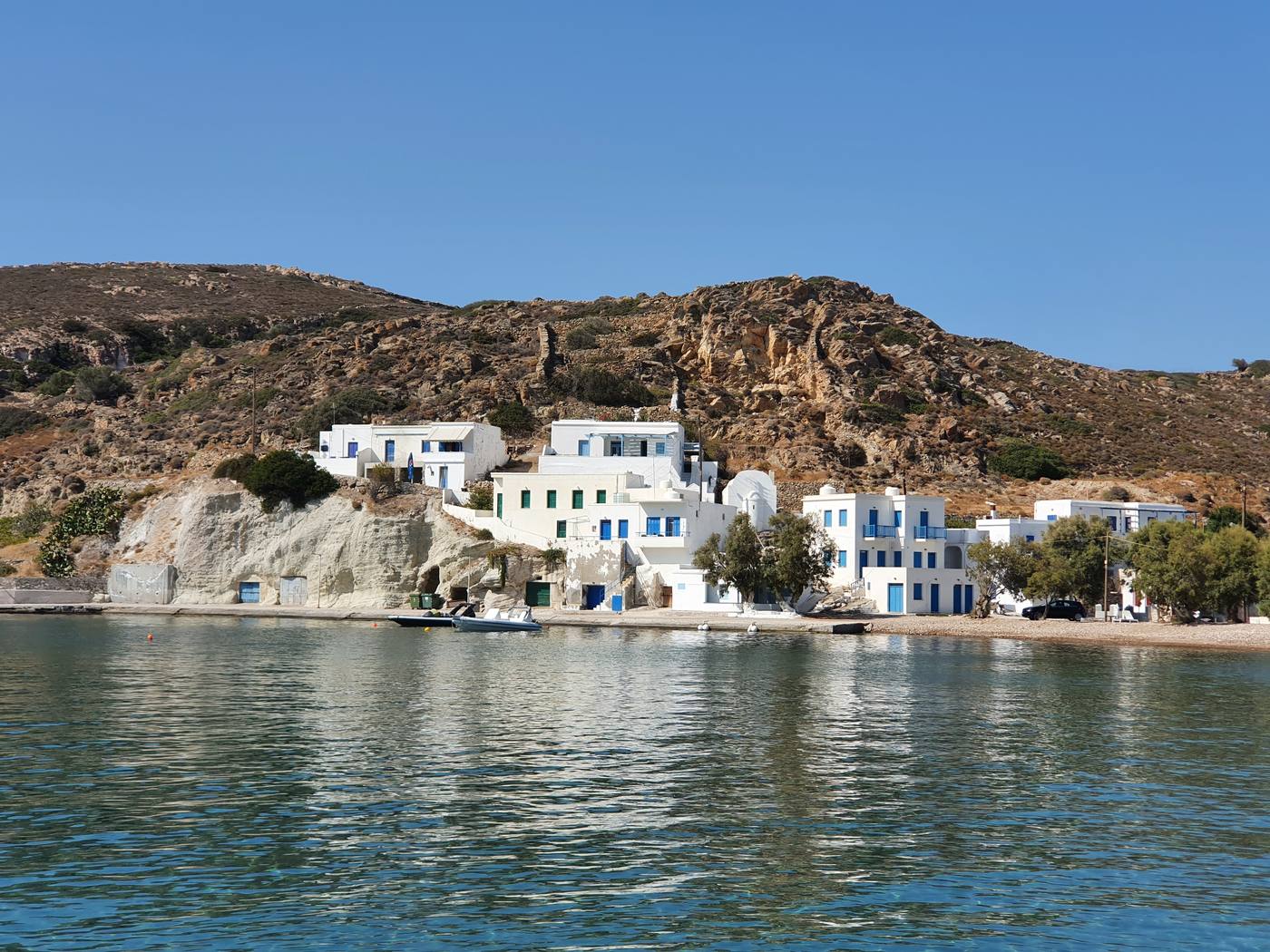
Goupa-Karra and Rema. Two small fishing settlements on the north-east coast, and the prettiest built thing on Kimolos after the Kastro: lines of sirmata, the traditional fishermen's boat houses, doors painted in strong colours. You can swim off the rocks, and from the water one offshore rock is said to look like an elephant.
Polyaigos. The uninhabited island east of Kimolos belongs to the same municipality. Its name means "many goats", and there are still goats. Boat trips run from Kimolos and from Milos to its beaches and sea caves, where Mediterranean monk seals live. From Psathi, Kimolos Nodes runs day trips out to the island; from Milos, several of the Adamas full-day operators combine Polyaigos with Kleftiko. Prices are quoted on request rather than published anywhere, so ask when you book. On foot you can reach a deserted monastery of 1622 and a lighthouse.
The beaches have a page of their own, because they vary enormously by wind direction: see the Kimolos beaches guide.
A Short History of Kimolos
Kimolos is volcanic, shaped by the same eruptions and collapses as Milos, and people were here by the Late Neolithic, around 5000 BC. Legend hands the name to a founding figure called Kimolos; geology hands it to the chalk. Kimolian earth was exported from antiquity as a pharmaceutical and a disinfectant, paying for a level of development you would not predict from the island's size: substantial finds from the 8th-century BC cemetery at Ellinika, and its own coinage by the 3rd century BC. Athens and Sparta each held it briefly before it passed into the Macedonian orbit, and under Rome the mining continued but the island became a place of exile.
The Venetians took it in the early 13th century and renamed it Argentiera, the silver one, for the way light comes off the rock. The Ottomans followed and stayed until the Russians arrived late in the 18th century, and throughout, pirate raids were a fact of life, which is precisely why Chorio sits up a hill behind a ring of blank house walls. Kimolos joined the Greek state in 1830 and spent the next century as the smaller, poorer neighbour. Occupation in the Second World War brought real food shortages, and like Milos the island was not liberated until 8 May 1945.
Walking on Kimolos
Walking is the main outdoor activity and the island is set up for it. Trails are waymarked in red and white and kept up by the Kimolistes volunteers and the local authority, and almost every route starts in Chorio and finishes at a beach, which gives the day an obvious shape.
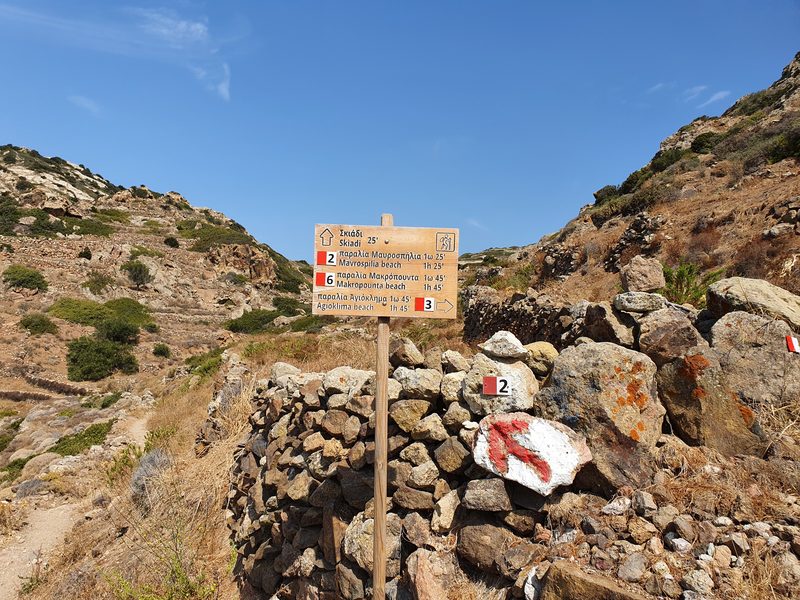
Distances are modest: marked routes run 1.5 to 8.5 km, taking 30 minutes to three and a half hours, and a fit walker can string two together. The 2.1 km route down to Rema and Goupa-Karra takes about 45 minutes and is the one to do if you only do one. The circuit past the old windmills to Pantokratoras gives the best view per unit of effort. At the harder end, the route via Sklavos and Paliokastro to the Consolina cave is genuinely medium grade.
Carry more water than you think, because there is nothing to buy once you leave the village, and skip the middle of the day in July and August. Spring is the best walking season by a distance, and the Kimolistes clear the trails on 1 May. Hiking maps are published by Anavasi and Terrain. Bring a mask too: Ellinika is the snorkelling standout, with a sunken ancient settlement off the islet of Agios Andreas.
What About Festivals and Events?
The calendar is built around panigiria, the church feasts, and these are community events rather than performances for visitors, clustered in high summer: 12 July at Dekas beach, 20 July for Prophitis Ilias, 26 July at Agia Paraskevi, 27 July and 27 August at Prassa, 6 August in Chorio and Klima, 23 August at Xerokampos, and bonfires for the Holy Cross on 13 September. The two that matter most are 15 August in Chorio, preceded by daily services from 1 August, and 21 November at Panagia Odigitria, the big one outside the season.
Two dates reward planning. In late August there is a panigiri on uninhabited Polyaigos, about as unusual an evening as the Cyclades offers, and getting there means asking locally about a boat and the exact date, since it moves slightly year to year. And 15 August doubles as the feast of ladenia, the island's flatbread of dough, tomato and onion, and the dish Kimolos is known for. Kimolos also runs its own small international film festival, now folded into a wider Kimolos Experience Festival of cultural events that runs June to September; exact dates are announced locally each year rather than fixed years in advance, so treat the calendar above as the shape of a typical year rather than a fixed diary.
Is There Any Nightlife on Kimolos?
Not in any meaningful sense, and do not come expecting otherwise. A handful of bars in Chorio and one in the Kastro stay open late in July and August; outside those two months most are shut. What most people do instead is take a drink down to a beach and sit under stars that on an island this dark are worth sitting still for. Where to eat and drink, including the places that keep going year-round, is covered in the Kimolos where to stay and eat guide.
Should You Stay Overnight?
Most people give Kimolos one afternoon between two boats, and you can see Chorio, eat and get back. But the case for a night or three is straightforward: the day-trip window falls in the hottest, brightest part of the day, every walking route takes two to three hours, and the Kastro after dark, the open-air cinema, a panigiri and an evening at Goupa-Karra all come after the last boat.
What surprised me both times was how many of the other visitors were on their fourth or fifth stay. On an island with one summer bus line, no sights to tick off and no nightlife, that is the endorsement that counts.
The downside is real. If you want variety, a choice of restaurants, or something to do on a wet day, Kimolos feels thin by day three. It suits walkers, swimmers, readers and people content to sit. If that is not you, take the day trip and go back to Milos.
Kimolos lies off the north-east coast of Milos, in the Cyclades, a under-half-an-hour crossing from Pollonia, with around 900 residents and one small summer bus line. Nearly everyone lives in Chorio, whose ring of blank-walled houses forms the Kastro itself. Skiadi rock, more than 80 churches and eleven waymarked trails are the island's substance, and the local dish is ladenia.
Planning the rest of your island time? Start with our complete Milos travel guide.
Heading to Athens? See our guide to the best day trips from Athens.
Last updated: 1 August 2026