Pollonia is the quiet alternative to Adamas. It is a single curved bay on the north-east corner of Milos, a Greek island in the Cyclades, with fishing boats tied up a few metres from the tables, tamarisk trees shading a shallow town beach, and some of the best cooking on the island. It is compact, flat and low-rise, and it suits people who want to eat well and swim before breakfast rather than tick off sights.
In this guide
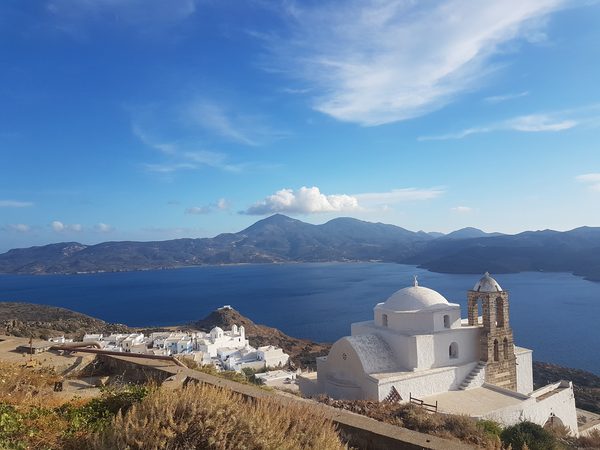
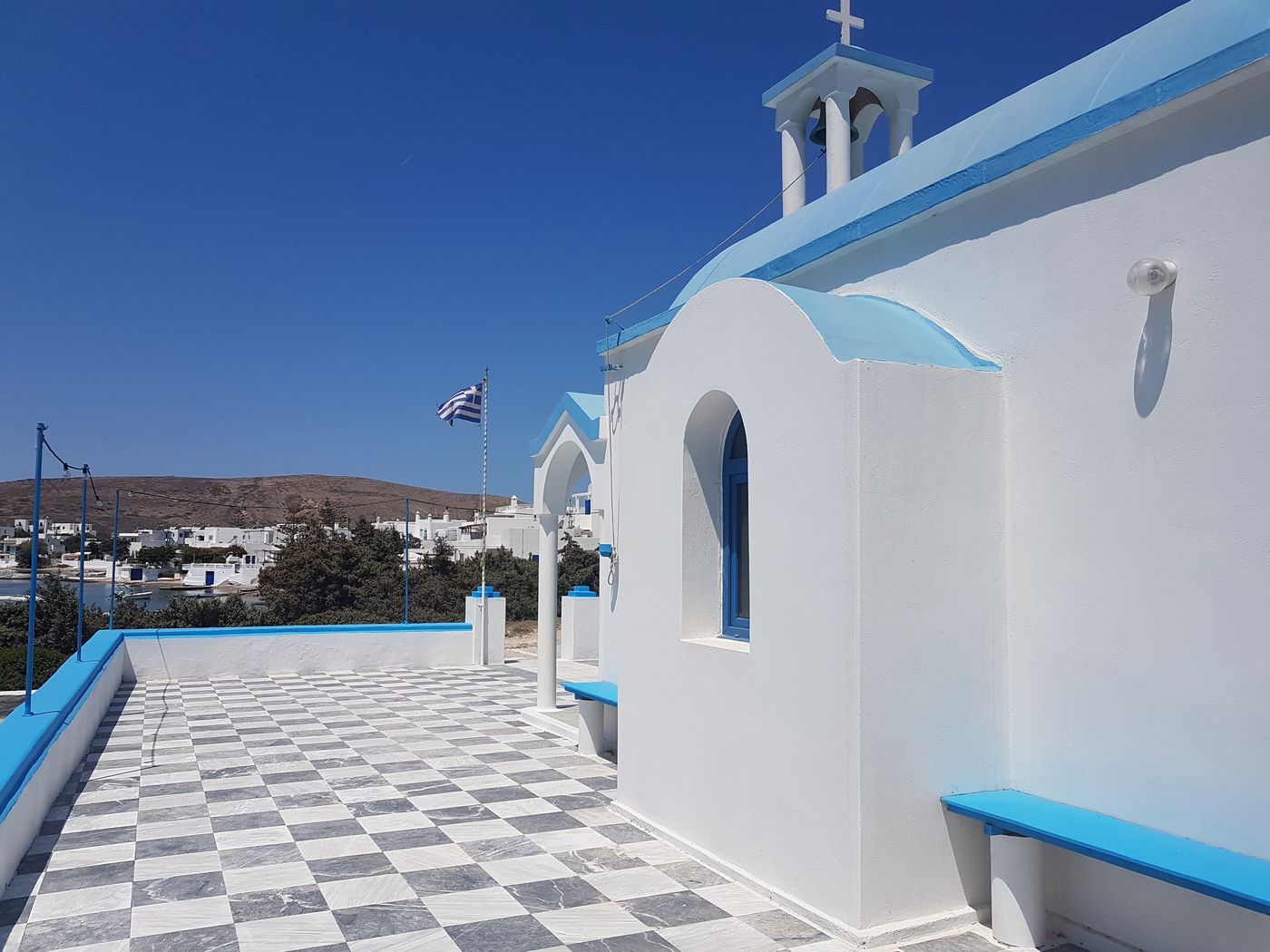
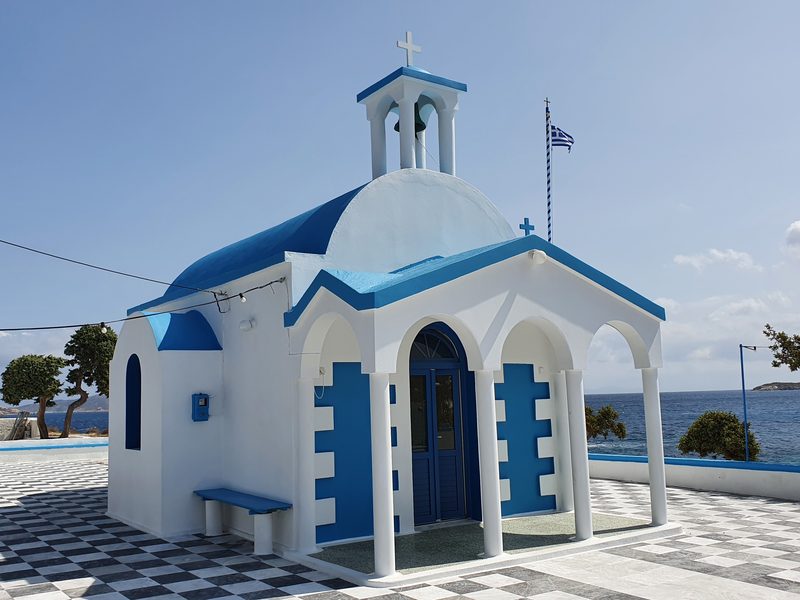
Visitors to Milos end up staying in one of three places: Adamas, the port; Plaka and the villages on the ridge above it; or Pollonia, out where the island runs out of land and the channel to Kimolos opens up. Pollonia is the smallest, and the only one that still reads as a working fishing settlement rather than a town that grew around tourism. The church of Agios Nikolaos stands right down by the water at the end of the promenade, and its dedication to the patron saint of sailors tells you what the place was built around.
What Is Pollonia Actually Like?
Small. Genuinely small. You can walk the entire seafront in ten minutes at a stroll, and there is no old town behind it to get lost in. Behind the seafront sits a shallow grid of low white houses, a few lanes, then fields. No hill to climb, no castle, no museum.
Which means Pollonia has no itinerary. The day is swimming, coffee, a boat trip if you fancy one, then a long dinner. Arrive expecting things to do and you will be finished by eleven and slightly baffled; arrive expecting to do very little and it is one of the most pleasant places on Milos.
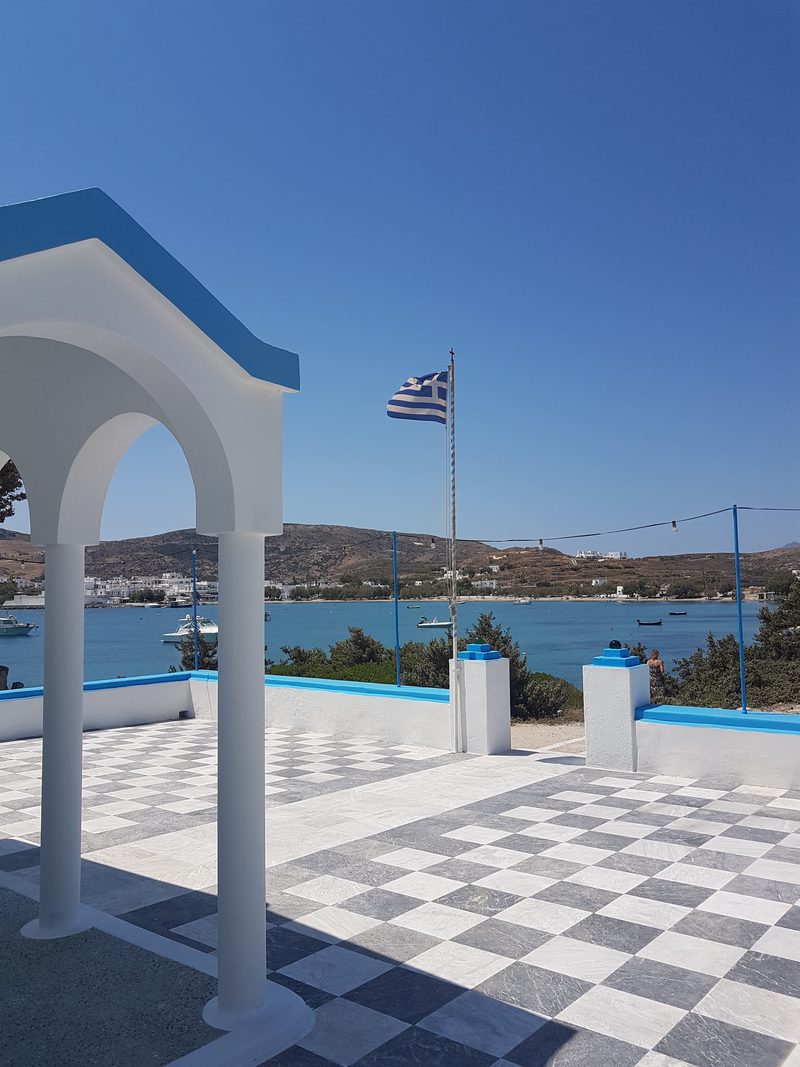
The promenade is the whole social life of the village. Walk it towards the church for the classic view back across the bay with the boats in the foreground. Somewhere along the shore there is a rock shaped like a chair, and the story goes that a couple who sit on it together stay together. Ask in a taverna and someone will point you at it.
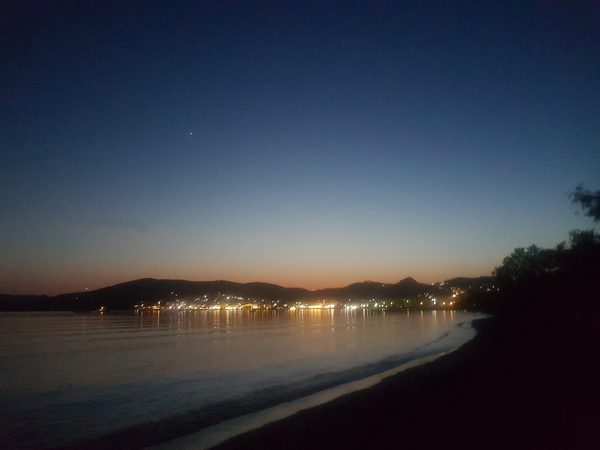
Pollonia in late September was my favourite version of it, with the village still busy at nine in the evening and winding down not long after. That combination is exactly why people pick it.
What Is the Town Beach Like?
The beach runs along the inner curve of the bay, in the village itself. The water stays shallow a long way out, and tamarisk trees grow almost to the waterline and shade it in patches, which is a rare luxury on an island where shade is normally something you bring. You come out of a taverna and you are on it.
- Location: North-east tip of Milos, in the village itself
- Access: Walk-in from the seafront, roadside parking nearby
- Facilities: Tavernas and cafes directly behind the beach; some sunbeds
- Wind exposure: Pollonia sits on the island's most exposed coast, but the bay itself curves round with Kimolos sitting offshore, and together they take real sting out of a meltemi. It is windier here than in sheltered Adamas, without catching the full brunt that hits the more open north-coast beaches. On a strong north-wind day the water still chops and the shade still cools. When in doubt, swim on the south coast: Paleochori and its neighbours sit in the island's lee when the north wind runs.
That north/south switch is the most useful habit to build on Milos, and the alternative is never more than about half an hour away.
The harbour end is calmer, sheltered by the boats and the small mole. Day sails leave from here as well as from Adamas, out to the Glaronisia islets and along the northern beaches, and small ferries cross to Kimolos. That short hop is covered in the Milos to Kimolos day trip guide.
Is Pollonia a Good Base?
Pollonia is the best base on Milos for couples and for people who care about eating, and the worst for anyone without their own transport.
In its favour. It is quieter than Adamas, which absorbs every ferry arrival along with the traffic that goes with a working port, and flatter than Plaka, where you park outside the village and walk up. Rooms sit by the water. And the concentration of good cooking is out of proportion to the size of the place. People drive across the island just to eat, which the best restaurants in Pollonia guide covers in full.
Against it. You are in the far corner of the island. Every beach on the famous south and west coasts is a drive, and the drive back at night is on unlit roads. You need a car or a scooter. Treat that as non-negotiable. Buses run, but around the local timetable rather than around beach days: on the winter schedule it is just two round trips a day, while at the height of July and August the operator runs closer to ten. Check milosbuses.com for the current week rather than assuming either extreme. And the good rooms go earlier here than anywhere else on Milos, because the village is small and the word is out. I cannot give you a reliable number of weeks or months, but for August in particular, book as soon as your dates are fixed rather than leaving it to the spring.
For the trade-offs across the island side by side, the where to stay in Milos guide sets Pollonia against Adamas and the Plaka villages.
How Do You Get There?
Pollonia sits at the end of the north-east road from Adamas, around 10km away. The drive is straightforward, asphalt the whole way with nothing to frighten a nervous driver, and coming off the ferry you can head straight out without going near Plaka. The bus operator quotes a maximum journey time of 15 to 20 minutes, which is a fair estimate for driving it yourself too.
Parking is around the edge of the village rather than on the seafront. Arrive at dinner time in August and you will circle for a while.
What Is Nearby?
The north-east coast is the best part of the drive, not just the bit you get through.
- Papafragas. Minutes back along the road and the obvious pairing with a Pollonia afternoon. The Papafragas caves guide covers what it is and how to see it safely.
- Fylakopi. Bronze Age ruins beside the same road. Little is standing and the hours have always been unpredictable, with reviewers reporting it closed for stretches of the season, so treat it as stop-if-open rather than something to plan around. The finds, including the Lady of Fylakopi figurine, are in the museum up in Plaka.
- A cave winery. Kostantakis, a five to seven-minute walk from the village centre, makes wines you will not see elsewhere, open May to October, daily 12:00 to 21:00. Walk in for a tasting; book ahead for the two-hour guided cave tour.
- The Glaronisia islets. Grey basalt columns rising out of the sea offshore, reached by boat from the harbour.
When Is the Best Time to Visit?
May and early June. Warm enough to swim, everything open, room still in the village. The sweet spot.
July and August. Hot, full, and the meltemi at its most likely. Book far ahead.
Late September. The sea is still summer-warm, the restaurants still run properly, and the evening crowd thins to something civilised.
Winter. Most of Pollonia closes. No reason to base yourself here out of season.
I would take late September in Pollonia over any week in August, and it is not close.
Who Is It For?
Couples, food-minded travellers, repeat visitors who want a slower version of Milos, and anyone who would rather swim from the doorstep than drive to a famous beach every morning. Families do well too, since the shallow bay and the short walk to dinner remove most of the friction.
It is not for first-timers on a three-day trip without a car, and not for anyone wanting a choice of bars after midnight. For that, stay in Adamas and drive out here for dinner instead. More on planning the island in the Milos travel guide.
Pollonia is on the north-east tip of Milos, in the Cyclades of Greece, reached by asphalt road from Adamas. It has a shaded, shallow town beach in the village itself, a harbour with boat trips and the small ferry to Kimolos, and more good restaurants than its size warrants. The bay catches the meltemi, so swim on the south coast when the north wind blows, and count on a car or scooter if you stay here.
Planning the rest of your island time? Start with our complete Milos travel guide.
Last updated: 31 July 2026