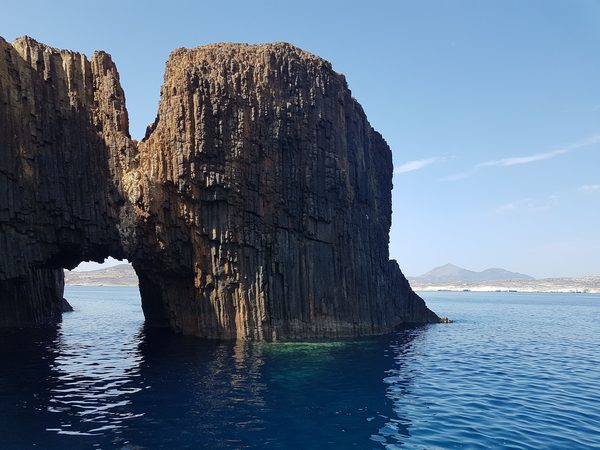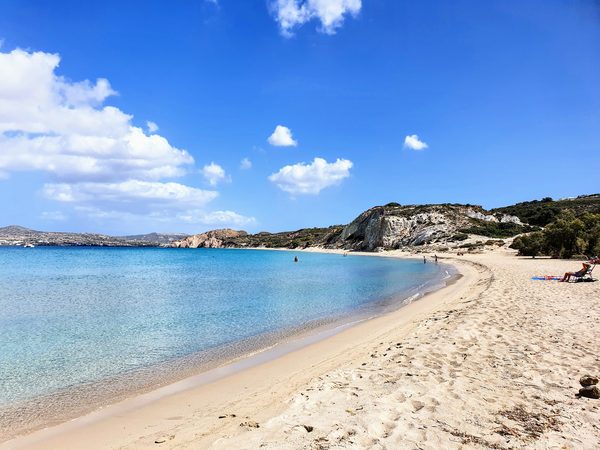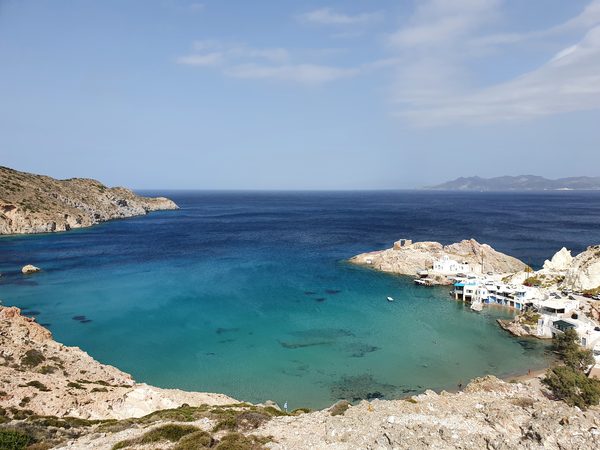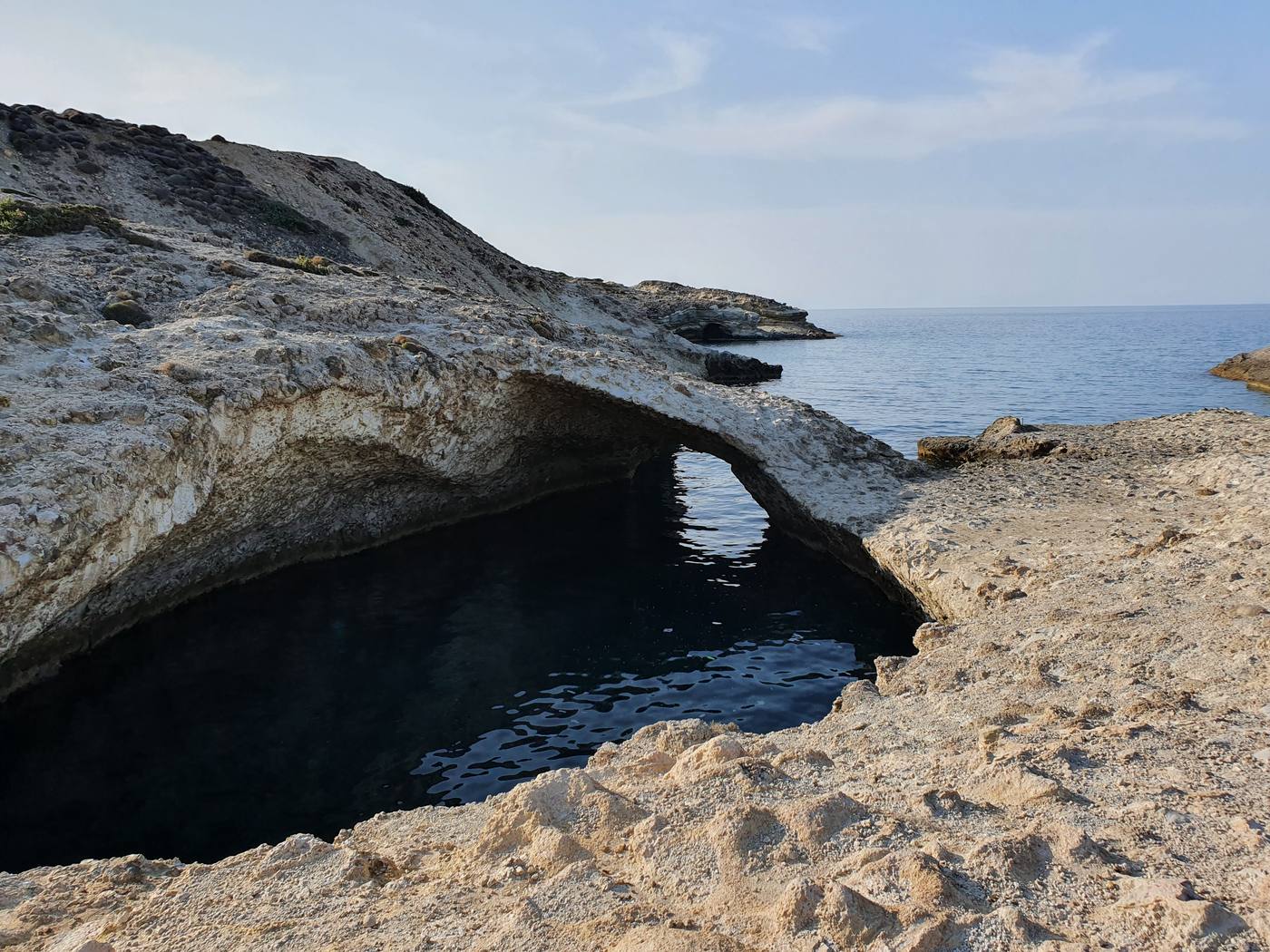
Papafragas is not really a beach. It is a narrow flooded channel on the north-east coast of Milos, in the Aegean's Cyclades, walled in by soft pale rock, with a few metres of sand at the far end and a cave mouth opening to the open sea. The view from the clifftop is the point, and it is free. The descent to the water is steep, unfenced and genuinely risky.
In this guide
- Location: North-east coast, roughly 10 minutes' drive from Pollonia, signed off the Adamas–Pollonia road
- Access: Dirt parking area at the top, then an unmarked scramble down bare rock
- Facilities: None whatsoever. No shade, no water, no lifeguard, no bins
- Wind exposure: North-facing and fully open to the meltemi. When it blows, the channel churns and swimming is out of the question; take the day to the south coast instead, as the Milos beaches guide explains.
Kapros and Papafragas sit side by side, a run of sea caves and rock channels where the water cuts inland from the cliff, part open to the sky and part still roofed in rock, which is exactly what made the place such a good hiding hole. Kapros is the gentler of the two and can be reached without much drama. Papafragas is the one on every photograph of Milos that isn't Sarakiniko: two vertical walls of soft pale volcanic rock, water the colour of a swimming pool between them, and a tiny beach at the head of the inlet that looks, from above, about the size of a bath towel. It more or less is.
Like several of the island's enclosed inlets, Papafragas was a pirate hiding place during the Byzantine centuries. A boat could be rowed in through the cave mouth and be invisible from any direction except directly overhead. Stand at the rim and the logic of it is immediately obvious.
What Do You Actually See From the Top?
Everything worth seeing, in about two minutes. From the parking area a short flat walk brings you to the cliff edge, where the ground simply stops and the channel opens beneath your feet. A second viewpoint a little further along frames the cave mouth and the open sea beyond it.
There are no railings, no marked path edge, and the rock at the rim is friable, crumbling under a boot heel. Keep back from the lip, keep hold of small children the entire time, and do not sit with your legs over the edge for a photograph.
I have stood at that rim in June and again in late September, and both times someone was inching towards the drop with a phone held out in front of them. It is a long way down onto rock and shallow water.
How Hard Is the Climb Down?
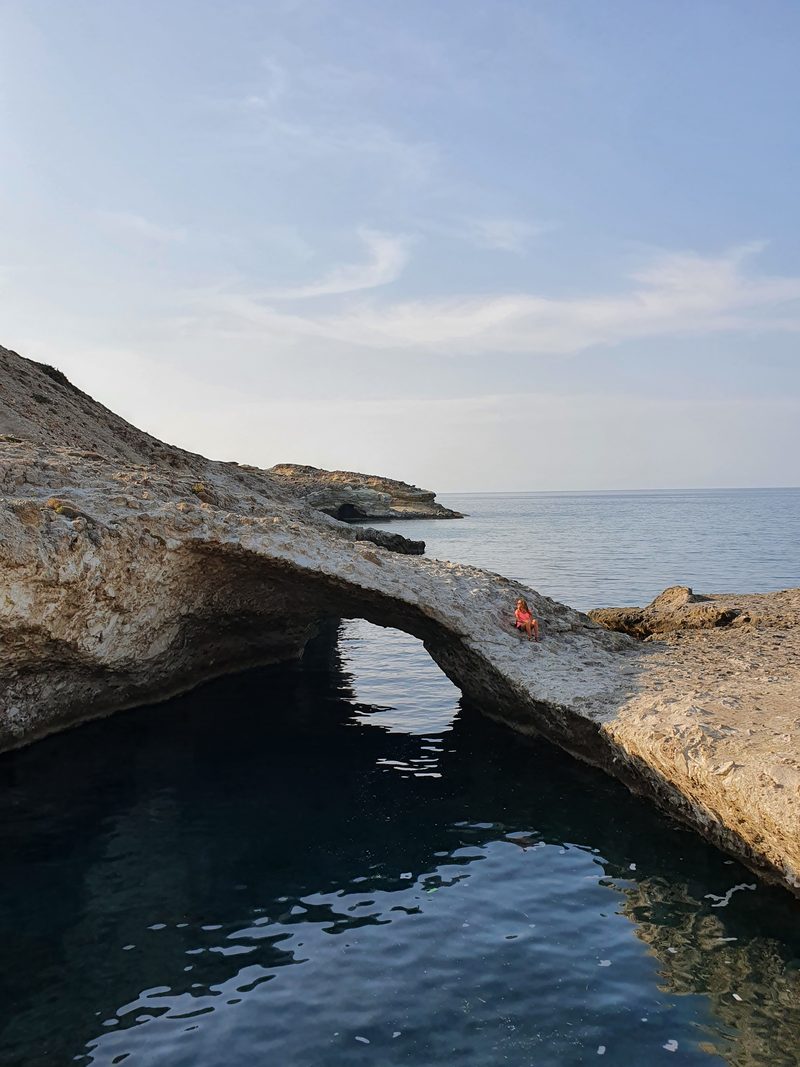
Hard enough that most people should not do it, and the brief version is this: there is no path, only a worn line down bare rock with a couple of near-vertical sections where you are using your hands as much as your feet. It is not a scramble that can be reversed easily if you lose your nerve halfway, because the awkward moves feel worse going up than coming down. There is nothing to hold on to that has been put there for you.
Skip it if you are travelling with young children, if your knees are unreliable, if you are in flip-flops, if you have been drinking, or if the rock is wet. Families with kids in particular are better served at Pollonia, a few minutes up the road, where the water is shallow and the beach is flat.
If you do go down, go in proper shoes with grip, go with someone else, and go in the morning before the rock is baking. Take water, because there is no shade at the bottom and the walls hold the heat.
Is the Swimming Any Good?
Only when the sea is flat, and even then with a caveat. In dead calm the swim is a genuinely strange experience: you are floating in a slot barely wider than a room, walls rising on both sides, rock roofing part of the channel over your head. There is nothing else quite like it on Milos.
Any swell at all changes the picture completely. Water funnelling into a narrow channel builds up, and it surges against rock rather than sand. Being pushed onto that rock is how people get hurt. On any day with visible movement in the channel, look and leave.
The other point worth knowing is that the inlet is enclosed and collects what the sea brings in. Even on windless days I have found plastic and weed rafted up at the sand end. It is not consistently the postcard.
What Else Is Nearby?
The remains of Fylakopi, one of the most significant Bronze Age settlements in the Cyclades, are a short distance along the same coast. It is a low, weathered site rather than a spectacular one, and access has historically been unreliable, and it has often been closed or fenced with no notice. Hours and admission are not published anywhere reliable enough to quote, and visitor reports describe the site as sometimes shut for extended periods, so check locally or with the Archaeological Museum in Plaka before planning around it, and treat it as a bonus if the gate happens to be open.
Kapros, immediately adjacent, gives you a similar rock-and-water formation for a fraction of the effort, and is the sensible substitute if the Papafragas descent is not for you.
Sarakiniko is fifteen minutes back along the north coast and works well as the same morning's second stop. The two are the island's headline rock landscapes and share the same wind constraint. Walkers can link this stretch of coast on foot; see the Milos hiking guide for what is actually walkable. For where Papafragas sits among the island's other calls on your time, the things to do in Milos guide puts it in order.
When Should You Go?
Early morning is best for both the light and the rock temperature. The parking area is small and free, fills quickly once the day's crowds build from around 9am in high season, and latecomers end up on the roadside verge nearby.
June and September give you the calmest odds. July and August bring the meltemi most reliably, and this is the wrong coast for it.
Papafragas sits on the north-east coast of Milos, Greece, roughly 10 minutes from Pollonia and signposted off the main road. The clifftop viewpoint is free, takes two minutes and delivers most of the value. The descent to the water is a steep, unfenced scramble with no path and no handholds. Swim only in flat calm, and not at all when the north wind is up.
Planning the rest of your island time? Start with our complete Milos travel guide.
Last updated: 31 July 2026