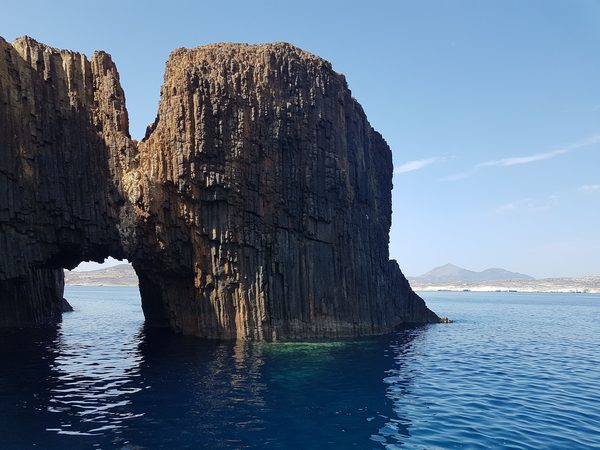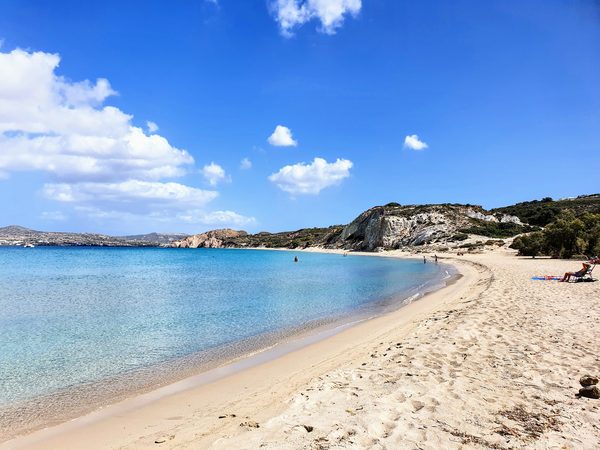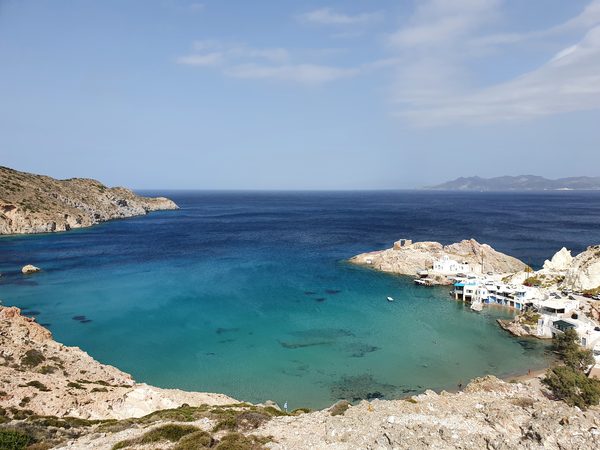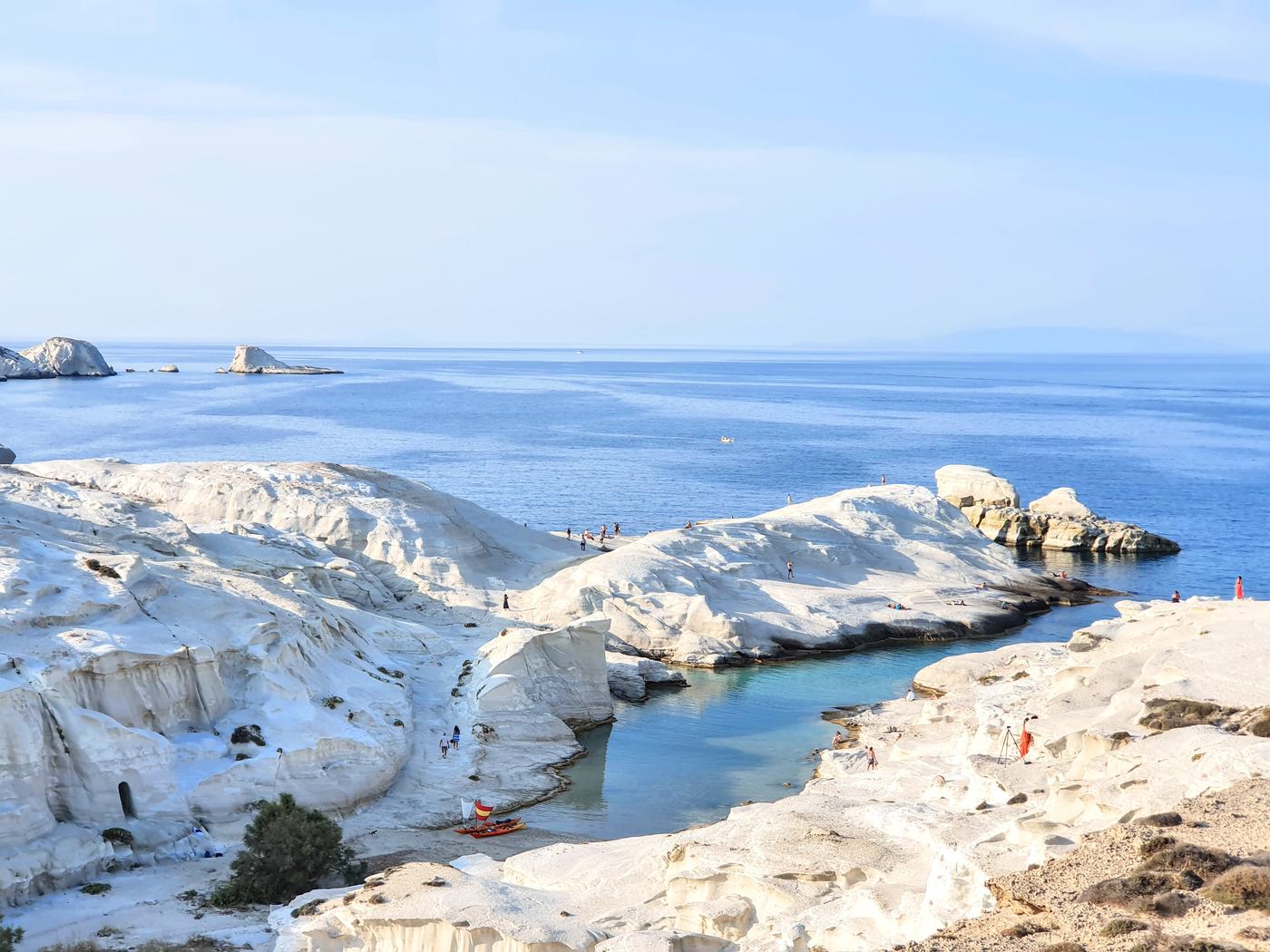
Sarakiniko beach in Milos is less a beach than a bare white rock shelf on the north coast, scoured smooth by wind and sea until it looks like a stretch of lunar surface dropped into the Aegean. The sand amounts to a small strip at the head of an inlet. People come for the rock, the water and the photographs.
In this guide
- Location: North coast, about a 10-minute drive from Adamas
- Access: Asphalt road all the way, roadside parking area
- Facilities: A small canteen by the car park and nothing else, so no sunbeds, no shade, no lifeguard
- Wind exposure: Fully open to the meltemi (north wind). When it blows, give up on Sarakiniko and drive to the south coast instead.
The rock is soft and volcanic, bleached almost to bone colour, cut by weather into ridges, hollows and rounded lips falling away into water dark enough to read as ink from above. Some faces carry sea fossils. What surprises people is the scale: photographs suggest a white desert, but the whole site is surprisingly compact. You can cover it in well under an hour, which is why it fills so quickly.
I have never once had Sarakiniko to myself and stopped expecting to years ago. The aim is not solitude, it is timing.
Where Do You Actually Swim at Sarakiniko?
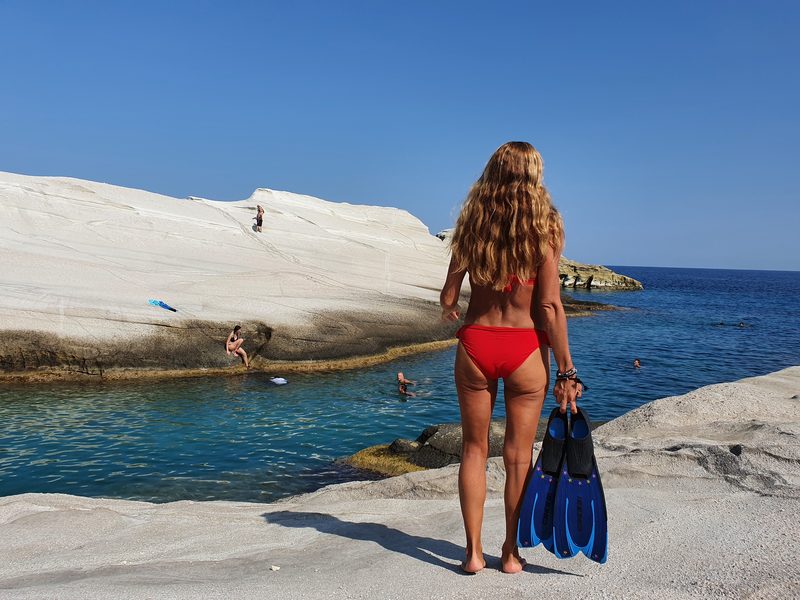
Swimming happens in the narrow inlet cutting inland between two walls of white rock. At its head is a patch of sand big enough for a handful of towels, so most people lay their things on the flat rock and drop straight into the channel. On a calm day it is superb, cool and clear, sheltered on three sides and deep within a few strokes. On a rough day it funnels the swell against hard rock, a very different proposition.
Jumping from the ledges is part of the ritual, and on a summer afternoon there is usually a queue. Two cautions: the rock is abrasive rather than smooth, so a bad entry or a scramble out takes skin off, and depth varies along the channel, so nobody should jump where they have not first swum and checked. There is no lifeguard.
Is There Anything to See Underwater?
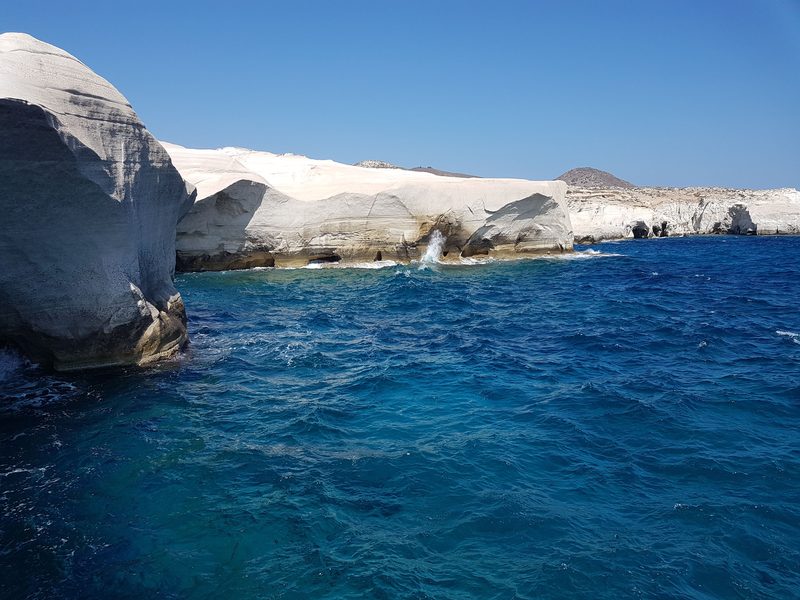
Most visitors miss this because they arrive with a camera rather than a mask. Snorkelling along the base of the rocks is genuinely good. The walls drop away, there are undercuts and small caves, and visibility on a still day is excellent.
Divers get an extra draw: a small tanker ran onto the rocks here in 2003, and divers still visit the wreck. That is a dive rather than a snorkel, so you will need a centre, and the Milos diving and sea kayaking guide covers the options. Ring ahead to check which centre currently has the wreck on its schedule and what it costs, since operators rotate their dive sites through the season.
How Bad Are the Crowds, and How Do You Dodge Them?
Bad, for most of the day, in high season. Sarakiniko is the easiest famous thing to reach on Milos, with asphalt to the door, no hike and no boat, so every rental car, ATV, minibus and cruise passenger with a spare hour ends up here. Mid-morning to late afternoon in July and August, the rock is busy and the parking is a scrum.
Early morning and the last hour before dark are the windows that work: fewer people, better light. Neither guarantees an empty landscape, but 08:00 and midday are different places.
A third option almost nobody uses: on a full-moon night, drive out after dinner. The white rock takes moonlight in a way that has to be seen rather than described, and the site is empty. Bring a torch and stay back from the water in the dark.
What Should You Know Before Going?
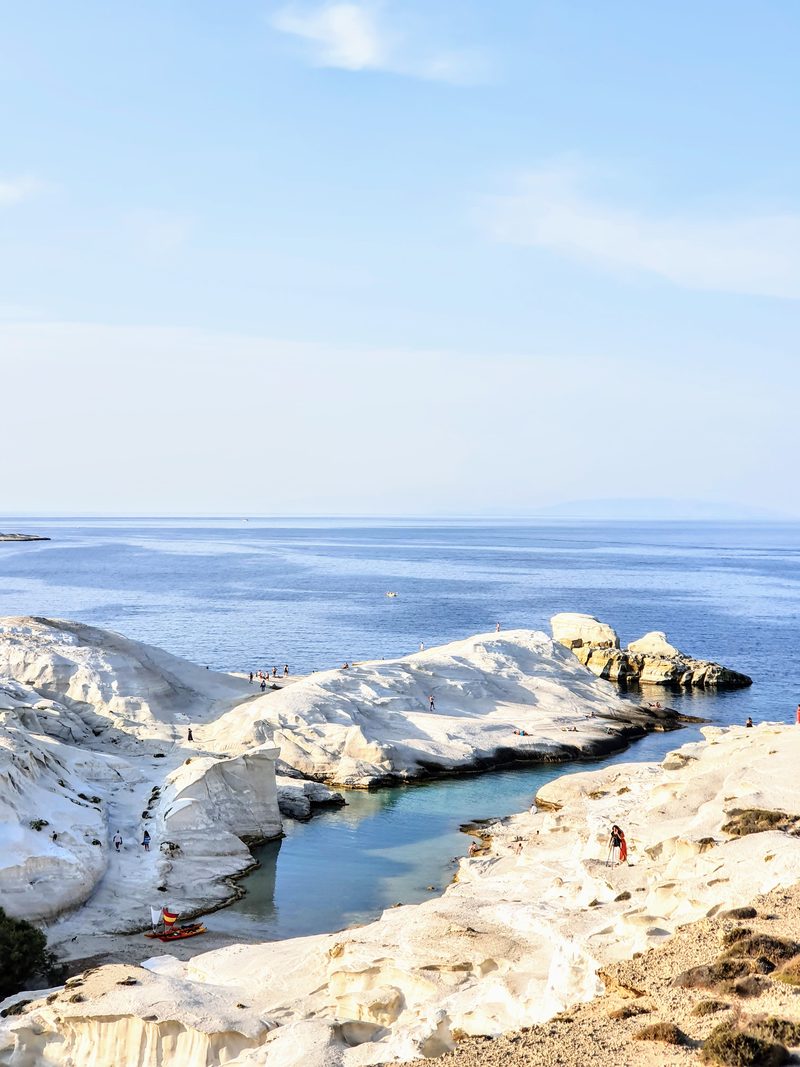
- There is no shade whatsoever. The pale rock throws the sun back up at you and the August heat off it is punishing. Hat, sunblock, and something to sit on that is not bare stone.
- Bring your own water. A small canteen truck sometimes operates by the parking area in high season, but it is informal and weather- and staffing-dependent rather than a fixture, so assume nothing about its hours or season.
- Wear proper shoes. The rock is uneven, ridged and slippery where feet have polished it. Flip-flops are how people go over.
- Take your rubbish with you. Facilities are minimal and the site suffers for it.
I build a Milos day around the wind rather than a list. If the forecast shows northerlies, Sarakiniko moves to another morning.
What About the Wind?
This ruins more Sarakiniko visits than the crowds do. The site faces north into open sea, and the meltemi, the strong summer north wind of the Aegean, hits it with nothing in the way. When it blows, the channel churns, spray comes over the ledges and swimming goes from lovely to unwise.
Milos handles this better than most islands, because it has coastline on every side. When the wind is northerly, cross to the south coast: Paleochori, Firiplaka and Tsigrado are usually calm on exactly the days Sarakiniko is not. Reverse it when the wind swings south, and the north coast comes back into play, including Firopotamos, Plathiena and Sarakiniko itself. On days it blows from every direction, go to the Mining Museum in Adamas instead. The obvious pairing with Sarakiniko, Papafragas a short drive east, has the same north-wind problem plus a steep scramble down.
How Do You Get to Sarakiniko?
By car or ATV
The reason the place is so busy. The road north out of Adamas is asphalt all the way, signposted, and fine in any rental car. Parking sits at the top of the site, a couple of minutes on foot from the rock; it remains free, with no charge or ticketing scheme, but in peak season it fills by midday and cars string along the verge.
By bus
A seasonal bus from Adamas has served Sarakiniko in recent years, which would make it one of the few Milos beaches reachable without your own wheels. It runs as a summer-only beach service rather than at the year-round frequency of the main Adamas lines, and the timetable is redrawn from year to year, so read the schedule posted in Adamas or check milosbuses.com on the day rather than relying on a fixed frequency or fare.
By boat
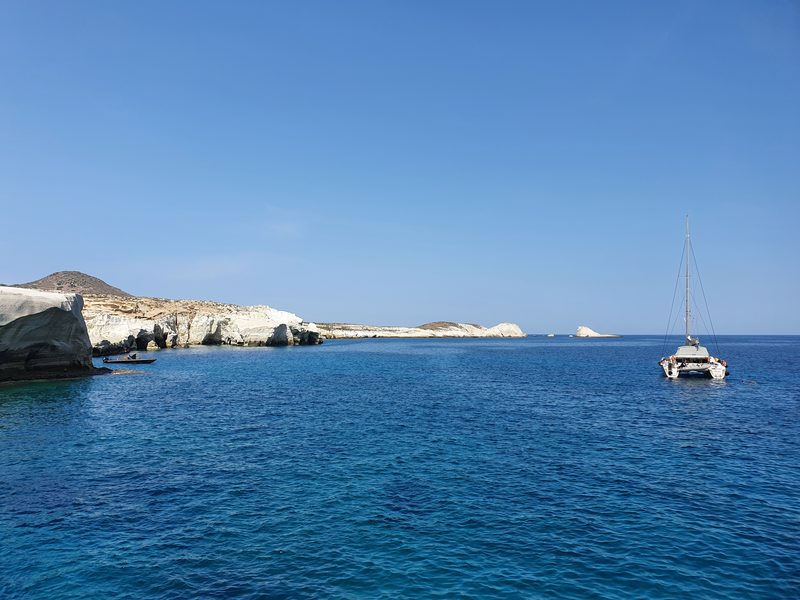
Many of the round-the-island boat trips pass this stretch of coast, and the formations are impressive from the water, though from a boat you do not walk the site.
When Is the Best Time to Visit?
Spring (April to May). Quiet, cool enough to walk the rock, sea still cold. Best for photography.
June. My preferred month: warm water, long light, crowds not yet at full strength.
July and August. Hottest, busiest, meltemi at its most persistent. Dawn or not at all.
September. Warm sea, softening light, numbers falling through the month.
For photographs, aim for sunrise. The low angle picks out every ridge and hollow, the white goes warm rather than glaring, and nobody is in the frame. Midday is the worst light the place gets, and exactly when most people shoot it. The "moon beach" nickname attached to Milos means this spot, and it is earned at either end of the day rather than in the middle.
Who Is It For?
Anyone who likes landscape more than sunbathing: photographers, swimmers happy to enter off rock, and anybody who wants the most distinctive thing on Milos. Families fare less well, with no sand to speak of, no shade, uneven ground and deep water offering no gradual entry. Take small children to a sandy bay and save this for an evening walk. For the rest of the island's coast, start with the guide to the beaches of Milos.
Sarakiniko beach sits on the north coast of Milos, in the western Cyclades of Greece, a short asphalt drive from Adamas with parking at the top. The sand is tiny; the attraction is the white volcanic rock and the swimming channel cut into it. No shade, no lifeguard, a canteen not to depend on, and full exposure to the meltemi, so on a north-wind day head for the south coast instead.
Planning the rest of your island time? Start with our complete Milos travel guide.
Last updated: 31 July 2026