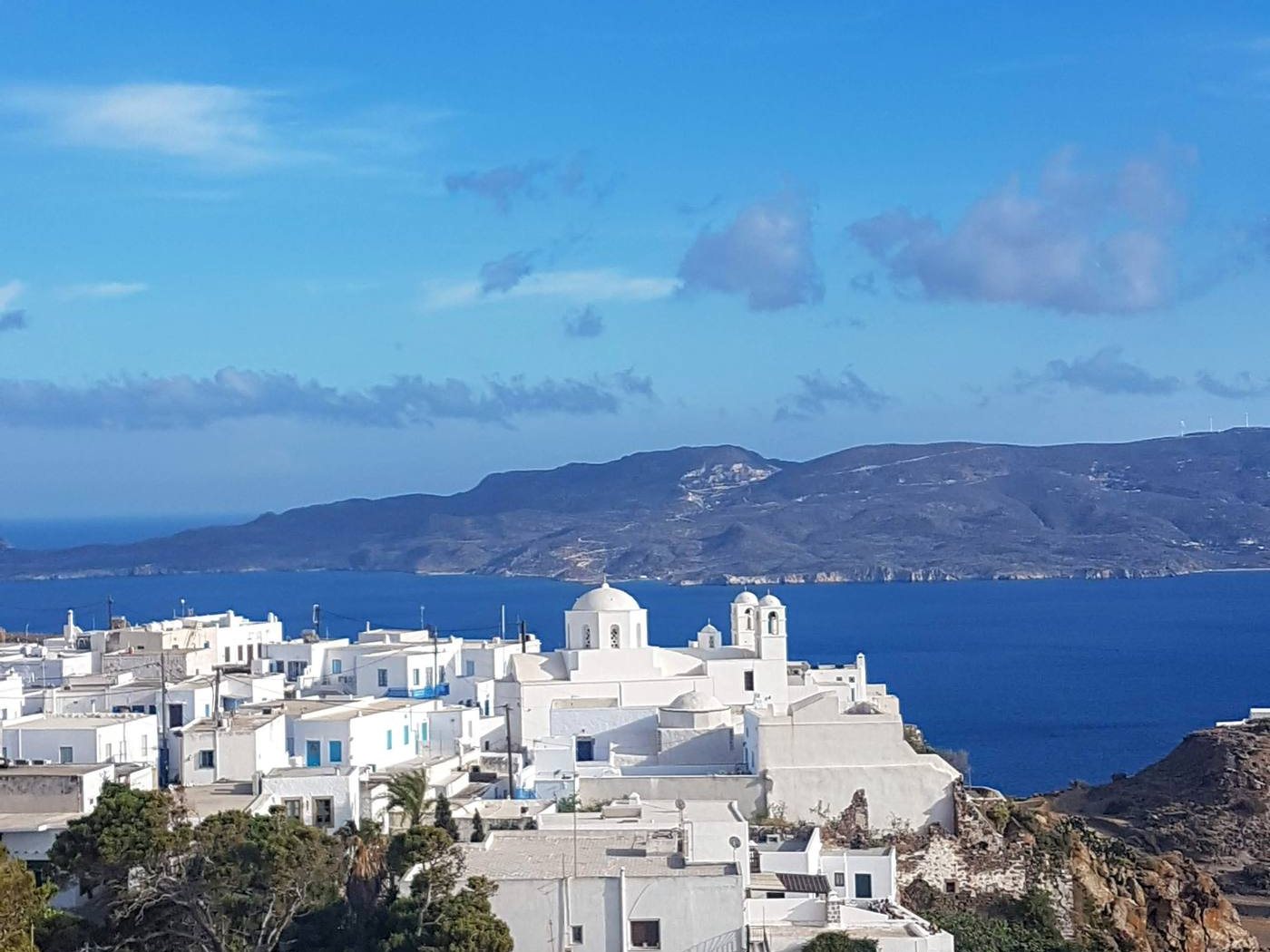
Milos is the volcanic Cycladic island that Greeks kept to themselves for decades and the rest of the world found in the 2010s. Around 70 beaches, white rock formations that look like nothing else in the Aegean, a working mining industry and a huge natural bay splitting the island in two. This Milos travel guide covers the layout, the timing, the logistics and the decisions that actually shape a trip.
In this guide
Milos sits on the western edge of the Cyclades, roughly a night's sleep and a boat ride from Athens, and a couple of hours from Santorini. It covers 160 square kilometres, which makes it the fifth largest island in the group behind Naxos, Andros, Paros and Tinos, and about 5,000 people live on it year round. The capital is Plaka, up on the hill; the port and the practical centre of the island is Adamas.
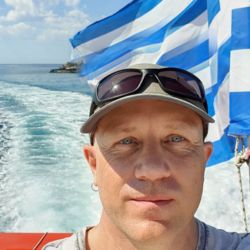
I co-wrote a guidebook to Milos and Kimolos and have gone back to both islands repeatedly, in June and in late September. What follows is the planning layer. These are the things I would tell a friend before they booked anything, with links through to the detailed guides on each subject.
Milos at a Glance
| Where | Western Cyclades, Greece |
| Size | 160 sq km, fifth largest in the Cyclades |
| Population | Around 5,000 |
| Capital | Plaka |
| Ports | Adamas (main), Pollonia (for Kimolos) |
| Airport | Small domestic field about 5 km south of Adamas |
| Currency | Euro. ATMs in the main towns, cash still useful in villages |
| Language | Greek; English widely spoken in tourism |
| Country code | +30 |
| Connectivity | Mobile reception good in most inhabited areas; Wi-Fi in hotels, rooms and tavernas |
| High season | July and August |
| Best months | June and September |
| Minimum stay | Three nights; five days is the comfortable number |
| The catch | The meltemi, the seasonal north wind, which decides where you can swim |
The single most useful sentence in this guide: when the north wind blows, drive to the south coast. When it swings south, go north. The island is shaped so that something is always sheltered.
Why Go to Milos?
Because of what is in the rock.
The archipelago of Milos, Kimolos, Polyaigos and the uninhabited Antimilos was thrown up by volcanic activity a couple of million years ago, on the same Aegean arc as Santorini, Nisyros and Methana. Santorini's volcano finished with one catastrophic collapse and left behind a view. Milos went the other way: its heat stayed in the ground and turned into minerals, and the minerals then wrote everything that followed. Obsidian made a small island rich in prehistory, the quarries are still working today, and the shoreline gives away what lies underneath it wherever you happen to be standing.
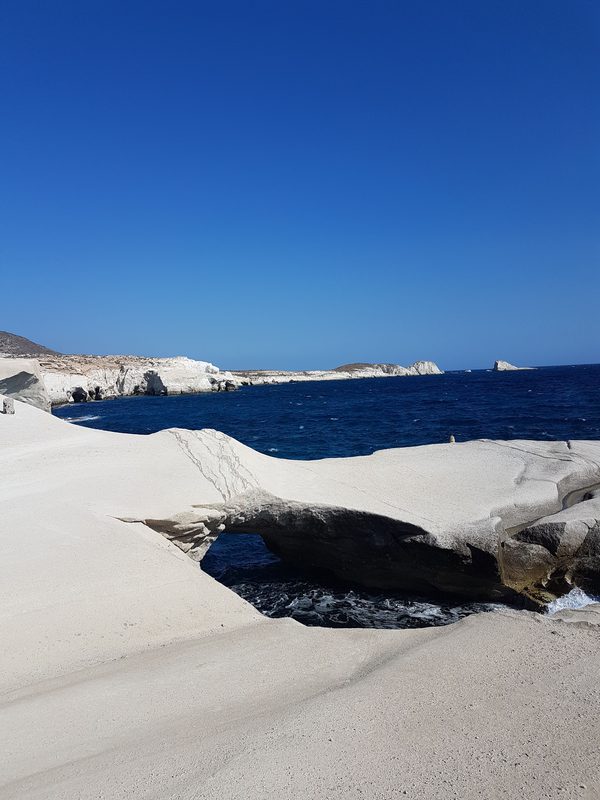
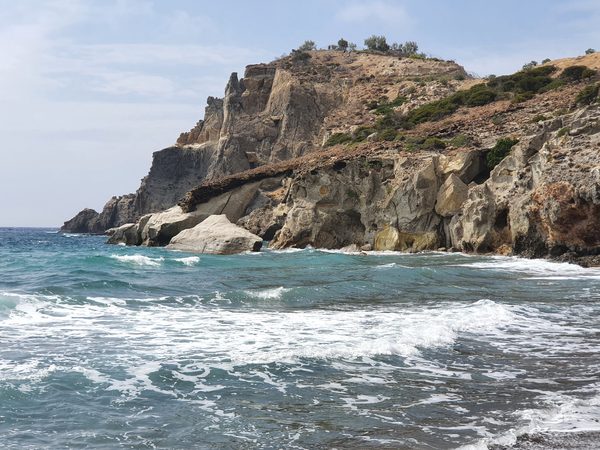
That is the appeal, and it is not the standard Cycladic one. Milos is dry, rugged and industrial in patches, with quarries and heavy lorries using the same roads as the hire cars. If your idea of a Greek island is prettiness from end to end, that will grate. What you get in exchange is this. At Sarakiniko the wind has scoured the rock into pale smooth ridges that run straight down into the sea. On the south coast the cliffs come up rust and sulphur. In several places the ground is still venting, with fumaroles heating the sand from below and the water at the edge coming up warm on your feet. The shore is bored through with sea caves as well. The whole western half has no villages, no sealed roads and a Natura 2000 designation, and climbs to Profitis Ilias at 751 metres.
The big cruise ships have not come here, and the small ones that do call are occasional rather than daily, which means the crowd is mostly people who chose to come rather than people delivered for six hours. If you are weighing it against the obvious alternative, the Milos versus Santorini comparison works through it, and there is a straight answer to whether Milos is worth visiting.
How Is Milos Laid Out?
Look at Milos on a map and the shape is immediately odd: a horseshoe wrapped around a large natural gulf whose mouth opens to the north. That gulf is the reason the island mattered in antiquity. It gave a deep, safe harbour on the sea route between mainland Greece and Crete, and it is still the reason everything works the way it does today.
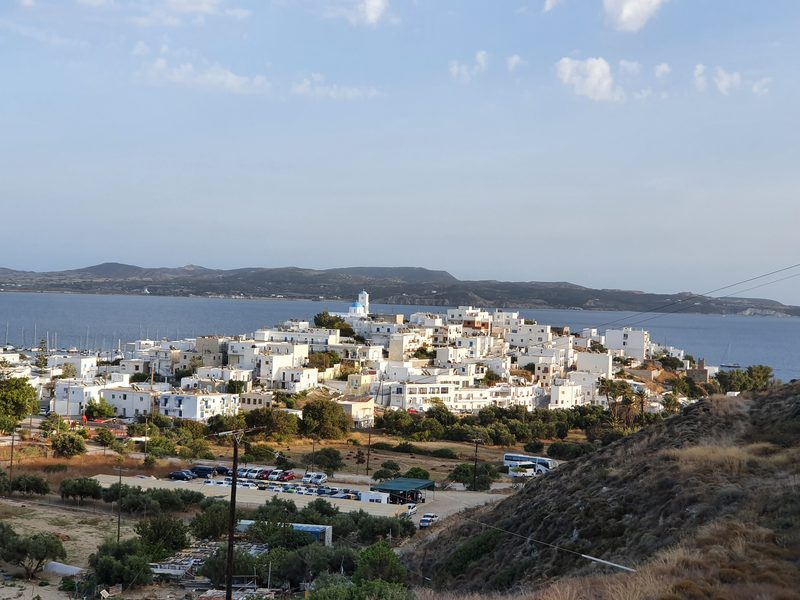
Adamas sits deep inside the gulf, on its eastern shore. Every ferry from Piraeus docks there.
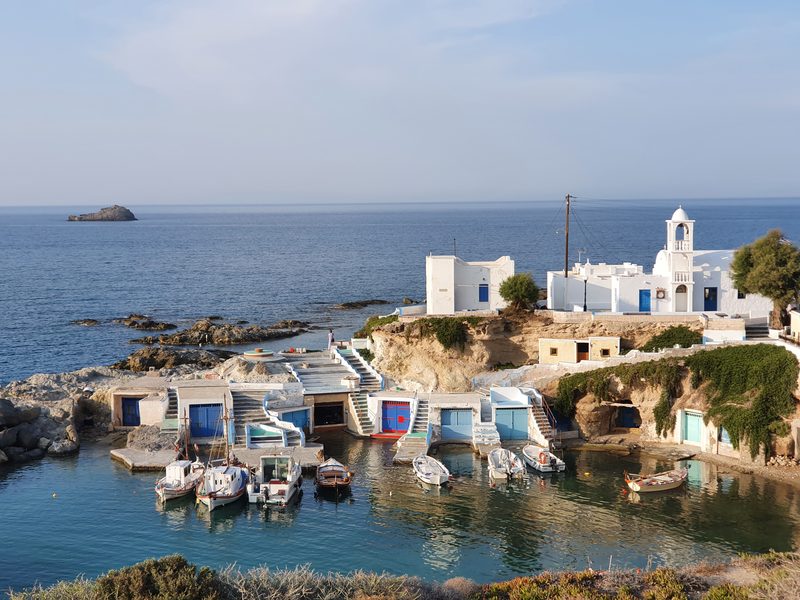
- The east. All the towns, all the hotels, all the hire yards and nearly all the asphalt. Adamas at the water, Plaka and Trypiti on the ridge above it to the north-west, Pollonia in the far north-east corner. The fishing hamlets of Klima, Firopotamos, Mandrakia and Fourkovouni hang off this half.
- The north coast. Adamas round to Pollonia: white rock, sirmata boathouses, Sarakiniko, Papafragas. Reachable in a normal car. Unusable in a strong meltemi.
- The south coast. Paleochori round to Kipos: coloured volcanic cliffs, the long sandy beaches, your bolt-hole when the north wind is up. Mostly asphalt, with some rough final approaches.
- The west. Mountainous, empty, no villages, no sealed roads, no fuel and no shops. You see it from a boat, an ATV or a 4WD. Kleftiko is down at its southern end.
Distances are small, and Adamas to Pollonia or across to the south coast is under half an hour on a decent surface. But the roads are narrow, the last stretch to a beach frequently turns to dirt, and Milos eats far more driving time than its size suggests. The getting around Milos guide covers the vehicle decision, and the beaches hub maps the coast in more detail than I can here.
When Is the Best Time to Visit Milos?
June and September, and it is not a close-run thing.
July and August are peak. Warmest sea, everything open, and every other European on holiday too. Milos does not fill the way Santorini or Mykonos do, but Adamas in mid-August is busy, rooms cost more, and ferries and hotels want booking months ahead if your dates are fixed. August is also when the meltemi is most likely to write off a beach day.
June and September give you warm water, full ferry timetables, open tavernas and a fraction of the pressure. If I could only book one two-week window in the year it would sit in late September, when the sea is still carrying every degree it gathered over the summer and you can drive down to the south coast without meeting much coming the other way.
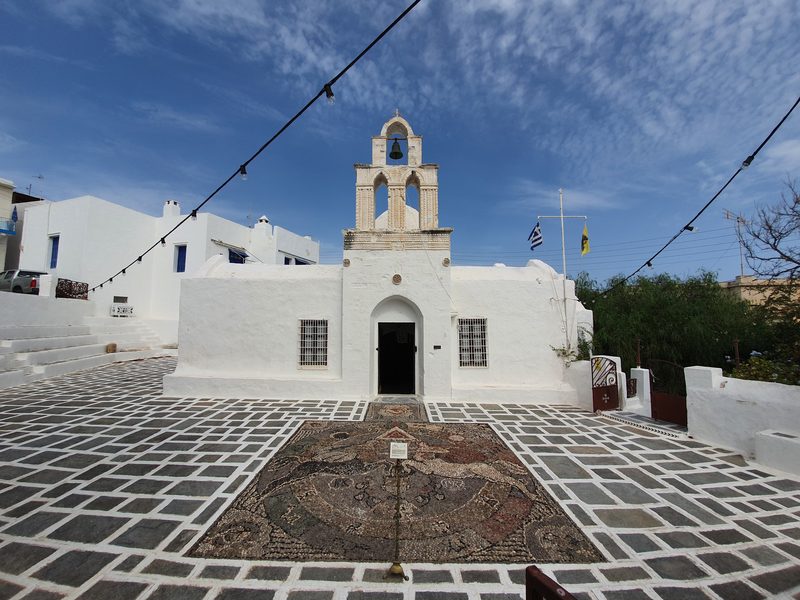
April, May and October are for walking rather than swimming. The island is greener than the Cyclades reputation suggests, with cypress, juniper, mastic, thyme and sage, plus a wetland at Achivadolimni that pulls in migrating birds. The sea will feel cold to most people, and some businesses have not opened or have already shut.
Winter is a different trip entirely: a handful of ferries a week, cancellations on a bad forecast, flying the reliable option, and many tavernas and rooms closed.
Greek Easter falls in April or May and rarely lines up with the Western date: Sunday 12 April in 2026, Sunday 2 May in 2027. Fireworks, the burning of a Judas effigy and a week of cooking make it a distinctive time to be on a small island, and almost nobody plans around it.
The Meltemi, and Why It Runs Your Holiday
The meltemi is a strong, dry north wind that blows across the Aegean mainly in July and August, sometimes into early September. It builds through the middle of the day, peaks in the afternoon and early evening, and usually drops off overnight.
On a meltemi day the north-facing beaches are finished: sand in the air, chop on the water, swimming that ranges from unpleasant to unwise, and floating rubbish pushed into the enclosed inlets. Cross to the south coast and Agia Kyriaki, Firiplaka or Paleochori will often be lying still under the same sky. Southerlies turn up more often than the meltemi's billing allows for, and when they do the rule inverts: the south takes the swell and the northern bays settle. It also cancels boat trips, including the Kleftiko sailings, and occasionally the small Pollonia–Kimolos ferry. Ask at your accommodation each morning; they will know which coast is working. Full detail in the when to visit Milos guide.
I plan boat trips for the first half of a stay, never the last. Leave Kleftiko until day five of five and a windy forecast can take the whole thing away from you with no second chance.
How Do You Get to Milos?
Two routes: a ferry from Piraeus, or a short domestic flight from Athens. There is no international airport, so almost everyone arriving from outside Greece connects through Athens either way.
By ferry from Piraeus (roughly 3 to 8 hours). Piraeus is about 10 km from central Athens at the end of the blue metro line. Budget roughly four hours if you are on a fast boat and up to seven on a conventional one. The cheapest sailings sit at the slow end of that because they call at several other ports on the way. All of them dock at Adamas. Sailings are frequent from June to September and thin out sharply either side. The full breakdown is in the Athens to Milos ferry guide.
By air from Athens (40–45 minutes). The airport sits around 5 km south of Adamas. Sky Express flies the route non-stop on a small turboprop, a handful of departures a day in high season and fewer off-peak. Faster on paper, often not door to door once you add the trip out to Athens airport and the transfer at the other end, and seats are limited enough that late bookings get expensive.
From other islands. Milos sits on the western Cyclades line, which links it to Sifnos, Serifos and Kythnos and Folegandros, with seasonal connections across to Santorini, Paros, Naxos, Mykonos, Ios and Syros. There are fewer sailings on the western chain than in the central Cyclades, so book onward legs before you commit to dates. The Milos island hopping guide covers the sequencing.
Every route, with the fly-versus-sail decision worked through, is in the complete guide to getting to Milos.
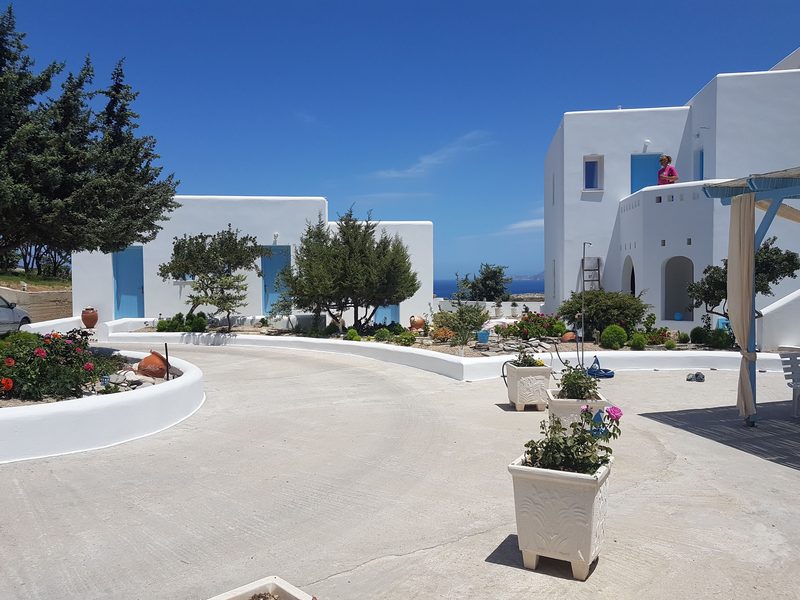
How Long Should You Stay on Milos?
Three nights is the floor. Five days is the number I would give anyone who asked.
Plenty of itineraries allow two or three days, usually because the traveller is fitting four islands into ten days. You can see the headline sights in three or four days: Sarakiniko, Plaka, a boat trip, a couple of south-coast beaches. But a large share of that time goes on transit, and one cancelled sailing costs you a day you cannot spare.
Five days lets the trip breathe: a boat day, two or three beach days on whichever coast is sheltered, an afternoon in Plaka and Trypiti, and a day for the museums or the west. A week is easy to fill without repeating yourself. Add a night or two on top if you want Kimolos properly rather than as a day trip. A day-by-day plan is in the Milos itinerary.
Where Should You Base Yourself?
Everything is on the eastern half, and the choice comes down to three towns plus the small settlements between them.
Adamas is the port and the practical answer: ferries, the bus terminal, the hire yards, the boat-trip kiosks and a waterfront of tavernas, all at the most central point on the island. That matters when the wind decides your beach each morning. It is not pretty in the postcard sense, being a working harbour town and scrappy in August, but for a first or a short visit I would still stay here. More in the Adamas guide.
Plaka is the capital, up on the ridge with the Venetian kastro above it and the west of the island laid out below: narrow lanes, small tavernas, the best sunset on Milos. The trade-off is awkward parking and a hill between you and everything logistical. See the Plaka guide and the restaurants in Plaka.
Pollonia is the quiet one. It is a small north-east coastal town with a long shallow beach, a good cluster of restaurants and the Kimolos ferry leaving from its quay. It suits couples, and it is the least convenient base for the south coast. Read the Pollonia guide and the Pollonia restaurants list.
The fishing villages. Klima, Firopotamos, Mandrakia and the rest are strings of sirmata, the two-storey fishermen's houses with a boat garage below and living space above, painted in the colours everyone photographs. A few rent out. Lovely to stay in, poor logistics, since you drive for everything. Klima is worth seeing even if you sleep elsewhere.
The full breakdown by traveller type is in the where to stay in Milos guide.
What Should You Do on Milos?
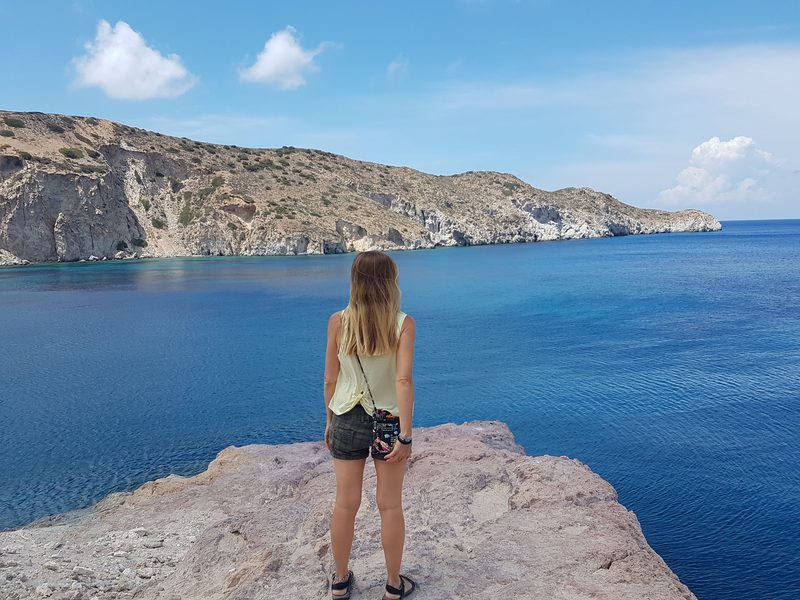
The island's own shortlist, if you only have a few days.
Sarakiniko. A shelf of soft volcanic rock weathered to something close to the colour of chalk, worked into humps and gullies, with the sea underneath it running an improbable dark blue. There is barely any sand and nothing at all to sit under, so come early or late, both for the light and because the glare coming back off that stone at midday is punishing. Most people turn up already knowing the photograph. It holds up in person anyway. Sarakiniko beach guide.
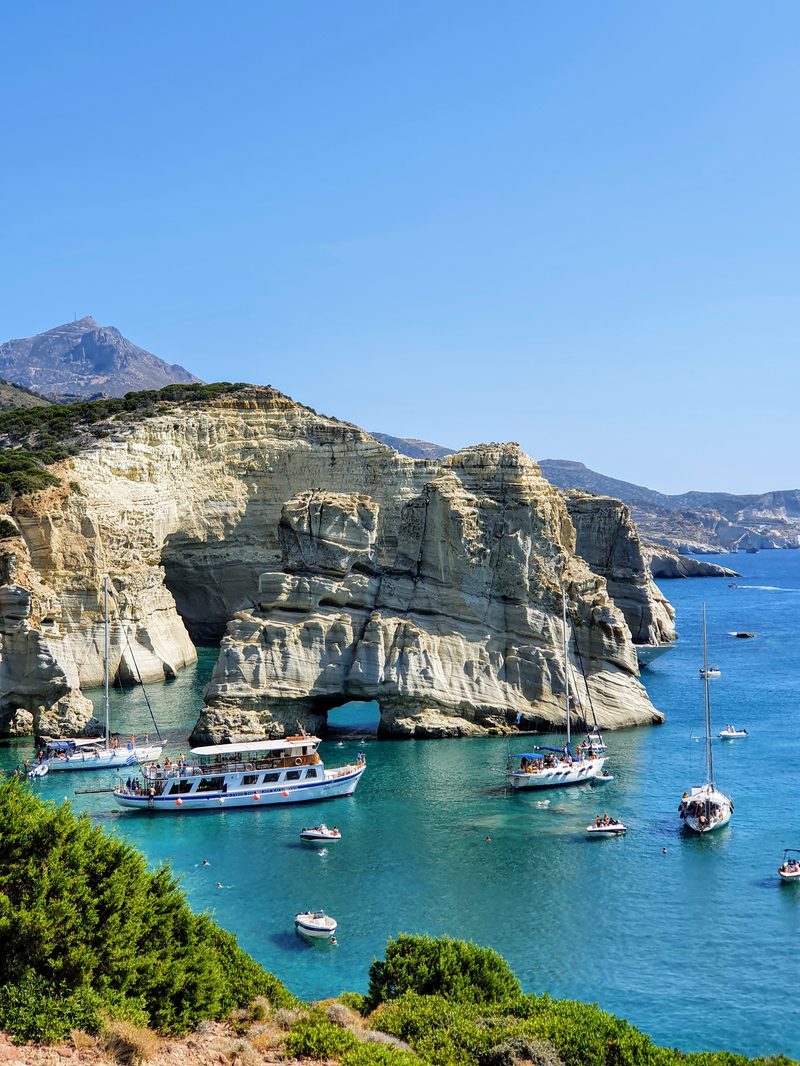
A boat trip to Kleftiko. White sea stacks and caves on the empty south-west coast, reachable only by water. Full-day sailings run from Adamas along a coastline most visitors never otherwise see, shorter cruises leave from Kipos and Agia Kyriaki, and several take in uninhabited Polyaigos too. If you tried to cut one thing from this list, this is the one I would argue with you about. Kleftiko guide and the Milos boat tours round-up.
The beaches, plural. Around 70 by the local count, of which fifteen or so repay giving up a whole day to. The famous south-coast pairing of Firiplaka and Tsigrado sits under banded volcanic cliffs; Paleochori has geothermal ground warming the sand; Provatas is the easy family choice; Firopotamos and Plathiena are small northern coves that stay snug in settled weather or a southerly and shut down completely in a meltemi, which is exactly the wind their position cannot handle. Papafragas is a rock cleft rather than a beach. The remote beaches need a quad or a boat.
Plaka and the kastro at sunset. Walk up through the old town to the chapel on the rock. Far fewer people than the equivalent scene on Santorini, and when the light goes you come back down into a village where dinner is already being served either side of you.
Trypiti, the catacombs and the ancient town. Below Plaka sit early Christian catacombs cut for burial, a Roman-era theatre with a sea view, and the spot where the Venus de Milo was found in the early 19th century. Trypiti and the catacombs.
The Mining Museum in Adamas. Small, unglamorous and the single best explanation of why the island looks the way it does. Skip it and half of Milos stays scenery rather than history. Museums and mining history.
The west. Rough tracks to Agios Ioannis, Triades and the far coast, on an ATV or in a 4WD only. Empty, dramatic, and the sunsets are yours alone. ATV rental explains the vehicle, and Milos hiking the routes on foot.
On the water. Sea kayaking and diving work the same cave-riddled coastline at a slower pace than the tour boats.
The wider list, including the things worth doing in bad weather, is in things to do in Milos, and the best positions for sunset and photography have their own guide.
Where and What Should You Eat?
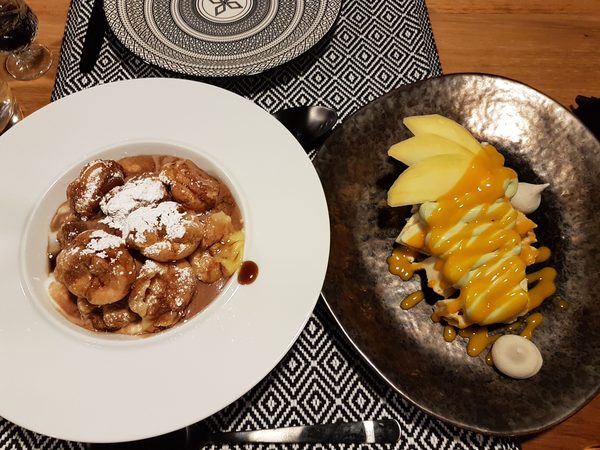
Milos eats like a Greek island rather than a resort. Tavernas outnumber restaurants, dinner costs a long way below Santorini's, and a menu of six or eight dishes is a good sign rather than a thin one, because it usually means somebody is cooking rather than reheating. Go to the fishing villages and Pollonia for fish; head inland and it turns to meat cooked slowly and cheese made on the island. The name every visitor is given is O Hamos, outside Adamas, a long-standing family taverna with its own farm produce, still walk-in only and busy enough in season that arriving early or expecting a queue is the sensible plan rather than trying to book.
Each town has its own cluster: see the Milos restaurants hub, or go straight to the picks for Adamas, Plaka and Pollonia.
Should You Add Kimolos?
Yes, if you have the days.
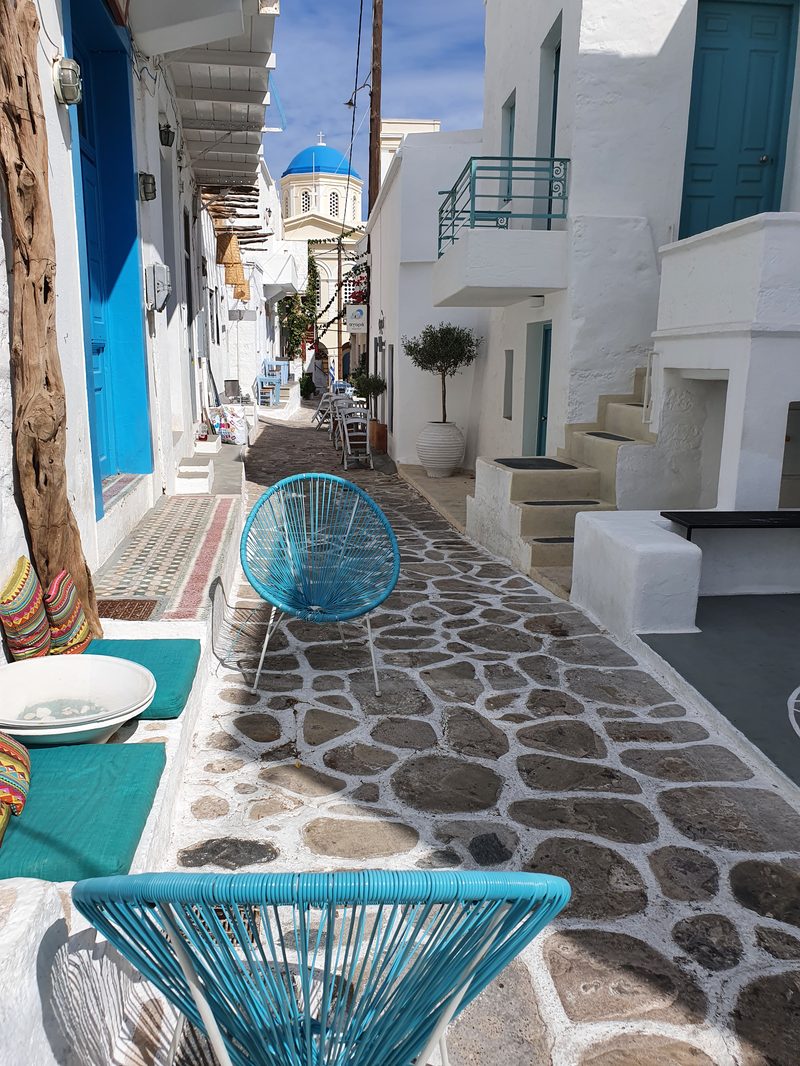
Kimolos sits across a short strait from the north-east corner of Milos, reached by a local ferry from Pollonia to Psathi in under half an hour. It is what Milos was before the attention: one hillside village called Chorio, a collapsing Venetian castle you can walk into, a mushroom-shaped rock called Skiadi, and beaches where you may be the only person on the sand. A single local operator runs a summer bus between the port, Chorio and the main beaches, though how far it runs either side of the peak weeks is unclear, so walking, a taxi or a hired scooter remain the safe planning assumption.
A day trip works but is tight. The last boat back governs everything, and most people arrive, climb to the village, eat and find the afternoon gone. A night or two is the version I would push you towards. Start with the Kimolos island guide, the day trip logistics, the Kimolos beaches and where to stay and eat there.
A Short History of Milos
Almost everything worth seeing on Milos connects back to its geology, so a few thousand words of history compress into this.
The volcano, two to three million years ago. Eruptions, earthquakes and tsunamis in the Aegean built Milos and its neighbours Kimolos, Polyaigos and Antimilos, all part of the same volcanic arc as Santorini, Nisyros and Methana.
Obsidian, from around 8,000 BC. People have lived here continuously since the Mesolithic, and what made Milos punch above its size in prehistory was obsidian: volcanic glass that takes a razor edge, quarried here and traded across the Aegean, and still turning up in excavations all over Greece. A safe natural harbour on the sea road between the mainland and Crete did the rest.
Fylakopi, from 3,000 BC. The first major settlement grew into a proper town by around 2,300 BC, with cyclopean walls, two-storey houses and a palace, before declining and being abandoned around 1,100 BC. A new town then took shape across the slope now occupied by Klima, Trypiti and Plaka. It was naturally defensible against pirates, later walled, and had a market, gymnasium, aqueduct, cemetery and theatre. Athenians, Macedonians and Egyptian dynasties each took a turn ruling it, and the Aphrodite of Milos, the Venus de Milo now in the Louvre, dates from this stretch.
Minerals and Rome. Beyond obsidian, the island exported kaolin for ceramics and pharmaceuticals, trachyte for millstones, bentonite for soap and pumice for polishing marble. Under Roman rule the theatre was rebuilt, Christianity took hold, and the catacombs below Trypiti were cut as burial chambers.
Venetians, pirates and Ottomans. The Venetians took over in the early 13th century and built the castle at Plaka, but never suppressed the pirate raids; Milos became a base for the pirates themselves, with Kleftiko and Sarakiniko among their anchorages. Kleftes means thieves. The Ottomans took the island in the mid-1500s and the inland town of Zefyria became the capital.
Modern Milos. The island joined the new Greek state in 1830 and the mines came back: sulphur, silver, manganese, kaolinite, bentonite, perlite, pozzolana. Some workings have closed, others still run. In the Second World War Milos was occupied, bombed by Allied aircraft and ringed with bunkers, and was not liberated until 8 May 1945, months after the mainland.
You will drive past the quarries at Voudia, Vani, Thiorichia and elsewhere, and you will share the road with the trucks. That is not an interruption to the island's story. It is the story. The museums and mining history guide picks it up in detail.
Milos Travel FAQ
Do you need a car on Milos?
Something with wheels, yes. The KTEL buses reach Adamas, Plaka, Pollonia and a few larger beaches cheaply and work fine for a short, low-effort stay, as the Milos bus guide explains. Without your own transport, though, you are choosing from a shortlist. A small hire car suits families and sealed-road beaches; a quad or buggy suits the rough tracks and the west. Book either well ahead for July and August.
Is Milos expensive?
Less than Santorini or Mykonos by a clear margin, and no longer a budget island. Most of the accommodation sits mid-market, with a small boutique and villa tier that gets bid up because there is so little of it, and nightly rates move too much with the date to print a fixed figure here. Eating out is ordinary Greek island pricing: a taverna main runs roughly 18-28 EUR as of 2026. Vehicle hire (roughly 21-30 EUR a day in low season rising to 45-80 EUR in July-August for a small car, less for a quad) and boat trips to Kleftiko are the costs people underestimate, and ferries add up fast if you island-hop. The full breakdown, including what not to bother pricing in advance, is in the is Milos expensive guide.
Is Milos good for families?
Yes, with a caveat. There are shallow sheltered bays at Papikinou near Adamas, and at Pollonia, Firopotamos and Provatas, and the island is calm and safe. The caveat is access: several of the most photographed beaches involve steep scrambles or long dirt approaches, and a full-day boat trip is a long time afloat for a small child.
Is Milos crowded?
In late July and August, parts of it are, especially Adamas, Sarakiniko and the popular south-coast beaches. The word undiscovered gets used about this island by people whose visit did not fall in high summer. But with no daily megaship surge and dozens of beaches to absorb the crowd, it never feels like Oia. In June and September it is quiet.
How many days do you need on Milos?
Three nights minimum, five days for a comfortable trip, a week if beaches are the point. Add nights for Kimolos.
Which is better, Milos or Paros?
Different trips. Paros has more nightlife, more restaurants, better connections and prettier towns; Milos has stranger beaches, more space and lower prices. The Milos or Paros comparison works through it.
Can you swim everywhere on Milos?
No, and the wind is why. On a meltemi day the north coast is unpleasant and occasionally unsafe, and Aegean currents are stronger than they look. Some beaches have rock entries that want water shoes, and at a good number of them there is nothing behind the sand at all: nowhere to buy a bottle of water, nowhere to get out of the sun. That is a problem you notice hours after it was worth solving. Carry your own supplies and check the forecast the night before.
Is Milos a good first Greek island?
If you want beaches, landscape and space, yes. If you are picturing whitewashed cliff-top villages and a famous sunset, that is Santorini, and Milos will not deliver it.
Milos is a volcanic island in the western Cyclades, 160 sq km, around 5,000 residents, with Plaka as its capital and Adamas as its main port. Ferries from Piraeus take roughly 3 to 8 hours depending on the boat; flights from Athens take about 45 minutes. Allow at least three nights and ideally five. June and September are the best months, July and August the busiest and the windiest. The meltemi decides which coast you swim on: north wind, go south; south wind, go north.
Heading to Santorini? See our guide to the best day trips from Santorini.
Heading to Mykonos? See our guide to the best day trips from Mykonos.
Heading to Athens? See our guide to the best day trips from Athens.
Last updated: 1 August 2026