The Milos to Sifnos ferry is the easiest island-hop in this corner of Greece. Sifnos is the next stop north on the same shipping line that links Milos to Piraeus, so most boats sailing between the two are simply passing through on a longer run. The crossing is short, both ports are calm places to wait, and the two islands complement each other rather than repeat each other.
In this guide
Most Greek island routes exist because somebody decided a market was worth serving. This one exists because of geography. Milos, Kimolos, Sifnos, Serifos and Kythnos sit in a rough line running north-east towards Attica, and virtually every ferry heading from Piraeus down to Milos threads along it.
Look up return ferry times and book at Ferryscanner.
Why Do So Many Boats Cover This Leg?
Because the western Cyclades line is a corridor, not a set of separate routes. You are not waiting for a dedicated Milos–Sifnos service; you step onto a boat that has been running since morning, ride it for one leg, and get off while everyone else stays on. In peak season that means high-speed catamarans, conventional car ferries and the odd longer service continuing towards Folegandros or Santorini all cover the same water.
The catch is that your departure times are set by somebody else's schedule. A sailing hour that suits Piraeus passengers perfectly can suit nobody standing on Milos. Check the actual sailings for your dates rather than assuming a convenient mid-morning departure exists.
Departures on this line span from the small hours of the morning to the evening, and I would not bank on a firm rule about which direction gets which time of day. Check the actual sailing you are booking rather than assuming a pattern.
How Long Is the Crossing?
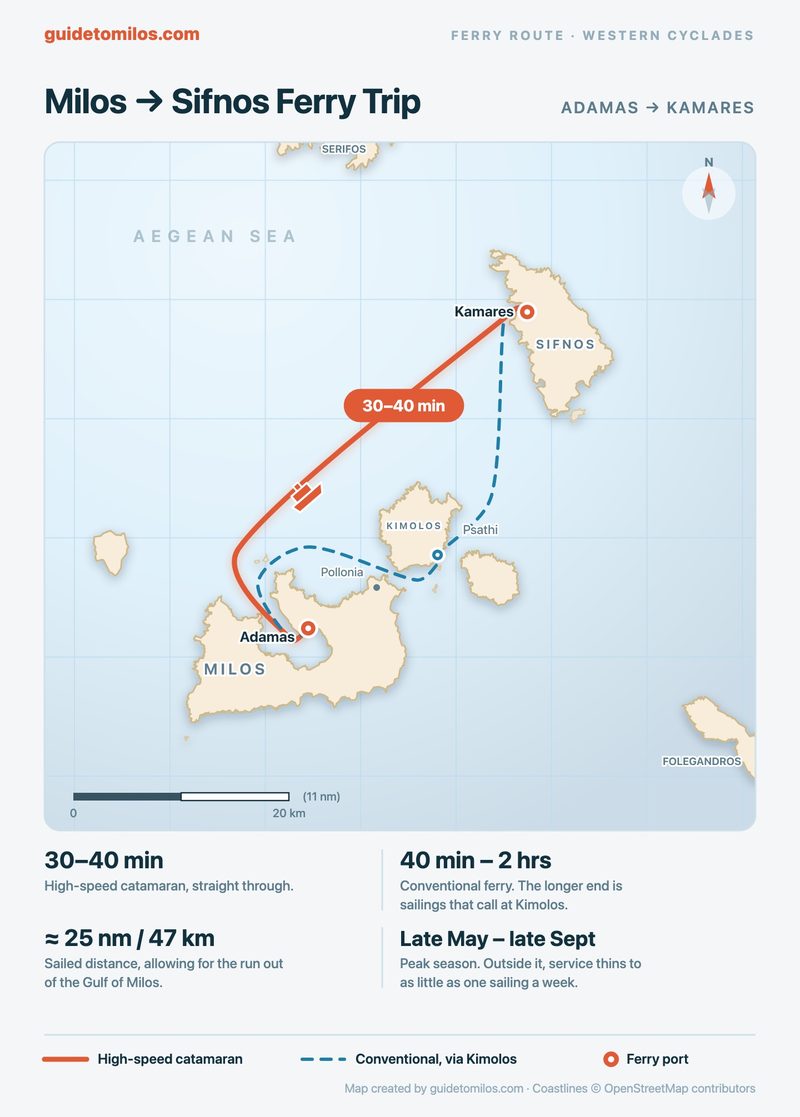
Short by Cycladic standards, and the shortest of the big-ferry legs out of Adamas. A high-speed boat covers it in roughly 30 to 40 minutes on a clear run; a conventional ferry takes noticeably longer, anywhere from around 40 minutes up to a couple of hours depending on stops. Some conventional sailings do route via Kimolos, which sits directly between the two islands on this line, while the dedicated fast catamaran usually runs straight through.
Treat any published time as a starting point rather than a promise. A fifteen-minute delay picked up three islands earlier arrives with the boat, and a leg this short has no slack in which to make it up.
Which Ports Are Involved?
Milos departures use Adamas, the only port that takes the big boats. The Adamas guide covers the town. On the Sifnos side you arrive at Kamares, a working port wrapped around a deep bay on the west coast, with a beach along one side and tavernas and ticket offices behind.
Kamares is not where most people stay. The island's centre of gravity is Apollonia, up in the hills, with Kastro and Artemonas nearby. Buses and taxis are generally coordinated with ferry arrivals, but taxi numbers are limited in peak season, so land late without a plan and you may still find yourself waiting for one.
Fast Boat or Conventional Ferry?
On a leg this short the time a high-speed boat saves is measured in minutes, which changes the calculation you would make on a longer crossing.
The conventional ferry is usually the better buy. It costs less, rides the swell far more comfortably, and lets you walk the deck for a scenic stretch of water. The extra time barely registers.
The high-speed boat wins on timing, not speed. Take it when its departure hour is the one that fits your day.
Wind decides it in July and August. The meltemi, the north wind that dominates the Aegean in high summer, is far harder on the small fast craft than on the big ships, and it is the most common cause of cancellations. Conventional ferries keep sailing in conditions that ground the fast boats, so on a tight connection in the windy months the bigger boat is the safer booking.
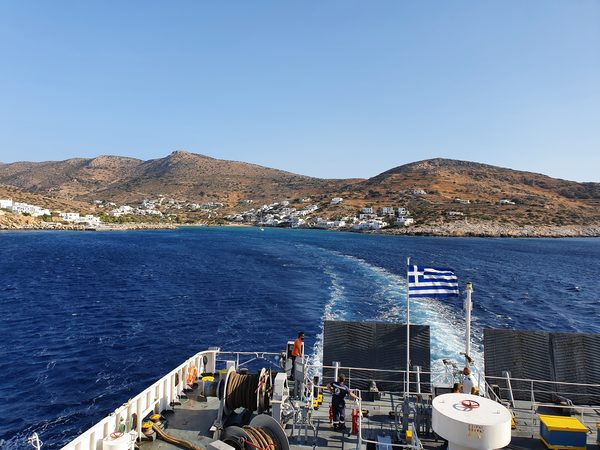
Given a free choice on a leg this short, I would take the slow boat, because time on deck with the western Cyclades sliding past is not a cost.
What Does Sifnos Add to a Milos Trip?
The two islands split the work neatly. Milos is the one you visit for its coastline, for the volcanic rock formations, the swimming and the boat trips. Sifnos you visit for its food: a long-standing reputation as one of the best-eating islands in the Cyclades, built on slow clay-pot cooking and a pottery tradition that still supplies the pots. It also walks better, with a maintained network of old stone footpaths linking villages, monasteries and coves.
Pair them and you get a fuller trip than doubling down on either. The island-hopping guide covers how this leg fits into a longer Cyclades chain, and the Paros to Milos route is the comparison to make if you are choosing which neighbour to add.
Does the Route Survive the Winter?
Not in the form advertised in August. Once high season ends the fast boats withdraw and the line falls back to a reduced conventional service. That is enough to keep the islands connected, but not enough to plan a casual hop around. In deep winter you may find a single realistic sailing in a week, and weather can remove that one.
Roughly late May to late September, the route behaves like a proper link. Outside that window, fix the crossing in your plan first and build everything else around it.
Where Do People Come Unstuck?
Booking the outbound without checking the return. The two directions are not mirror images, and on a short break that asymmetry can cost you a day.
Assuming a day trip works. It sometimes does in peak season, but the timings are tight and one delay strands you. Sifnos deserves a night.
Leaving July and August bookings late. Small boats on a popular corridor fill early.
Cutting it fine before a flight. Never sail either direction on the day of an onward flight from Athens. The Athens ferry route covers connection timing back to Piraeus, and the getting to Milos overview sets out every approach to the island.
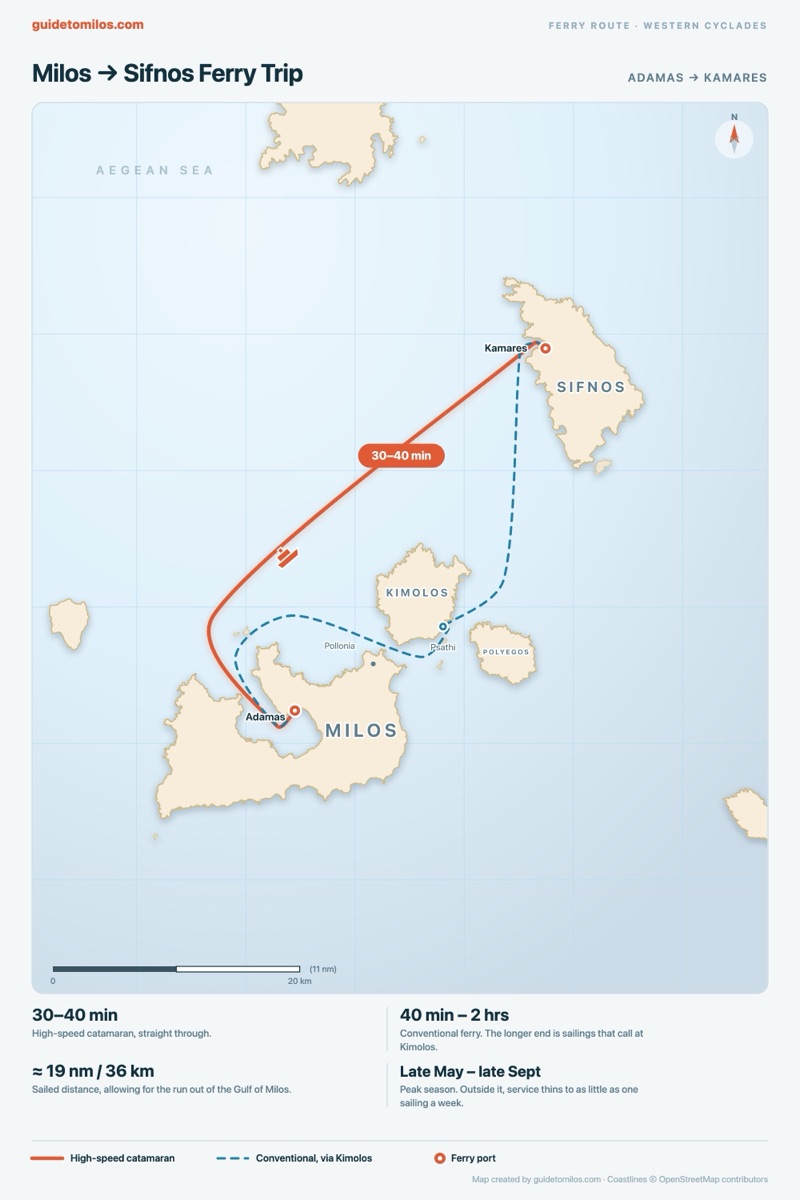
Sifnos is the next island north of Milos on the western Cyclades line, served by both high-speed and conventional ferries between Adamas and Kamares. The crossing is brief, frequency is good from late spring to early autumn and thin outside it, and the conventional ferry is the more comfortable choice for the sake of a few extra minutes.
Planning the rest of your island time? Start with our complete Milos travel guide.
Heading to Santorini? See our guide to the best day trips from Santorini.
Heading to Athens? See our guide to the best day trips from Athens.
Last updated: 2 August 2026