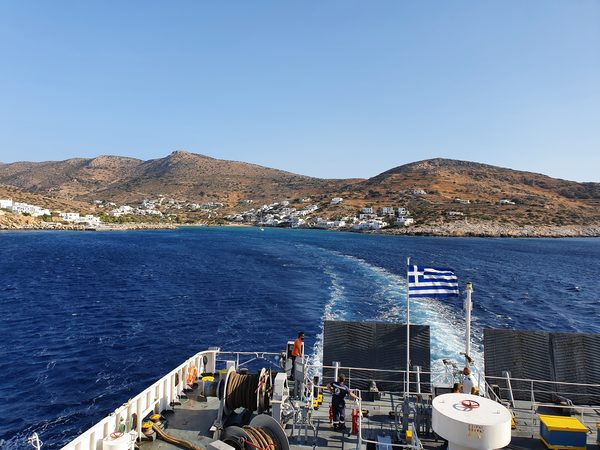
The Paros to Milos ferry is one of the shortest and most useful hops in the western Cyclades, typically taking somewhere between one and a half and two and a half hours on a fast boat. You sail from Parikia on Paros into Adamas on Milos. This guide covers both directions, the ports at each end, luggage, day-trip feasibility and how to book in August.
In this guide
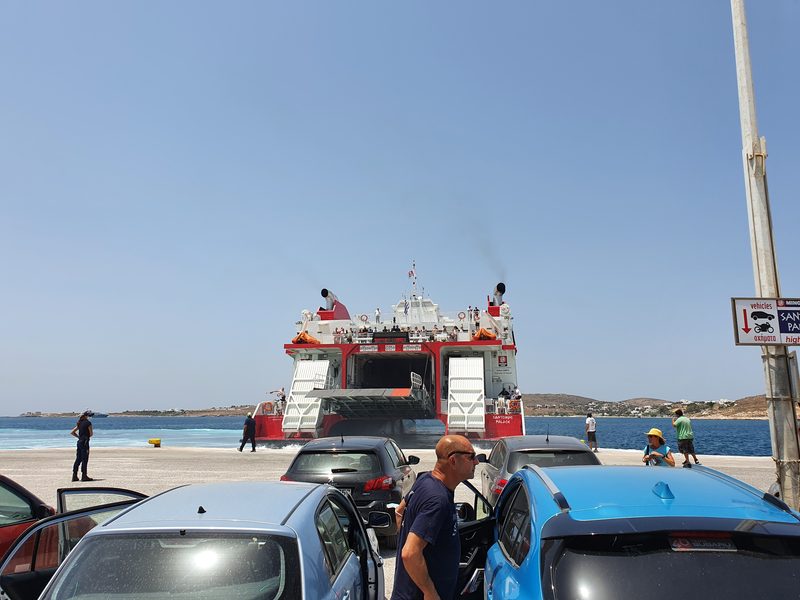
Paros sits near the middle of the Cyclades and works as the network's junction box: boats from Piraeus, from Naxos and Santorini to the east, and from the western string of Sifnos, Serifos and Milos all converge on Parikia. That is why so many island-hopping itineraries are built around a Paros stopover. Milos sits at the south-western edge of the group, close enough to be an easy leg but far enough out that plenty of people never get round to it.
The route runs both ways in roughly equal numbers, and it is the same boat and the same water either way. What differs is what each port does to you on arrival.
How Long Does the Paros to Milos Ferry Take?
Plan on roughly 1.5 to 2.5 hours on a high-speed boat. The spread is real rather than lazy hedging: some sailings run more or less directly, others call at Sifnos or Serifos on the way, and every port call adds its share of manoeuvring and unloading time.
Conventional car ferries do serve the route, run by Hellenic Seaways as part of its long Cyclades loop, and they are slower again, often five hours or more end to end, so treat that option as a half-day rather than a quick transfer. Seajets covers the high-speed side. On this particular route the pattern is the more familiar one: Hellenic Seaways' conventional ships carry vehicles, and the Seajets high-speed boats deployed here do not, so a rental car is a conventional-ferry-only proposition on this leg.
To check sailing times and book, head to Ferryscanner.
Frequency swings hard with the season. High summer gives you a workable choice of departures; the shoulder months thin out quickly, and in winter you should assume nothing daily. Check the sailing you actually intend to take rather than trusting any duration you read in an article, including this one, since timings shift year to year as operators redeploy boats.
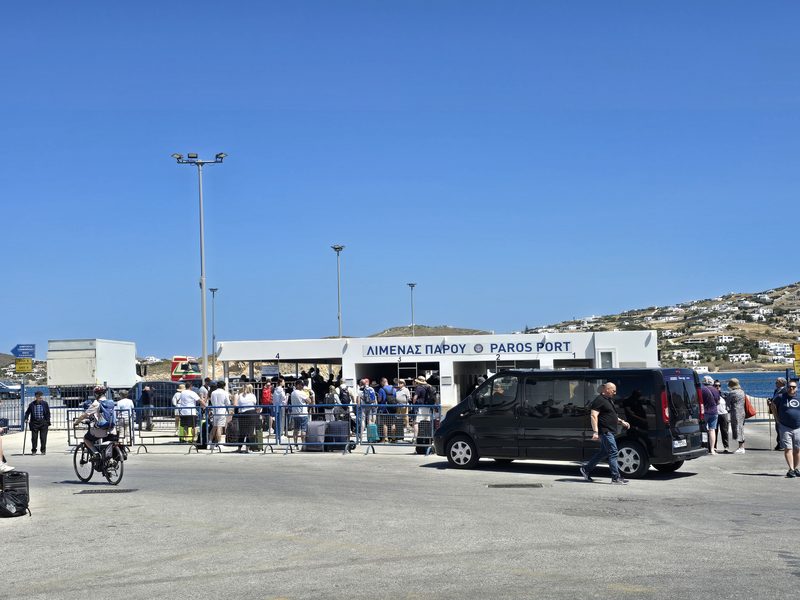
Which Ports Do You Use at Each End?
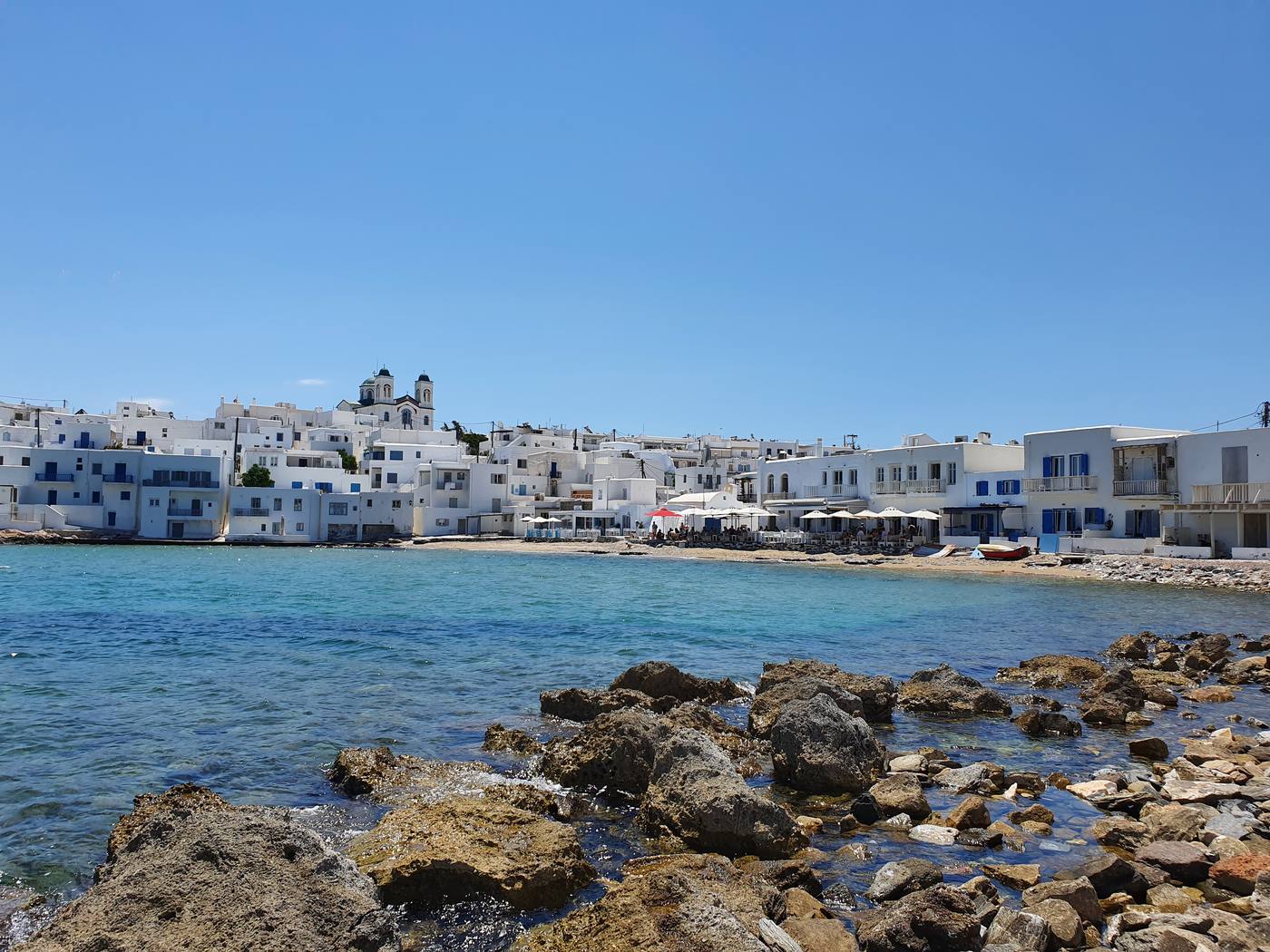
On Paros: Parikia. The port sits in the middle of the island's main town, which makes this one of the least stressful departures in the Cyclades. If you are staying in Parikia, the quay is a walk away rather than a taxi ride. The flip side is August, when the quay handles boats from several directions at once and every wheeled suitcase on the island converges on one gangway.
On Milos: Adamas. Every ferry docks at Adamas, on the sheltered inner bay, with the town wrapped around the harbour. Car hire desks, the bus stop, tavernas and plenty of hotels are a short walk from where you step off. My full breakdown of the town is in the Adamas guide, and the wider arrival picture, including the airport, is in how to get to Milos.
I always book the Milos-bound leg for the morning if I can. Arriving into Adamas with daylight left means you collect a vehicle, find your room and still reach a beach; a late arrival costs you the whole first day.
What Are the Boats Actually Like?
Most of what crosses this stretch in summer is high-speed: enclosed cabins, numbered seats, no real deck to stand on. Quick and functional, and on a calm day nobody minds. On a windy day the smaller fast boats slam, and this corner of the Cyclades gets plenty of wind. Take something for seasickness before boarding rather than after, and pick the larger vessel when you have the choice.
- Deck tickets may not carry a seat. On conventional ferries a deck-class ticket buys passage, not a chair. Board early and claim somewhere.
- Food on board is expensive and dull. Buy something in Parikia or Adamas before you sail.
- Delays are normal. Leave generous slack ahead of anything that connects onwards: a flight, a car pickup, a booked tour. This is the most common way people come unstuck on Greek ferries.
Is a Milos Day Trip From Paros Realistic?
It is possible in peak season and it is a long day. Two crossings of up to two and a half hours each, plus the time either side of the boats, leaves a usable window on Milos only if there is an early departure and a late return on the same date. In July and August that combination sometimes exists; outside those months it often does not.
If it does line up, book a vehicle in Adamas in advance and head straight out. Sarakiniko is close to town and photogenic, but the beaches that justify the journey are further round the coast. A Kleftiko boat trip typically takes most of a day on its own and will not combine with a same-day return.
My view is that Milos deserves at least two nights, and three is better. A day trip gives you the ferry ride and a beach; it does not give you the island. If you are still choosing between the two, I compare them properly in Milos or Paros.
What About Luggage and Vehicles?
Large bags go in racks by the doors on high-speed boats, or on the car deck of a conventional ferry. Either way you are separated from them, so keep documents, medication and valuables with you. There is rarely a formal weight limit for foot passengers, but there is a practical one: you carry your own case up the ramp and sometimes up a flight of stairs.
Taking a hire car between the islands is usually a false economy. Many Greek rental companies prohibit ferry transport of their vehicles outright, and where it is allowed you pay a separate vehicle fare. Hiring fresh on each island is nearly always cheaper. If you do need to move a vehicle, check the individual boat rather than the boat type. The operators run mixed fleets on these routes: some of the high-speed catamarans take a couple of hundred cars and others are foot-passenger only, so "fast boat means no cars" is not a rule you can rely on.
How Far Ahead Should You Book?
For August, book as soon as the schedule is published. This is a short, popular leg with limited capacity per sailing.
Greek ferry schedules are not released all at once, and which operator files first shifts around from year to year. If you cannot yet see a Paros–Milos sailing months out, that is quite possibly a publishing lag rather than an absence of service, so check again before rerouting your itinerary.
Which Islands Pair Well With This Route?
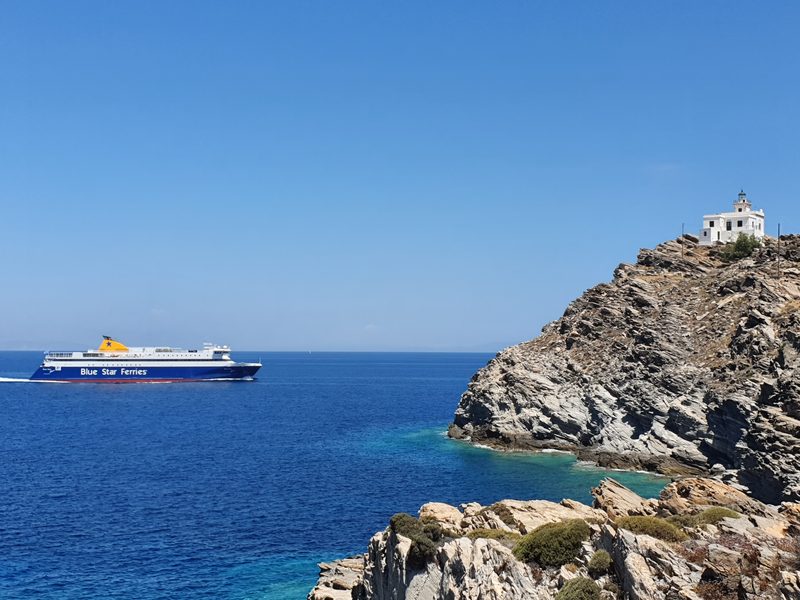
Sifnos sits between the two and is the natural addition. Same water, and it turns a two-island trip into a three-island one without a long crossing. See the Milos to Sifnos ferry guide for that leg.
Serifos and Kythnos continue the chain north towards Piraeus, making a clean one-way loop: sail into Athens, work down the western string, finish on Paros. The Athens to Milos ferry guide covers starting from the capital, and Milos island hopping sets out how the wider connections fit together.
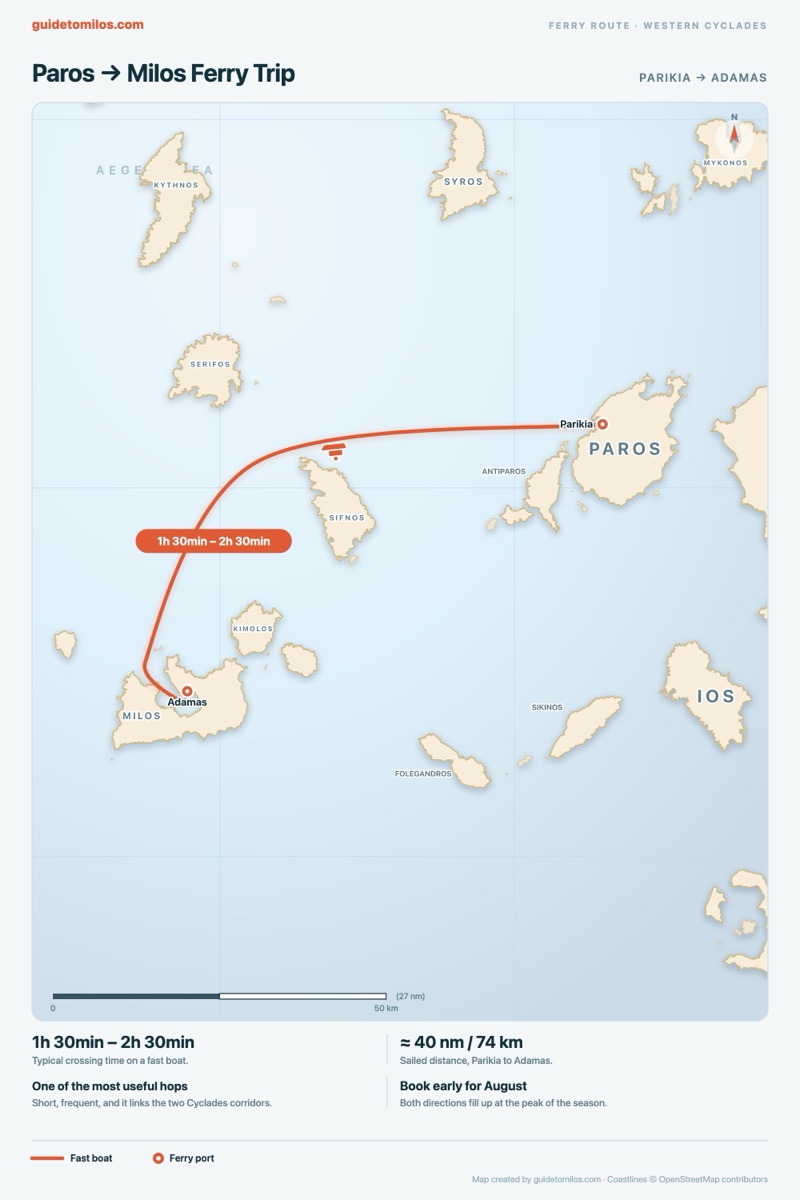
The Paros to Milos ferry runs Parikia to Adamas in roughly 1.5 to 2.5 hours on a high-speed boat, longer if it calls at Sifnos or Serifos. Sailings are frequent in July and August and thin sharply outside the season. A same-day return is only occasionally possible in peak summer, so treat Milos, at the western edge of the Cyclades, as a two- or three-night stop.
Planning the rest of your island time? Start with our complete Milos travel guide.
Heading to Santorini? See our guide to the best day trips from Santorini.
Heading to Athens? See our guide to the best day trips from Athens.
Last updated: 7 September 2026