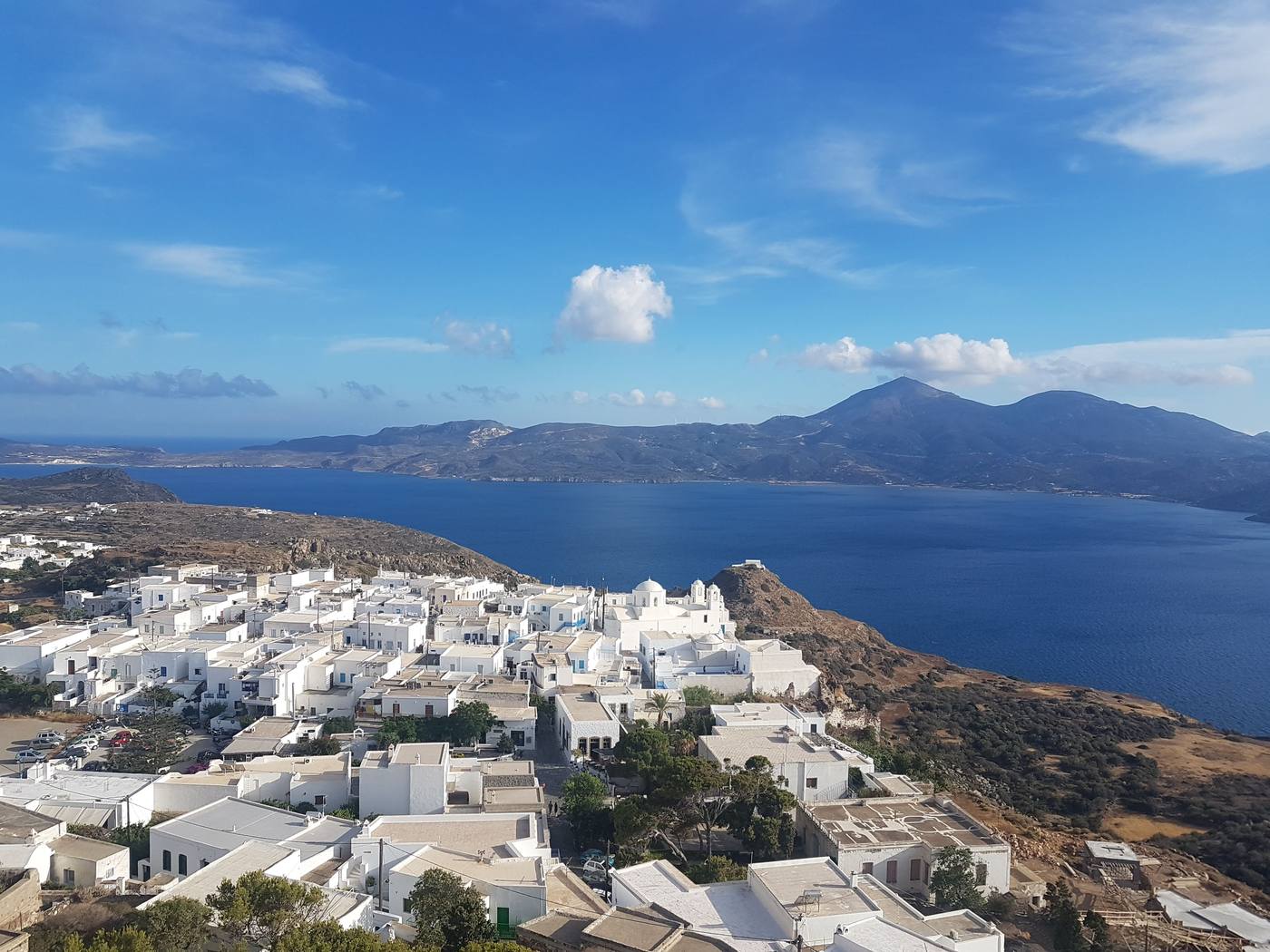
Plaka is the capital of Milos, in Greece's western Cyclades, and the prettiest village on the island: whitewashed houses stacked on a ridge high above the bay, with a ruined Venetian kastro on top. The climb to that summit for sunset is the best free thing to do on Milos. There is no beach, and no cars get in.
In this guide
Plaka sits on the high ridge north-west of the port, looking down over the island's great enclosed harbour. What makes it the capital is history rather than size. It is a fortified hilltop settlement that outlasted Zefyria, the abandoned inland town whose churches it inherited.
What Is Plaka Like to Walk Around?
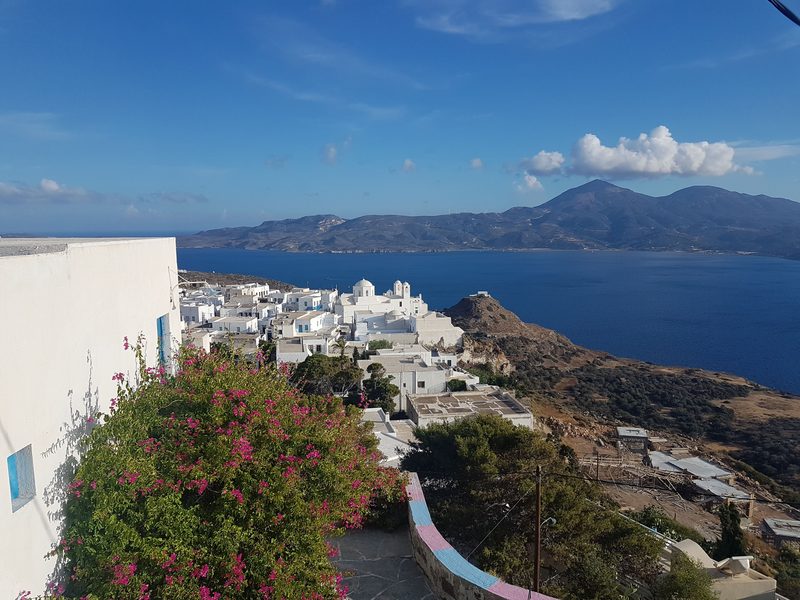
Small, steep and pleasantly disorientating. The lanes are stone-paved with the joints painted white, the walls lime-washed, and the level changes constantly, so you lose your bearings within four turns. That is the appeal. You wander, and you find a church you were not looking for. Cafes and tavernas are folded into the fabric rather than lined along a front; the Plaka restaurants guide covers eating, and the tables with a view get booked.
The limitation is that Plaka has little to do. Two small museums, a few churches, one castle hill. Give it a slow half-day and an evening rather than a full day.
I have walked these lanes in mid-June and again in late September. The difference is noise: in June they are busy from six in the evening, while in late September you can have stretches to yourself at the same hour, in the same light.
What Is the Kastro Climb Like?
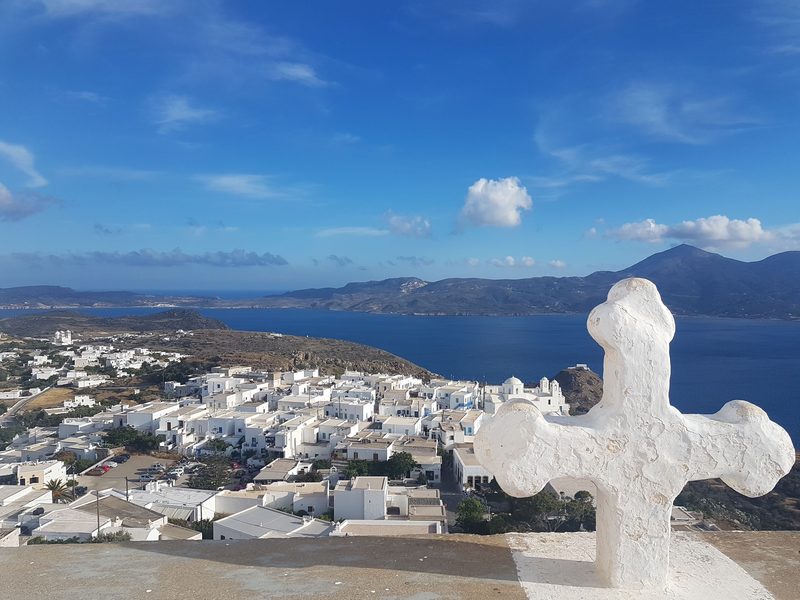
The Venetian castle is not a castle in the way most people picture one. The Venetians took Milos from the Byzantines in the 13th century and fortified the summit in the Cycladic manner, with no curtain wall, just houses packed so tight against the hill's edge that an attacker met masonry wherever he turned. What survives is fragmentary. The reason to climb is the 360-degree view: the whole bay on one side, the western cliffs and open sea on the other.
The climb. From the upper lanes a stepped path is cut into the rock. Ten to fifteen minutes of steady uphill, with the last stretch proper steps on an uneven surface. Not technical, but not step-free either, and anyone with knee or balance trouble should treat it as a real climb rather than a stroll.
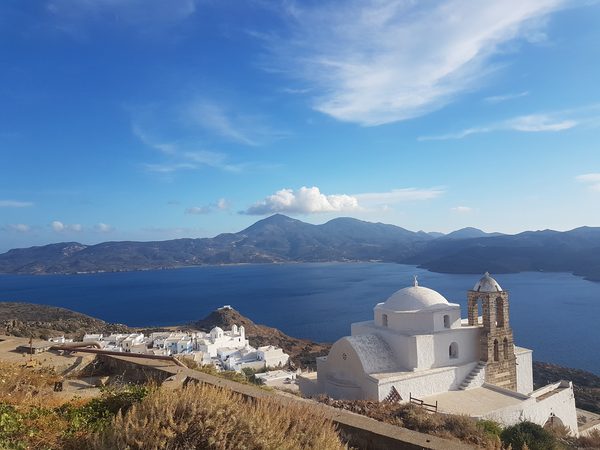
Partway up you pass Panagia Thalassitra, church of the Virgin of the Sea and protector of sailors, white against bare rock on its shelf of hillside and probably the most photographed building on the island. Go inside if it is open, for the carved wooden iconostasis. At the very top is Panagia i Sikiniotissa, rebuilt by islanders in 1944 after wartime bombing destroyed its predecessor. The rocks beside it are the standard sunset seat.
Timing. Start at least 45 minutes before sunset, because the light goes quickly once the sun touches the sea. Carry water and a layer, because the summit is exposed and the breeze that felt pleasant in the lanes is stronger up there. Bring a phone torch: the descent is in near-darkness once the crowd disperses, and the steps that were easy going up are the hazard coming down.
Expect company. In high summer a hundred or more people sit on the rocks facing the same direction, and the walk down is a slow queue. Late September gave me twenty.
If the photograph matters more than the evening, the kastro is one option among several here, and the Milos sunset photography spots guide works through where to stand and when.
Where Do You Go if the Kastro Steps Are Too Much?
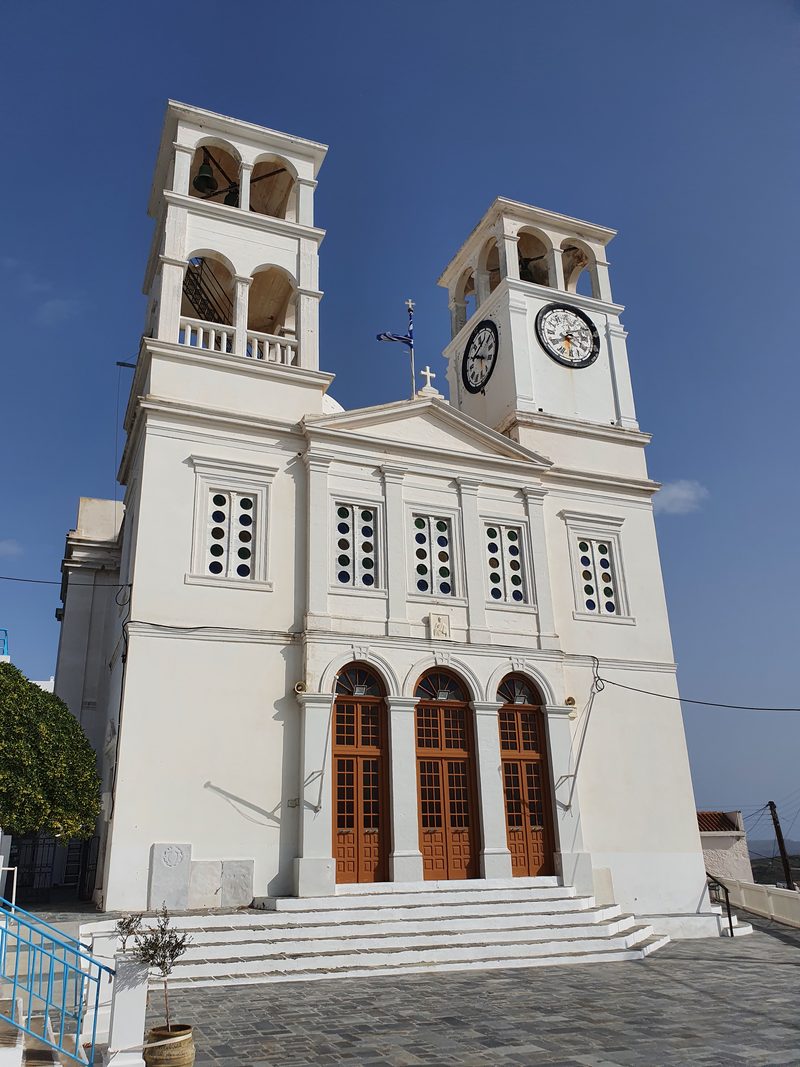
Lower down, the cathedral of Panagia Korfiatissa sits in a wide marble courtyard hanging off the western edge of the ridge. This is Plaka's second viewpoint, and the one to use if the kastro is beyond you: level, step-free, facing the same sunset over open water. It went up in the early 1800s, partly from salvage carried from the deserted churches of Zefyria, and holds icons, carved woodwork and a gilded 16th-century Epitafios.
Which Museums Are Worth Your Time?
The Archaeological Museum first, if you only do one. It occupies a neoclassical building by Ernst Ziller, the architect behind much of 19th-century Athens, and you can see it properly in under an hour. Its entrance room is dominated by a full-size cast of the Aphrodite of Milos, the Venus de Milo, dug up in 1820 by a farmer named George Kentrotas in a field outside Trypiti, and in the Louvre since 1821. Standing before the cast where the thing came out of the ground beats filing past the real one in Paris.
The piece I would actually queue for is the Lady of Fylakopi, a terracotta figure from the 14th century BC found at the Bronze Age settlement on the north coast. She is easy to walk straight past, which is why the museum deserves a slow lap. Around her sit more Fylakopi finds, sculpture, inscriptions and the obsidian tools that explain why this island mattered at all. Admission is 5 EUR. From April to the end of October it opens 08:30 to 15:30, closed Tuesdays only; over winter the same hours apply but it also closes Mondays and Thursdays.
The Folk and Historic Museum, next door to Panagia Korfiatissa, covers island domestic life from roughly 1850 to 1930: furniture, looms, costume, tools, photographs. It shows how people on this rock actually lived, which the archaeological museum cannot, when it is open. This is a small, community-run collection with no schedule reliable enough to print here, and it has sat closed for entire seasons before. Treat it as a bonus if you find the door open rather than something to build the Plaka half-day around, and lean on the cathedral courtyard next door if it is not.
Two smaller collections exist too: a War Museum in an underground 1943 shelter and emergency hospital, said to open daily through the season for a few hours either side of midday and again in the evening, and a private Sand Museum in an alley, more interesting than it sounds. Both are small private affairs. The Sand Museum is run personally by its founder and the War Museum's own posted hours were not something I could confirm directly, so treat both as generally operating in season but check locally rather than planning a precise arrival time around either. For mining collections, see the Milos museums and mining history guide.
How Do You Get There, and Where Do You Park?
Plaka is roughly 4 km from the port at Adamas, five to ten minutes by car on a good road climbing through Triovasalos. Buses run up from Adamas and are the sensible summer option, but frequency swings hard with the season, from a couple of round trips a day in winter to close to ten at the height of July and August. The last service back down matters more than the one going up, and it is worth checking milosbuses.com for that specific week rather than assuming a fixed evening departure. See the getting around Milos guide.
Driving is where people come unstuck. Plaka is closed to traffic, as are the neighbouring villages, so you park in the designated areas on the edge and walk in. By early evening the spaces are gone and latecomers crawl the approach road; park lower and walk up rather than circling. Inside, it is all on foot and much of it on steps. That applies to reaching your accommodation with luggage as much as to sightseeing.
Does Plaka Work as a Base?
In favour. The most attractive place to stay on Milos by a distance, and it improves rather than fades once the day visitors leave. Sunset every night without driving, a restaurant cluster people cross the island for, and close to Trypiti, Klima and the north-west beaches.
Against. No beach and no swimming within walking distance, so a car or ATV is effectively compulsory. Parking is outside and you carry your bags in. Steps are everywhere, which rules it out for some travellers entirely. It is also quiet at night by design; for bars and a waterfront, Adamas or Pollonia suit better. The where to stay on Milos guide compares the bases.
What Is Nearby?
- Trypiti, fifteen minutes along the ridge: windmills, wide views, and a name from the Greek for "hole", since the soft rock is riddled with them. The catacombs, the Roman theatre and the Aphrodite find-spot lie below it. Trypiti and catacombs guide
- Klima, the coloured fishing village with boat-garage syrmata built into the shore, down a steep road below Trypiti. Klima guide
- Plathiena, the nearest beach: a sandy bay a short drive below the village, lovely in settled weather and shut down by a meltemi. Plathiena beach guide
These link on foot if you start early and accept steep ground; the Milos hiking guide has the routes.
When Should You Go Up?
Spring (April to early June). Mild climbing weather, museums without queues.
High summer (July to August). Beautiful and crowded: busy summit, tight parking, and lanes that hold the day's heat into the evening.
Late September to October. My preferred window, with the light at its best and a fraction of the August crowd, though some businesses close from mid-October.
For where Plaka fits into a wider trip, start from the things to do on Milos guide.
Plaka is the capital of Milos, one of Greece's Cyclades islands, about 4 km and five to ten minutes from the port at Adamas. The village is closed to cars, so park outside and walk in. The climb to the Venetian kastro takes ten to fifteen minutes on steps and is free; start at least 45 minutes before sunset, with water and a torch. There is no beach in Plaka.
Planning the rest of your island time? Start with our complete Milos travel guide.
Heading to Athens? See our guide to the best day trips from Athens.
Last updated: 31 July 2026