The Greek island of Milos owes almost everything to what is under it. Obsidian made it rich in the Stone Age, sulphur and bentonite kept it working through the industrial era, and quarrying carved the coastline that now fills everyone's camera roll. The Milos Mining Museum in Adamas is the best hour you can spend understanding why.
In this guide
Most islands in the Cyclades sell you a view. Milos sells you a cross-section. The volcanic upheavals that built this corner of the Aegean two to three million years ago, part of the same arc as Santorini and Nisyros, left a geology varied enough that the island has been dug and shipped out of for roughly ten thousand years without running dry. People have lived here continuously since around 8,000 BC, and for most of that time the reason was mineral, not scenic.
That one fact explains the Aegean-wide trade links a small island had before Athens amounted to anything, the heavy trucks you pull over for on the road to Pollonia, and the coloured shorelines that make people book flights. Four museums cover the story, split between Adamas and Plaka, and two unhurried mornings will do all of them.
Why Was Obsidian So Important?
Obsidian is volcanic glass. Fracture it and you get an edge sharper than anything else available in the Neolithic world, which made Milos the supplier of blades, scrapers and arrowheads to a large slice of the prehistoric Aegean. Archaeologists have turned up Milos obsidian at sites all over Greece, which is about as clear a proof of long-distance trade as you could ask for.
The wealth that came with it built Fylakopi, on the north-east coast near Pollonia. Settlement there goes back to around 3,000 BC, with a proper planned town from about 2,300 BC, and over the following centuries it acquired cyclopean walls, two-storey houses and eventually a palace. It declined and was abandoned around 1,100 BC, after which the population shifted to the sheltered slope between Klima, Trypiti and Plaka, safer ground against pirates, which was later walled and given a market, gymnasium, aqueduct, cemetery and theatre.
You can visit the Fylakopi site, and I would not build a day around it. Very little is standing, opening days are informally staffed, and reviewers report it closed for stretches of the season, so treat it as a stop you make if the gate happens to be open rather than a fixture in the plan. The finds are in Plaka in any case, which is where the site starts to make sense.
What Actually Happened to the Venus de Milo?
The statue the French call the Venus de Milo and the Greeks call the Aphrodite of Milos was carved in the late Hellenistic period, in the 2nd century BC, when the island was passing between Athenian, Macedonian and Egyptian control. It is probably the most recognisable Greek sculpture on earth, and it has not been on Milos for more than two hundred years.
It came out of the ground in 1820, under Ottoman rule, found by a local farmer named George Kentrotas on the slope below Trypiti. Word of the discovery reached a French naval officer, Jules Dumont d'Urville, who realised immediately how important it was and got a message to the French Ambassador. From there the accounts stop agreeing with each other. Several versions of how the statue left Greece are in circulation, and which of them is true remains disputed. What is not in dispute is the destination: it was presented to King Louis XVIII and reached the Louvre in 1821, where it has stayed.
So you cannot see the Venus de Milo on Milos. What you can see is a cast in the Archaeological Museum in Plaka and, since 2022, a replica at the spot where Kentrotas turned it up, looking out over the Aegean. The find spot sits on the walking path between the Roman theatre and the catacombs, the single best half-hour of history on the island, covered in the Trypiti and catacombs guide.
The replica at the find spot is worth the detour more than the one in the museum. Standing where a farmer's spade turned up marble, with nothing but sea in front of you, does more than a glass case ever will.
From Sulphur to Bentonite: The Mining Centuries
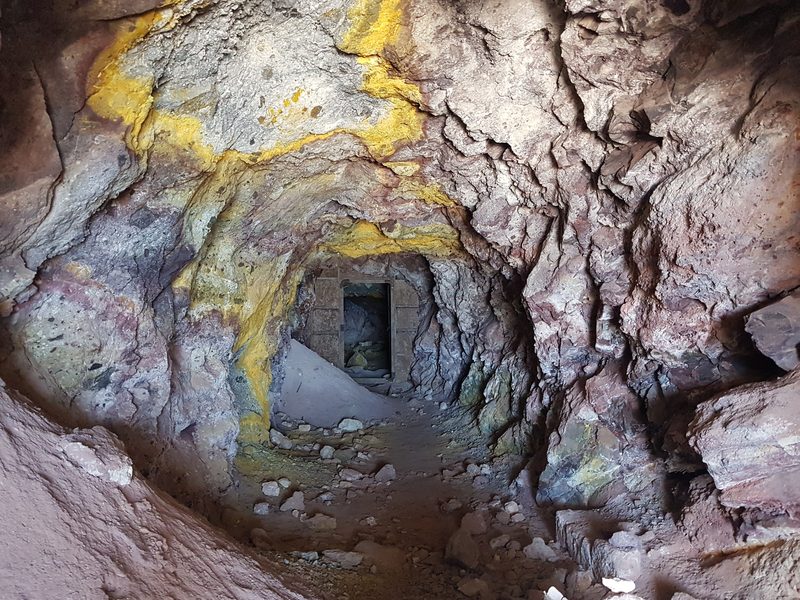
Obsidian was only the start. Long before the industrial era, Milos was exporting kaolin for ceramics and pharmaceuticals, trachyte for millstones, bentonite for soap and pumice for polishing marble and mosaic. That mineral spread is unusual for an island this size, and it is why Milos kept mattering commercially through periods when its neighbours did not.
After Milos joined the new Greek state in 1830, the industry restarted in earnest. Over the following two centuries the island produced sulphur, silver, galenite, manganese, kaolinite, bentonite, perlite and pozzolana. Some of those workings are long finished. Others, bentonite and perlite in particular, are still active as of 2026, and Milos remains a working industrial island rather than a purely touristic one. Imerys, which absorbed the original Greek firm S&B, is the dominant operator: something like a million tonnes of bentonite a year, roughly 30% of European production, plus the largest perlite mine on the island, above Tsigrado. A handful of smaller operators work other seams alongside it.
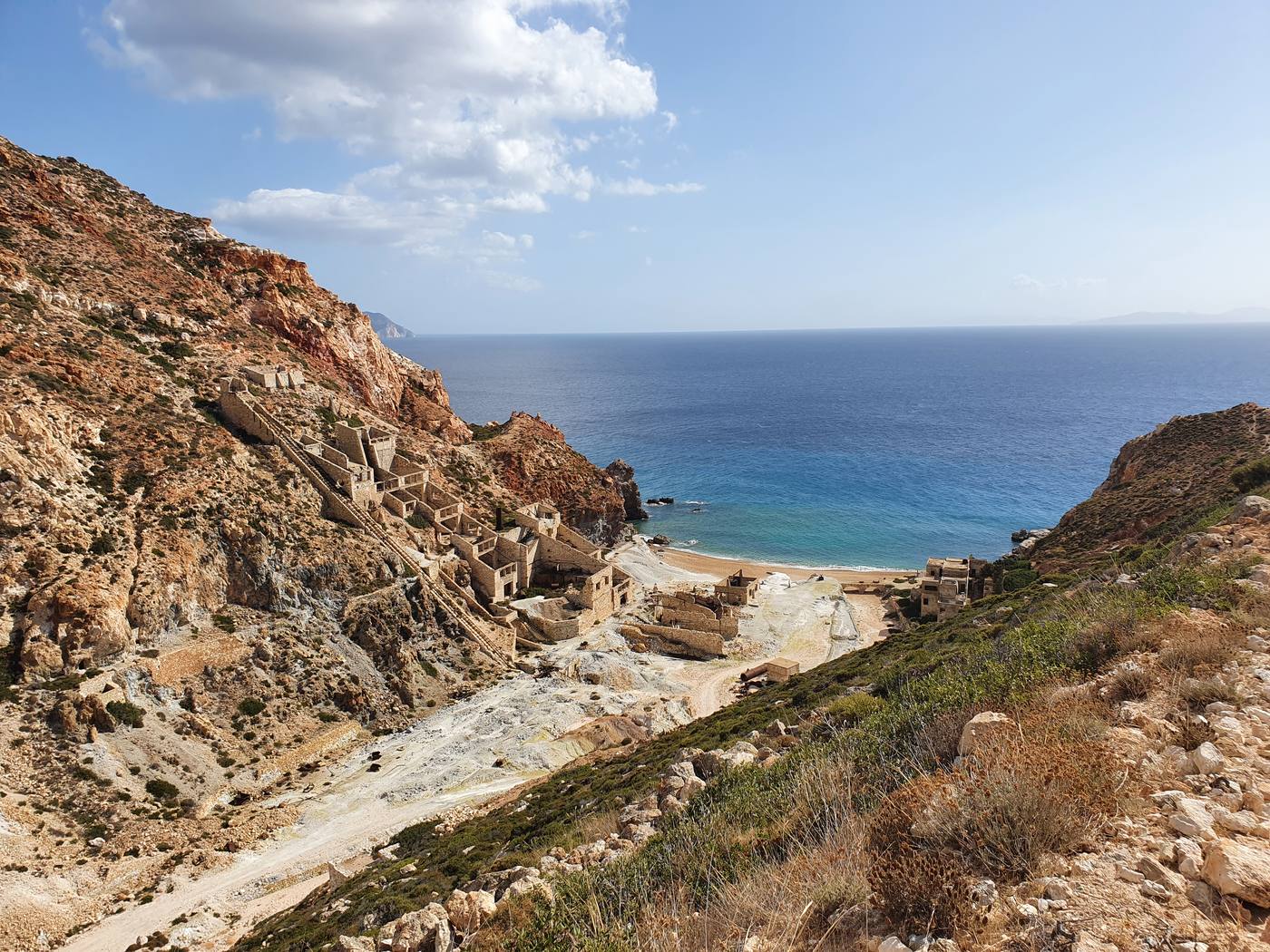
The abandoned sulphur works at Thiorichia on the east coast, rusting machinery and mine buildings standing directly above a beach, is the most photogenic wreck of the lot and a proper expedition to reach; see the remote beaches of Milos guide.
The one working quarry most visitors can reasonably see is the bentonite pit at Aggeria in the north-east, huge, with bands of colour running through the rock. I would rank it among the more memorable things on the island, which is not a sentence I expected to write about a mine. Access is awkward, some approaches are closed off and loaded trucks use those roads, so obey the signage; several operators run 4WD tours that include it.
Which of the Four Museums Should You Prioritise?
Four collections carry the island's story. None takes long, and two are genuinely very good.
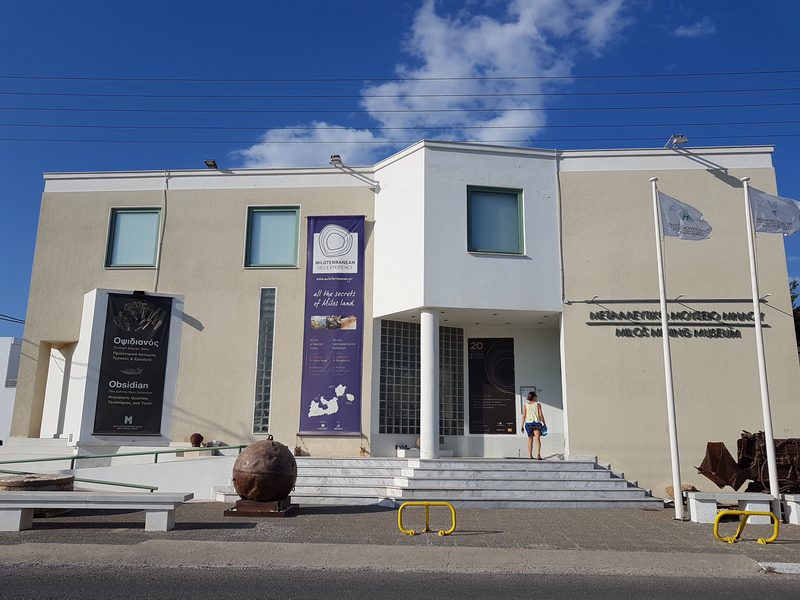
Milos Mining Museum, Adamas
This is the one to prioritise, and the reason people search for the Milos Mining Museum by name. It lays out the island's geology and its working history side by side: cases of the actual minerals pulled out of Milos over the millennia, with descriptions that assume you are interested rather than five years old, alongside old mining tools, geological and topographical maps, and archive photography of the industry at work.
Do not skip the basement. There is a short documentary down there on the mining decades of living memory, and it is the part that turns a display of rocks into a story about the people who dug them. The museum also runs occasional guided geological walks to significant sites around the island, which are worth asking about if your dates line up.
It is an easy walk from Adamas port in the direction of Papikinou beach. Admission is 7 EUR (10 EUR with an audio tour), 4 EUR for seniors 65 and over, and free for children under six and school groups. Hours shift through the season: shorter mornings-only in spring, extended with an evening session in high summer, tapering again into autumn, and closed to general visitors from November to March (educational groups only). Details and the current month's hours are on the museum's official site.
Make this the opening move of the whole holiday. Everything you drive past for the rest of the week makes more sense afterwards, including the beaches.
Archaeological Museum, Plaka
If the Mining Museum shows you what Milos is made of, this one shows you what the island did with it. The obsidian blades and cores in these rooms are the hard evidence behind the trade story, and the Fylakopi material around them is the settlement that grew rich on it. See the two together and the prehistoric economy stops being an abstraction and becomes a supply chain with a warehouse at one end.
There is a full-size cast of the Aphrodite of Milos here too, which most visitors photograph on the way through. Give the time instead to the Lady of Fylakopi, a terracotta figure from the 14th century BC with far more presence than her size suggests. Sculpture, reliefs and inscriptions fill out a collection you can work through in an hour. If you only go into one museum in Plaka, make it this one.
Admission is 5 EUR. From April to the end of October it opens 08:30 to 15:30 and closes only on Tuesdays; over winter the same hours apply but it also closes Mondays and Thursdays.
Ecclesiastical Museum, Adamas
Housed inside the church of Agia Triada, which has stood in some form on this spot since the 9th century AD. The collection covers rare books, icons, gold and silver work and wood carving, and the centrepiece is the iconostasis, the carved screen of icons dividing the nave from the sanctuary. Even if religious art is not your thing, pause in the courtyard on the way in for the mosaic floor by the local artist Giagos Kavroudakis. The same hand did the courtyard at the church of Kimisi tis Theotokou on the hill above town.
This is a small, volunteer-curated collection inside a working church rather than a museum with a fixed rota, and it opens around the curator's own availability more than a printed timetable. Visitors describe finding it open and being shown round personally, and also finding it locked despite an advertised hour. Treat any hours you see quoted online as a rough guide, not a promise, and if the door is shut, try again later in the day rather than assuming it is closed for the season.
Folk and Historic Museum, Plaka
Next door to the Panagia Korfiatissa cathedral, this one covers ordinary Milos life, concentrated on roughly 1850 to 1930: costume and household utensils, looms, working tools, old photographs and the furniture they all sat in. It is a domestic counterweight to the mining museum's industry and the archaeological museum's antiquity, and it takes half an hour. Worth combining with the cathedral courtyard next door, which has one of the better sunset positions in town.
This is the museum I would least bank on. It is a small, community-run collection with no fixed schedule I would put in front of you as fact, and it has gone whole seasons without opening in the past. Treat it as a bonus if you find the door open rather than a fixture of the Plaka half-day, and have the cathedral courtyard next door as your fallback if it is not.
How Mining Made the Beaches
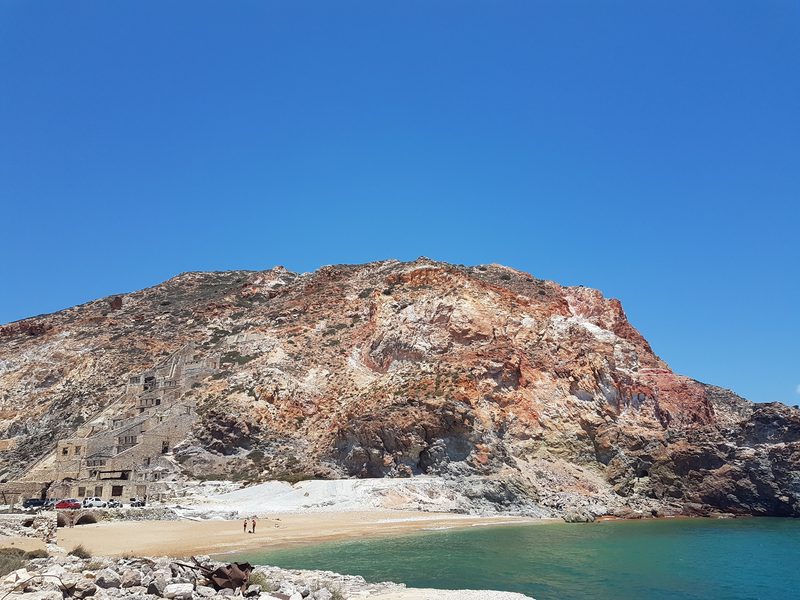
The coastline people come here to photograph is a mineral coastline, and in places an industrial one. Sarakiniko's white rock is volcanic ash scoured by sea and wind; Firiplaka is banded geology in cross-section; the cliffs behind Paleochori are stained by mineral deposits and warmed by geothermal activity, enough that the sand at the waterline can get hot underfoot to a degree you notice. Which is the argument for doing the museums early. Once you know what bentonite looks like, you stop seeing pretty beaches and start seeing one island turned inside out. The full run is in the Milos beaches guide, and the wider list in the things to do in Milos guide.
How Long Do You Need for All of This?
Two half-days. One morning in Adamas for the Mining and Ecclesiastical museums, which are minutes apart, and a second in Plaka for the Archaeological and Folk museums. Save the Trypiti walk, taking in the theatre, the Venus find spot and the catacombs, for a late afternoon once the heat has dropped. All four are small and indoor, and none is likely to be open all day, so check hours before you set off.
Milos, in the Cyclades of Greece, has been mined for roughly ten thousand years, starting with Neolithic obsidian and running through sulphur, bentonite and perlite to the present day. The Milos Mining Museum sits a short walk from Adamas port and is the best single introduction to the island. The Venus de Milo was found near Trypiti in 1820 and has been in the Louvre since 1821; on Milos you see a cast in Plaka and a replica at the find spot. Check current opening hours for all four museums before you go.
Planning the rest of your island time? Start with our complete Milos travel guide.
Heading to Santorini? See our guide to the best day trips from Santorini.
Heading to Athens? See our guide to the best day trips from Athens.
Last updated: 1 August 2026