Choosing between Milos and Santorini comes down to one question: do you want beaches or do you want a view? Milos has the better beaches by far, more room to breathe and lower prices. Santorini has the caldera, a view no other Greek island can match, along with the crowds and the costs that come with it.
In this guide
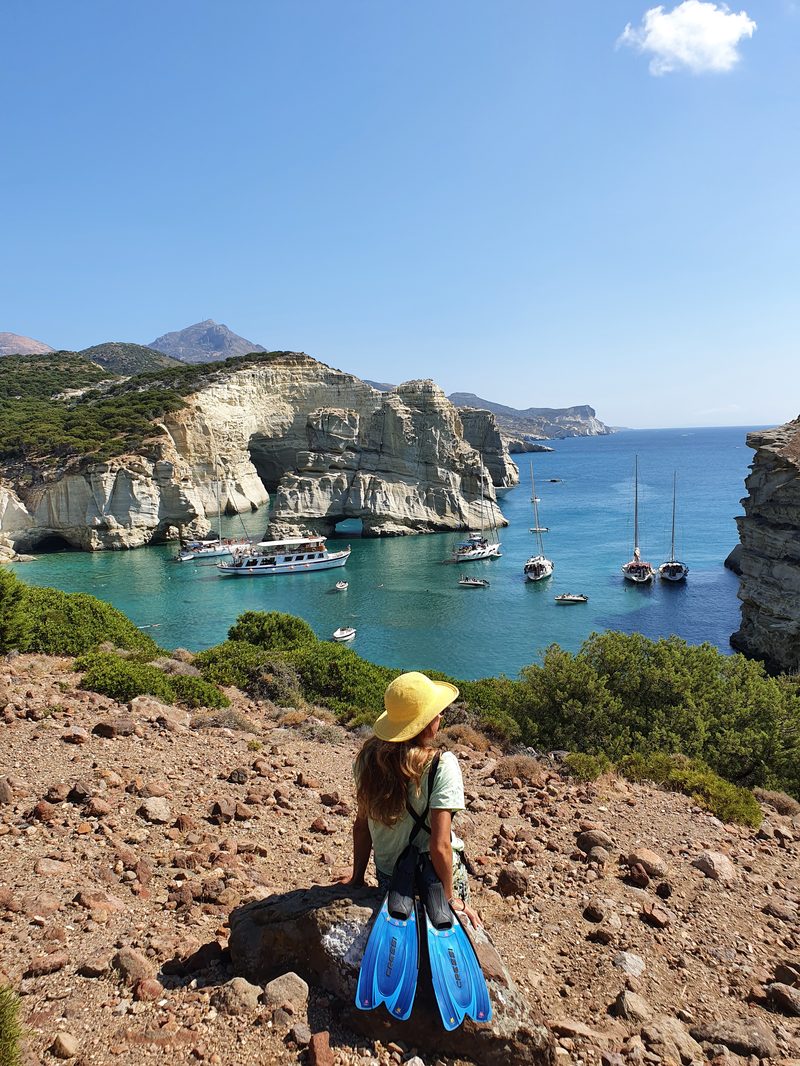
Both Milos and Santorini are Cyclades islands, and they sit closer together than most visitors expect. A ferry between them takes a couple of hours, which is why so many people end up doing both rather than choosing. But if you only have a week and one island to give it to, the two places pull in genuinely different directions.
I live in Athens and have spent a lot of time on Milos, and I've also visited Santorini half a dozen times. What follows is a straight comparison, not a pitch for either: there are trips where I would send you to Santorini without hesitating, and more where I would send you to Milos.
Milos vs Santorini at a Glance
| Milos | Santorini | |
|---|---|---|
| Landscape | Volcanic rock in white, ochre and rust; mining scars; 160 sq km | Flooded caldera, cliff-top towns, black volcanic soil |
| Beaches | Dozens of them, wildly varied, the island's main draw | A handful, mostly dark sand or pebble, a secondary attraction |
| Crowds | Busy in peak weeks, still walkable | Heavy, concentrated in Oia and Fira |
| Cost | Noticeably cheaper across accommodation and eating out | Among the most expensive islands in Greece |
| Getting there | Domestic airport, ferries from Piraeus | International airport, far more flights and ferries |
| Nightlife | Low-key: tavernas, a few bars | Considerably more of it |
| Best for | Beaches, swimming, boat trips, quiet | The caldera view, sunsets, hotels with pools, wine |
Comparison reflects the general character of each island rather than any single season.
Which Island Has the Better Landscape?
They are both volcanic, and that is where the similarity stops.
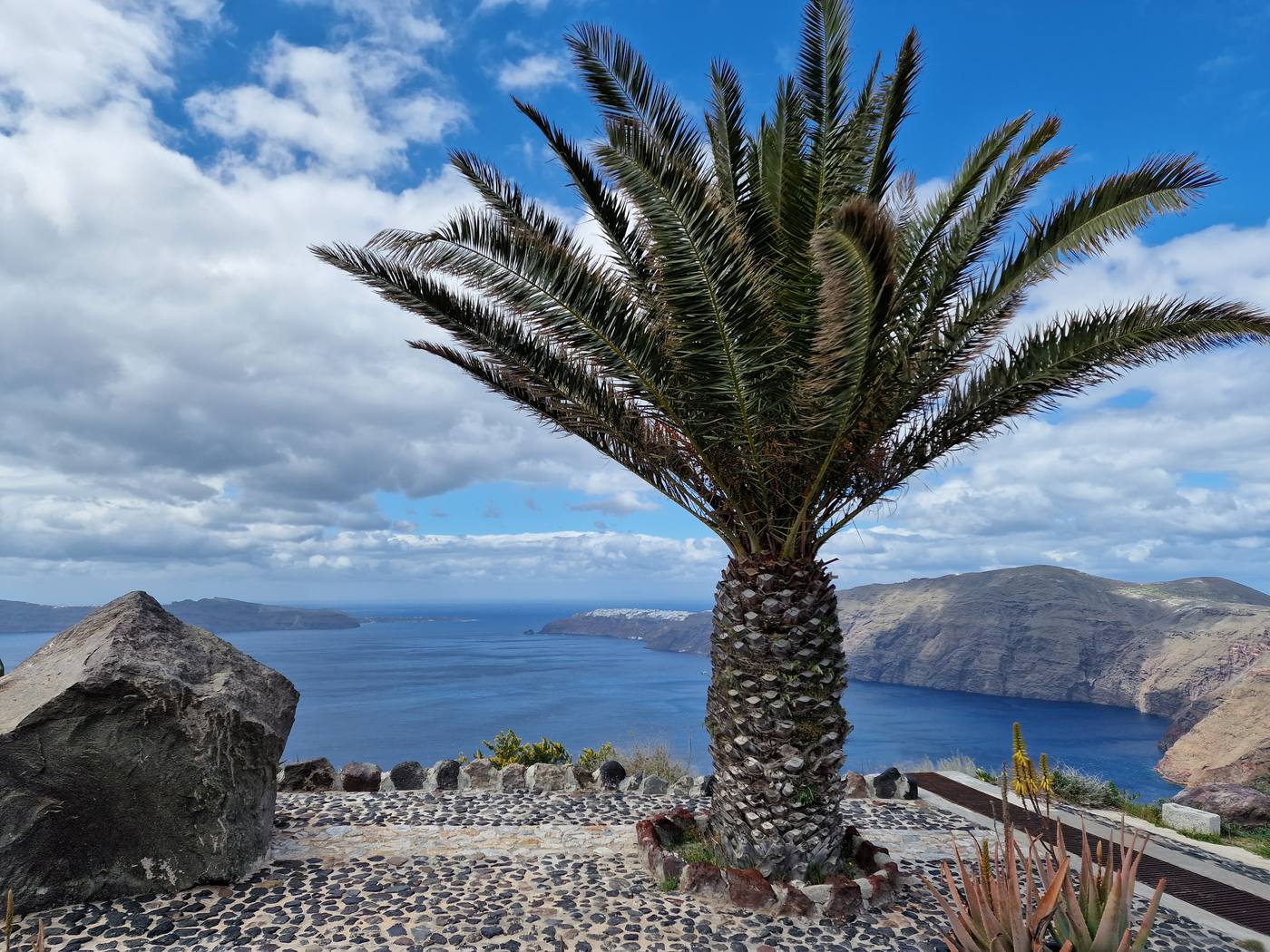
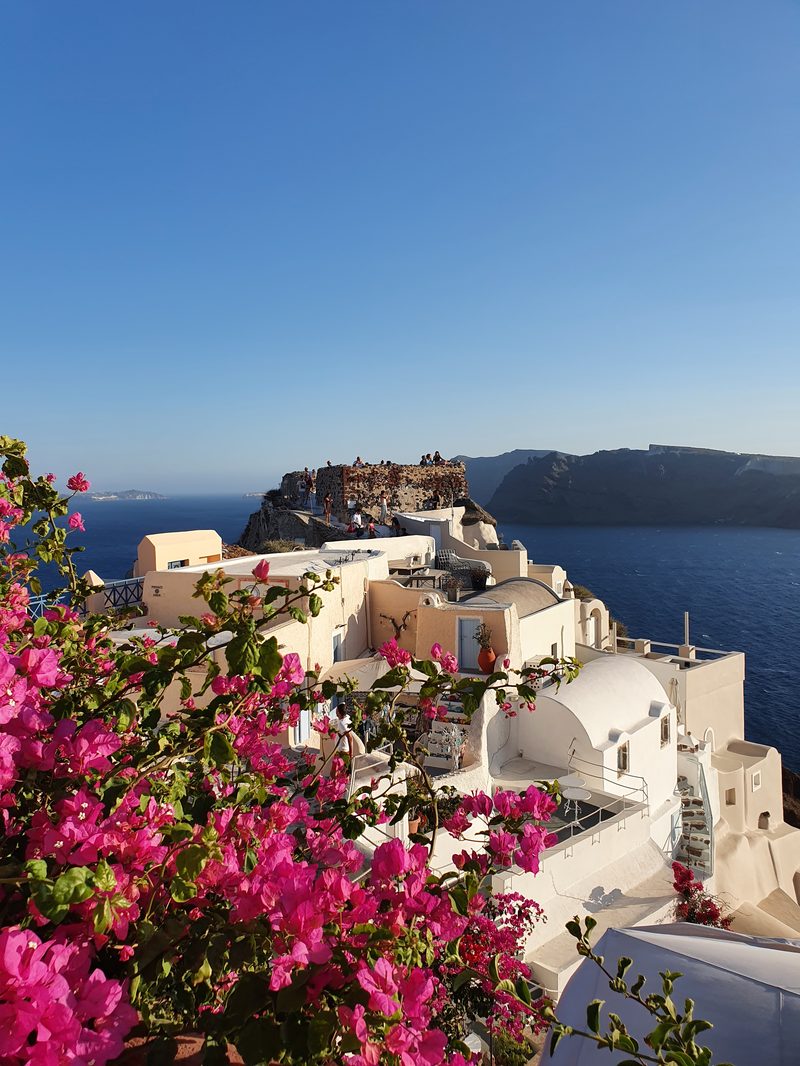
Santorini's shape is the result of an eruption that tore the middle out of the island and let the sea in. What survives is a crescent of cliff with towns strung along the top edge of it, looking down several hundred metres onto water that fills the old crater. Nothing else in the Aegean looks like that, and photographs undersell it, because the scale only registers when you are standing on the rim.
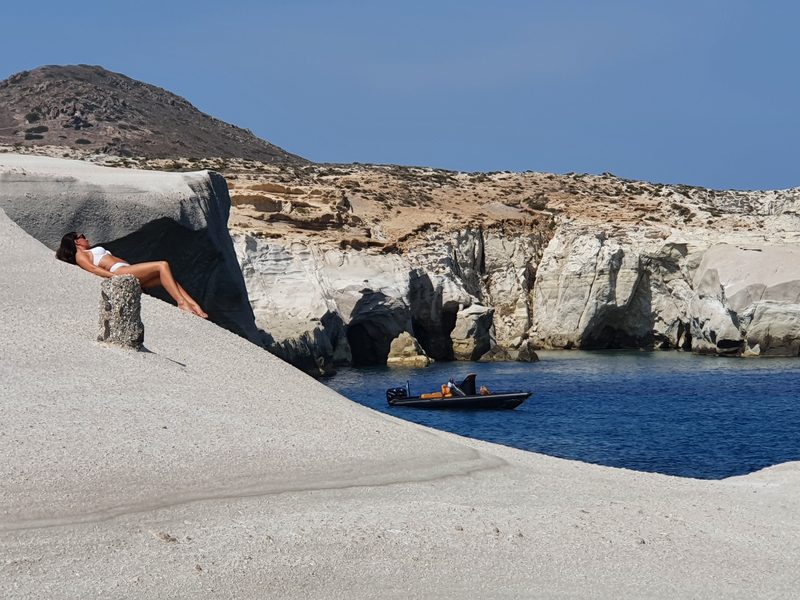
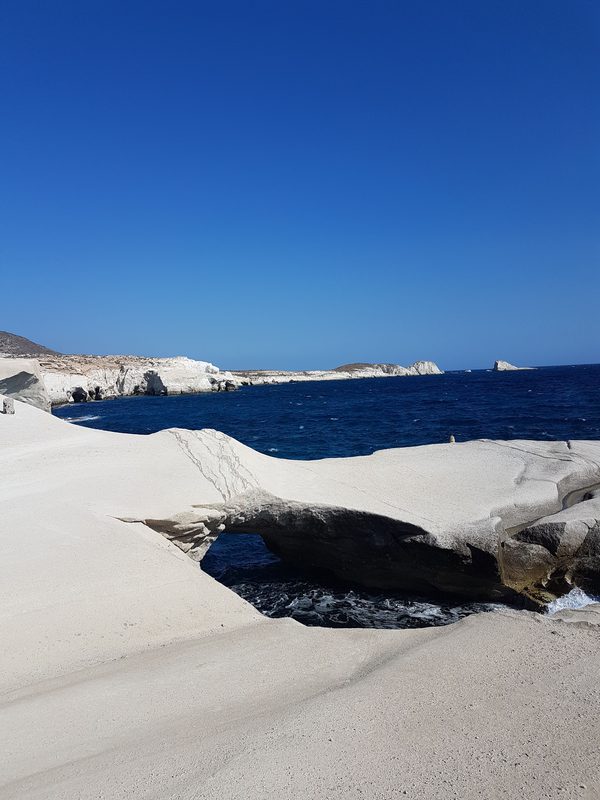
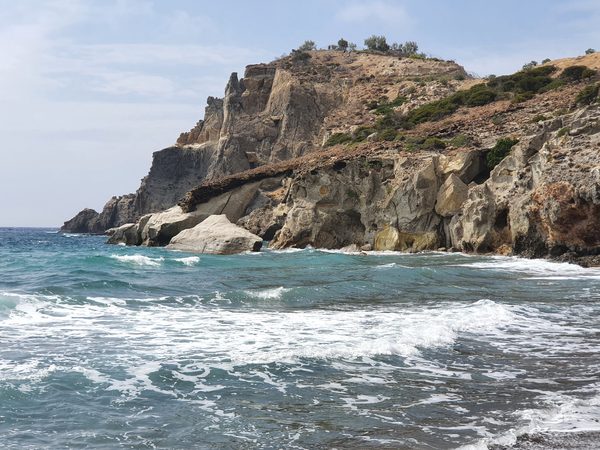
Milos is volcanic in a different register. Its geology went into minerals rather than a single catastrophic collapse, and the island has been mined for them since antiquity. The result is a coastline that changes colour every few kilometres: the white, wind-sculpted rock shelves of Sarakiniko that everyone photographs and calls lunar, rust-red cliffs further east, sulphur-yellow bluffs in the south, grey-green hills inland. There are fumaroles, thermal water seeping into the shallows, and dozens of sea caves along the shore. The western half has no roads worth the name, no villages and no infrastructure, just mountains rising to Profitis Ilias at 751 metres and a Natura 2000 designation. A huge natural bay bites into the island's middle, splitting east from west and doing a lot of the work in making Milos feel bigger than its 160 square kilometres.
The mining is not a blemish on the scenery. On Milos it is the scenery. Half the colours you will photograph exist because of what is in the rock.
Verdict: Santorini wins on a single overwhelming view. Milos wins on variety, and on the amount of landscape you can actually walk into and swim off. See the Sarakiniko beach guide for the most photographed piece of it.
Which Island Has the Better Beaches?
This one is not close. Milos wins, and it wins by a distance.
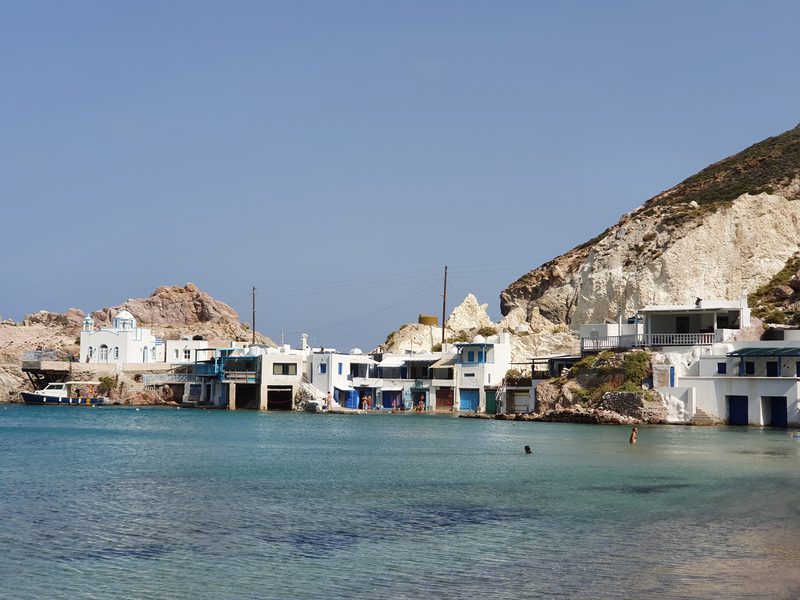
Swimming is the reason most people come to Milos, and the island rewards it out of all proportion to its size. Sarakiniko is white rock rather than sand, more a lunar swimming platform than a beach. Firiplaka and Tsigrado on the south coast sit under coloured cliffs. Paleochori sits over geothermal ground, and the sand at one end genuinely runs hot: Sirocco, the taverna there, still buries lobster, lamb and squid in it, cooking with the ground itself rather than a grill. Provatas is the family option. Firopotamos and Plathiena are small, sheltered and backed by fishing houses. And Kleftiko, the sea-cave bay on the uninhabited southwest coast, is only reachable by boat, which is why a boat trip round the island is close to compulsory rather than optional.
Santorini's beaches are the weak part of its offer. The volcanic sand and shingle at Kamari and Perissa run hot underfoot, the water shelves fast, and none of it is what you would travel for on its own. People who go to Santorini for a beach holiday tend to come back mildly disappointed. People who go for the caldera come back happy.
The one qualification on the Milos side is the wind. The meltemi blows from the north through much of the summer, and on a bad day the north-coast beaches are unusable. The island's saving grace is that you can simply drive across to the south coast and find flat water. That flexibility is worth more than any individual beach.
Verdict: Milos, comfortably. The full run-down is in the Milos beaches guide.
How Do the Crowds Compare?
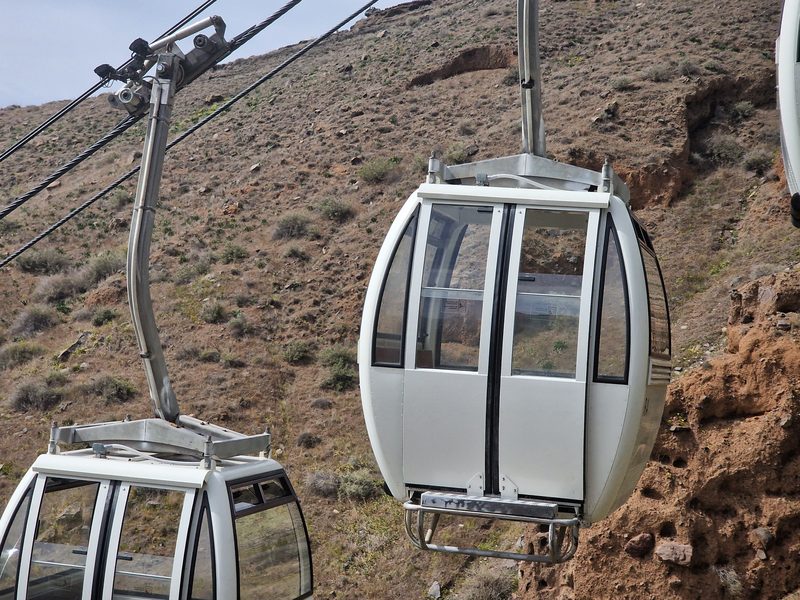
Santorini is one of the most visited islands in the Mediterranean, and the visitors are not spread evenly. They concentrate in Fira and Oia, on the caldera path between them, and in the hour either side of sunset. Cruise ships tender passengers ashore for the day, and coach parties work a fixed circuit of the same viewpoints. In late July and August the lanes in Oia move at the pace of the slowest person in them.
Milos has been getting steadily busier since its international profile went up in the 2010s, and anyone telling you it is undiscovered has not been in Adamas in mid-August. Sarakiniko in particular now has a proper crowd on it through peak season. But two things still separate the islands. Milos takes cruise ships in small numbers and small sizes, a couple of dozen calls a season on boutique vessels, where Santorini absorbs megaships daily, so there is no equivalent surge of several thousand day visitors. And the crowd that does arrive disperses across dozens of beaches and a big, empty western half rather than funnelling into two clifftop towns.
Late September is when Milos is at its best, with the sea still warm, the tavernas still open and the roads to the south coast almost empty. If you have flexibility, take that fortnight over anything in August.
Verdict: Milos, and the gap is wider than the visitor numbers alone suggest. Timing matters for both islands, so see when to visit Milos.
Which Island Is More Expensive? (2026)
Santorini prices at the top of the Greek market. The caldera-view rooms carry a premium that has nothing to do with the room and everything to do with the window, restaurants on the rim charge for the same view, and in peak season the whole island prices as though demand will never fall. So far, it has not.
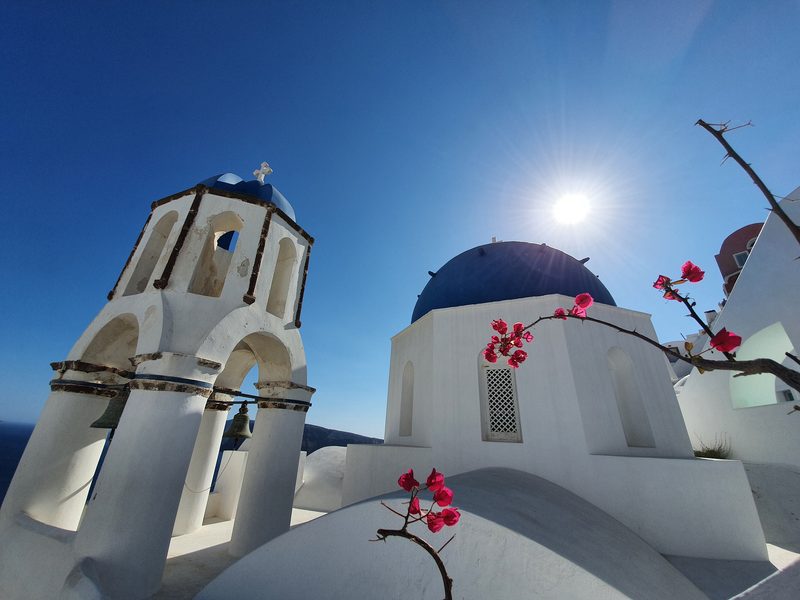
Milos is cheaper across the board, though it is not a budget island any more. The accommodation stock is mostly mid-market. Simple rooms and family-run guesthouses make up the bulk of it, and the boutique and villa end of the scale is small enough to count. Eating out is closer to normal Greek island prices than to Santorini's. Car and ATV hire, boat trips and ferries are the other main costs, and none of them carry a Santorini-style markup.
Some real numbers, at 2026 prices. A mid-range double in high season on Milos runs roughly 220 to 350 EUR a night, and a taverna main 18 to 28 EUR. On Santorini, a mid-range double away from the caldera runs a broadly similar 150 to 350 EUR, but the headline average is pulled well above that by caldera-view suite inventory; a taverna main off the rim is 14 to 25 EUR, while dinner for two at a caldera-view restaurant in Oia runs 130 to 220 EUR against roughly 55 to 85 EUR for the same meal away from the view. The gap between the islands, in other words, is less about the ordinary price of a room or a meal and more about how much extra Santorini charges for the view itself.
The gap narrows at the luxury end, because Milos has fewer high-end beds and the ones it has get bid up. Where Milos saves you real money is in the middle of the market.
Verdict: Milos, clearly. More detail in the guide to how expensive Milos is.
Which Is Better for a Romantic Trip?
This is the one where Santorini has a genuine claim, and it is worth being fair about it. A caldera-view terrace at sunset is a legitimately extraordinary thing, and if the trip is a honeymoon or a proposal and you want that single overwhelming image, Santorini delivers it and Milos does not.
What Santorini also delivers is company. You will be having that moment alongside several hundred other people having the same moment, with phones raised, and in Oia the sunset has taken on the character of a scheduled event.
Milos plays it quieter, and it has a long history of doing so. Among Greeks the island has been known for decades as a couples island, somewhere you go for a romantic week rather than a party one, and that reputation predates the international attention by a long way. The sunset equivalent is the Venetian kastro above Plaka: a short climb up through the old town to a chapel on a rock with the whole west of the island and the sea below it. Fewer people, no coaches, and a walk back down through lanes full of small tavernas.
I would take the Plaka kastro over the Oia sunset. It is a smaller view and a better evening.
Verdict: Santorini for the one-off, unrepeatable image. Milos for a week that feels romantic rather than a photograph that looks it. More on the capital in the Plaka guide.
Where Do You Eat Better?
Santorini has the more developed restaurant scene, with a serious fine-dining tier, plus something Milos cannot match: its own wine industry, grown on volcanic soil in low basket-trained vines, with cellar visits built into most itineraries.
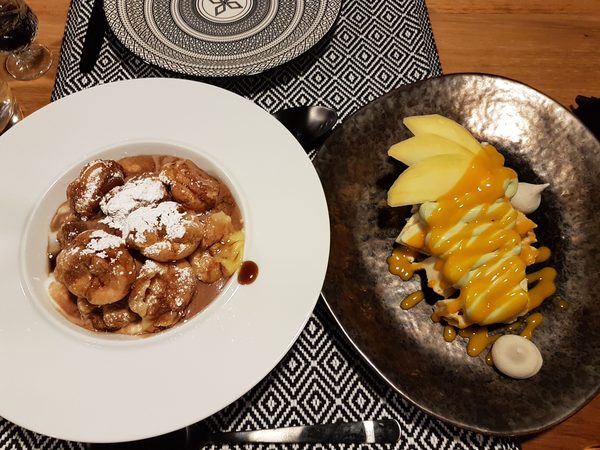
Milos eats simpler and, for my money, better value. The island runs on tavernas rather than restaurants: grilled fish in the fishing villages, slow-cooked meat and local cheese inland, menus kept short because the kitchen only makes what it makes well. Adamas, Plaka and Pollonia each have their own cluster of places worth crossing the island for.
The one place everyone will tell you to go is the taverna O Hamos, outside Adamas, which has been a fixture for years and was still trading and drawing queues in summer 2026. It remains walk-in only. There are no reservations, so arrive early or expect to wait.
Verdict: Santorini for a special dinner and for wine. Milos for eating well every night without thinking about the bill. Start with the Milos restaurants guide.
Which Island Is Easier to Get To?
Santorini, by a wide margin, and for some travellers this decides the whole question.
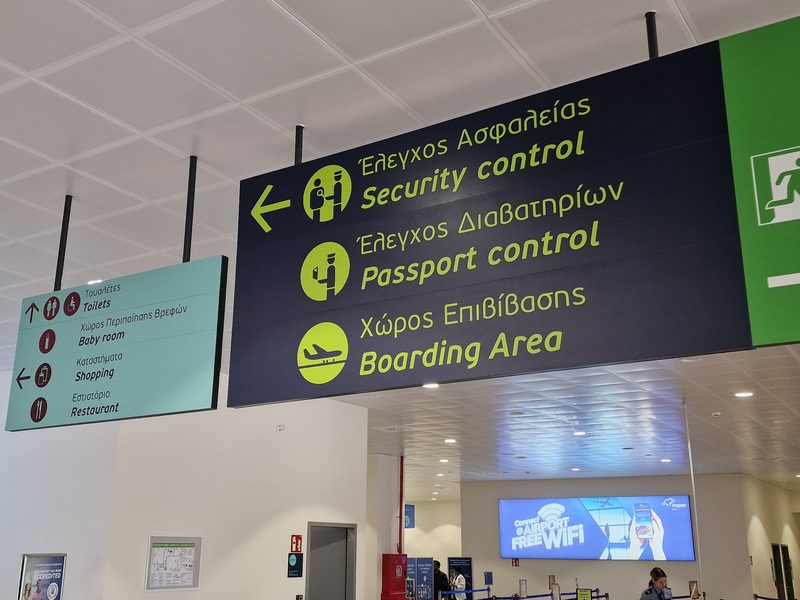
Santorini has an international airport taking direct seasonal flights from across Europe, so you can land there without touching Athens. It is also one of the best-connected ports in the Cyclades, served by both conventional ferries and high-speed catamarans on a dense network of routes.
Milos has a small domestic airport, which means international visitors connect through Athens. The main approach is by ferry from Piraeus: a conventional ferry takes roughly four to seven hours depending on the boat and the stops it makes, while the high-speed catamaran service cuts that to around two and a half hours. Milos also sits on the western Cyclades line, which links it to Sifnos, Serifos, Kythnos and Folegandros. Adamas is the main port, with Pollonia handling some smaller boats. Schedules, operators and fares change every season, so check live timetables close to your dates.
Verdict: Santorini, easily. If your holiday is a week long and you want minimum transit, that matters. Full options are in the how to get to Milos guide.
Can You Visit Both on One Trip?
Yes, and a lot of people should. The two islands are connected directly in season, with the crossing usually taking somewhere around two to three hours depending on the vessel, and it is one of the easier hops in the Cyclades.
The split I would suggest for a ten-day trip is roughly two-thirds Milos, one-third Santorini. The caldera towns, the sunset, a winery and the archaeological site at Akrotiri are Santorini's core attractions, and they can be covered properly in two or three days. Milos needs longer, because its appeal is cumulative: you need enough days to get to the south coast, take a boat to Kleftiko, walk Plaka, and still have beach days left over.
Do Santorini second if you want the trip to end on the big view, or first if you would rather finish somewhere calm. Details of the crossing are in the Milos to Santorini ferry guide.
What Are the Real Downsides of Each?
Milos.
- The wind. The meltemi is a genuine factor from roughly June to September, and it can flatten a beach day or cancel a boat trip to Kleftiko at short notice. Build slack into the plan.
- Fewer luxury beds. If you want a large five-star hotel with a spa, the choice is thin and gets booked far ahead.
- Quiet nights. Nightlife means tavernas, a handful of bars and not much after midnight. That is a feature for most visitors and a problem for a few.
- You need wheels. The bus network exists but is limited, and the best beaches are awkward to reach without a car or ATV. Some of the south-coast access roads are rough, and a couple of the descents (Tsigrado in particular) are properly steep.
- The west is off-limits to normal cars. The most dramatic half of the island needs a 4WD, an ATV or a boat.
Santorini.
- The crowds. Concentrated, unavoidable in peak months, and worst exactly where you want to be at exactly the hour you want to be there.
- The prices. The highest of any Cycladic island, and the premium is charged on everything near the rim.
- The coaches. Cruise-day traffic on a small road network, and viewpoints that fill and empty on a timetable.
- The beaches. Perfectly fine, not a reason to come.
- The steps. Caldera towns are built on a cliff, and getting to and from many hotels means a lot of stairs with luggage.
So Which One Should You Choose?
Choose Santorini if: it is your first trip to Greece and you want the image you have in your head; you are flying in from outside Greece and want a direct flight; the trip is a honeymoon and the view is the point; you care about wine; you have three or four days and no more.
Choose Milos if: you want to swim every day in a different place; you would rather have space than spectacle; you are travelling as a couple and want quiet over scene; you are watching what you spend; you like boats, walking and rough landscape; or you have been to Santorini already and want to see what else the volcanic Cyclades do.
For most people asking me the question, the answer is Milos, with the caveat that Santorini's caldera is a genuine one-off and worth seeing once in your life, ideally as a short second stop rather than the whole holiday. If you are still weighing it up, the is Milos worth visiting page makes the case at length, and the Milos travel guide covers the practical planning.
Milos and Santorini are both Cyclades islands, connected by a direct ferry that usually takes around two to three hours in season. Milos covers 160 square kilometres, has a domestic airport and dozens of beaches; Santorini has an international airport, far better connections and the caldera view. Milos is the cheaper island and the better one for swimming; Santorini is the more expensive, more crowded and more spectacular. If you can only pick one, pick Milos unless the caldera is the reason you are coming.
Planning the rest of your island time? Start with our complete Milos travel guide.
Heading to Santorini? See our guide to the best day trips from Santorini.
Heading to Athens? See our guide to the best day trips from Athens.
Last updated: 1 August 2026