Naxos and Milos sit on two different Cyclades ferry corridors, and the boat between them is the seam where those corridors meet. Some sailings run straight across, others hand you off at Paros, and outside high summer the link thins out fast. Getting this leg right is mostly about checking the calendar before you book the hotels.
In this guide
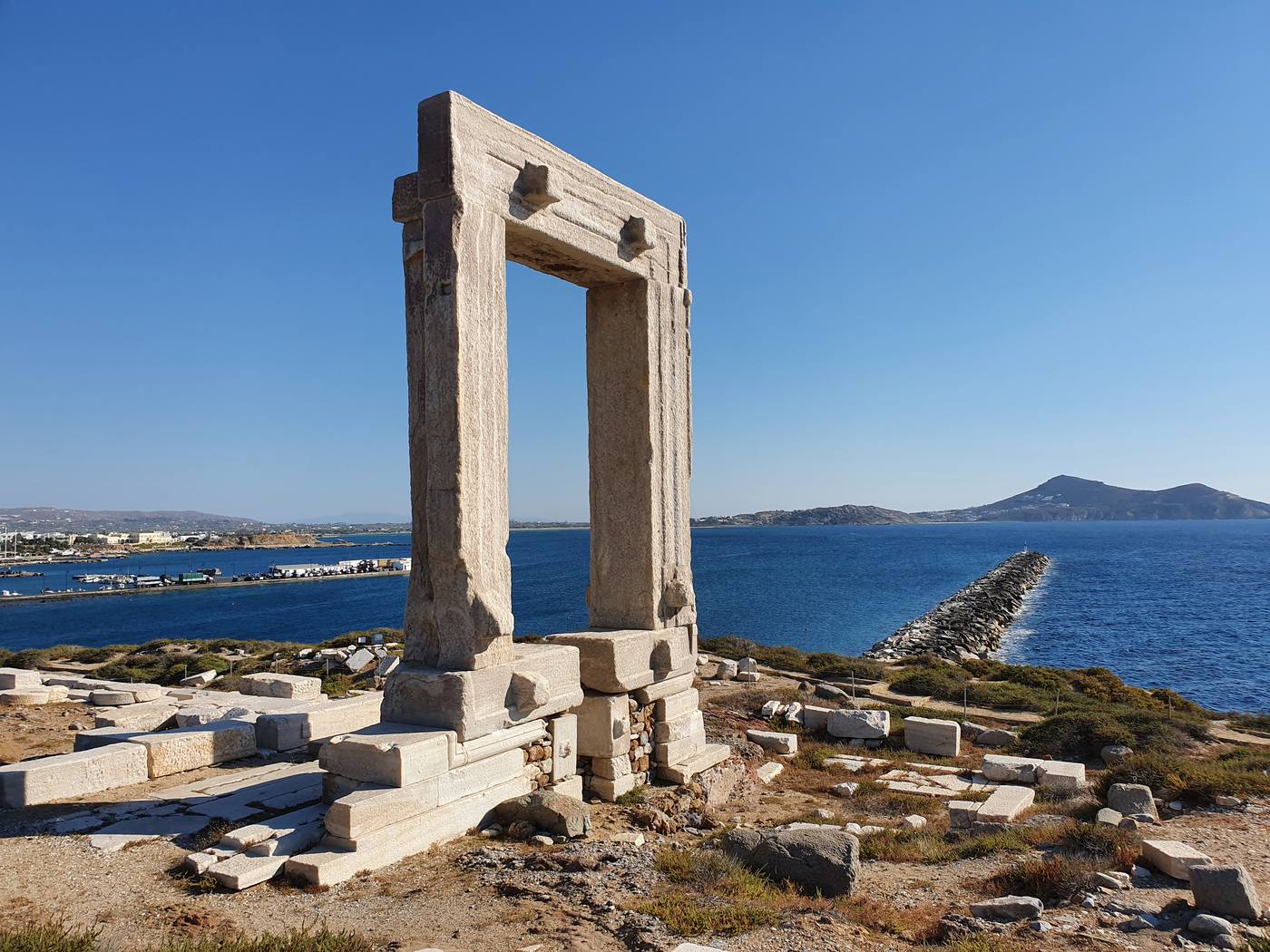
Naxos is the big one. It is the largest island in the Cyclades, with mountain villages, a farming interior and a food culture that has nothing to do with tourism. Milos is the volcanic one, a long hop west across the middle of the Cyclades, where the coastline does the work. They pair beautifully as a two-island trip. What they do not do is sit on the same ferry line.
Check current ferry schedules and book at Ferryscanner.
Naxos belongs to the busy central spine that runs Piraeus–Syros/Paros–Naxos–Ios–Santorini, and in high season that spine has boats on it all day. Milos belongs to the western Cyclades line, which loops out through Kythnos, Serifos, Sifnos and Folegandros. The two networks touch, but they touch at specific points and on specific days, which is why a crossing that looks trivial on a map can turn into an afternoon of route-hunting.
Every itinerary I have built around this corner of the Cyclades has ended up obeying the same rule: pick your Naxos-to-Milos date first, then build the rest of the trip around it.
Is There a Direct Boat, or Do You Change at Paros?
Both patterns exist, and which one you get depends on the season and the operator's routing that year.
The through-sailings are typically high-speed boats working a long chain that starts at one end of the Cyclades and finishes at the other, calling at several islands on the way. On those, Naxos to Milos is one hop on somebody else's much longer journey, so the departure time is whatever the chain dictates rather than whatever suits you.

The alternative is to go via Paros. Paros is a short hop west of Naxos with a heavy year-round service, and it has better westward connections than Naxos does. If the direct boat does not run on your date, Naxos–Paros–Milos is usually the fallback, either as a same-day connection with a wait at Parikia or as an overnight stop. The Paros to Milos ferry guide covers that second leg in detail.
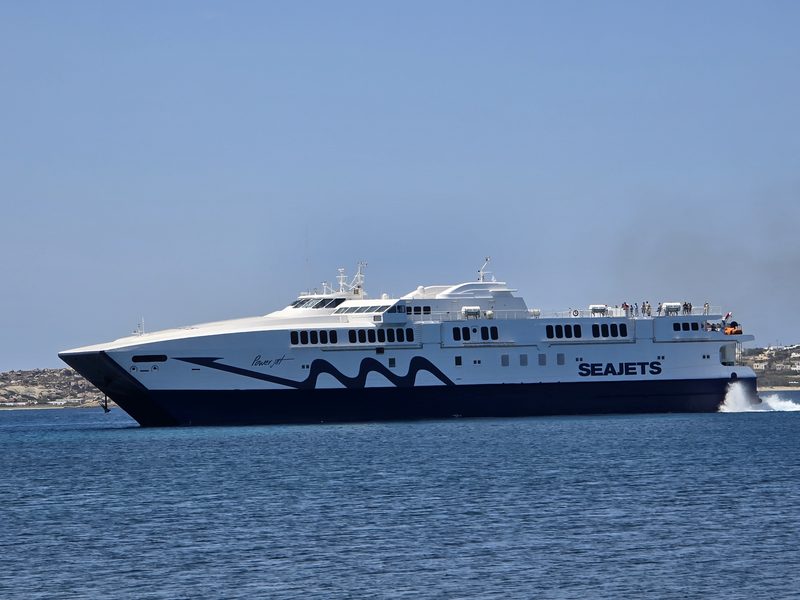
A direct Naxos–Milos sailing does exist, running year-round rather than as a summer-only extra, with Blue Star Ferries on the conventional side and Seajets running the high-speed option. Whether the via-Paros alternative can be booked as a single through-ticket, rather than two separate fares with a self-managed changeover, is not something I can confirm either way, so book it as two legs and treat any combined-ticket option you find as a bonus rather than an assumption.
Journey time. On the direct sailing, expect somewhere in the region of four hours on the Seajets high-speed service, stretching to six and a half or more on the Blue Star conventional ferry. Treat that as a wide planning bracket rather than a promise, since it depends heavily on how many calls the specific boat makes. A via-Paros connection adds the wait or overnight at Parikia on top of both legs, so it rarely beats the direct sailing on time even though it can be the more reliable fallback.
What Is the Port at Naxos Like to Use?
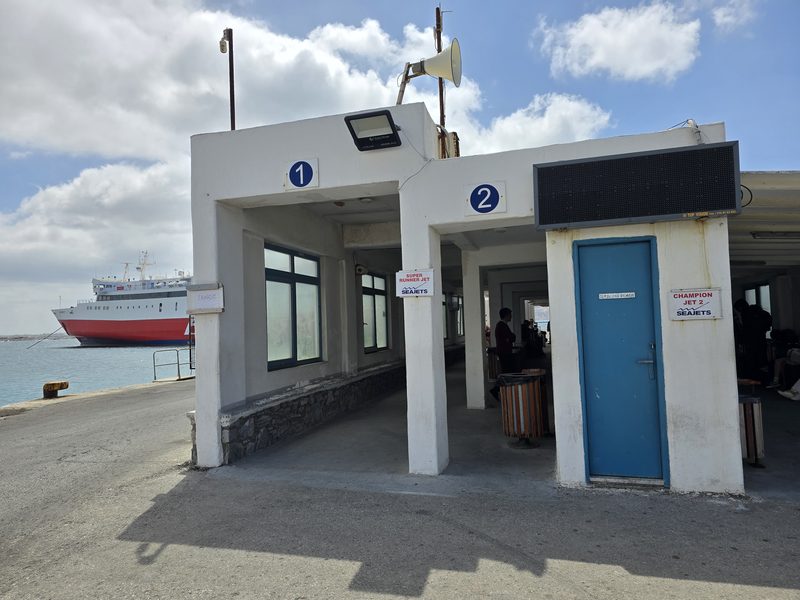
Easy, which is not something you can say about every Cycladic port. The ferry quay sits at the edge of Naxos Town, a few minutes on foot from the waterfront cafes and the old quarter climbing up behind them. If you are staying in town you can walk to your boat with a suitcase. If you are staying out at Plaka or Agios Prokopios, it is a short taxi or a bus in.
The one thing that catches people is scale. Naxos handles a lot of traffic in August, and several boats can be alongside or manoeuvring at once. Departure boards are not always obvious, so the reliable move is to find the operator's ground staff, the ones in branded jackets with a clipboard, and confirm your boat before you join a queue. Boarding tends to be brisk, because these boats are usually running to a tight turnaround.
At the Milos end, big ferries all dock at Adamas, the port town tucked deep inside the island's sheltered gulf. The Adamas guide covers what is there when you step off.
When Does This Link Get Thin?
This is the part that genuinely changes a trip.
July and August. The busiest period, the widest choice of sailings, and the one time you can be fairly relaxed about finding something on your preferred date. Book early anyway, because popular westbound sailings sell out, and Milos accommodation sells out sooner than the boats do.
June and September. Still workable, still my favourite time to be on either island, but the frequency drops and the options narrow. Build in a day of slack.
Shoulder and winter. The direct link itself runs year-round rather than vanishing outright, but it thins hard once the high-speed boats scale back and the conventional ferry is doing most of the work. If nothing useful turns up for your dates, the fallback is still Piraeus and out again on the western line, and that route has year-round service regardless of what the direct island-to-island link is doing.
The meltemi. The north wind that blows through the Cyclades in summer hits the smaller high-speed boats hardest. Big ferries mostly shrug it off; catamarans and the lighter jets are the ones that get cancelled or turned into a rough three hours. If you are prone to seasickness and the forecast is northerly, the larger vessel is worth the extra time.
Which Way Round Should You Do the Two Islands?
There is a decent argument for finishing on Milos. Naxos gives you villages, hiking and long lunches inland; Milos gives you a coastline you spend your days getting to by boat, quad or car. Ending on the coast tends to feel like the right shape for a holiday, and it also puts you on the western line for the run back to Piraeus.
Running it the other way works too, particularly if you are flying home from Athens and want the bigger island's easier connections at the end.
Two full days on each is the minimum that does not feel rushed. Three on Milos if you want the boat trip to the sea caves without gambling the whole visit on one weather window.
If you are still deciding which western-Cyclades island to add at all, the Milos or Paros comparison is the closest match to this decision, and the Milos island hopping guide sets out which onward connections actually exist from Adamas. For the full picture of every way onto the island, start with how to get to Milos.
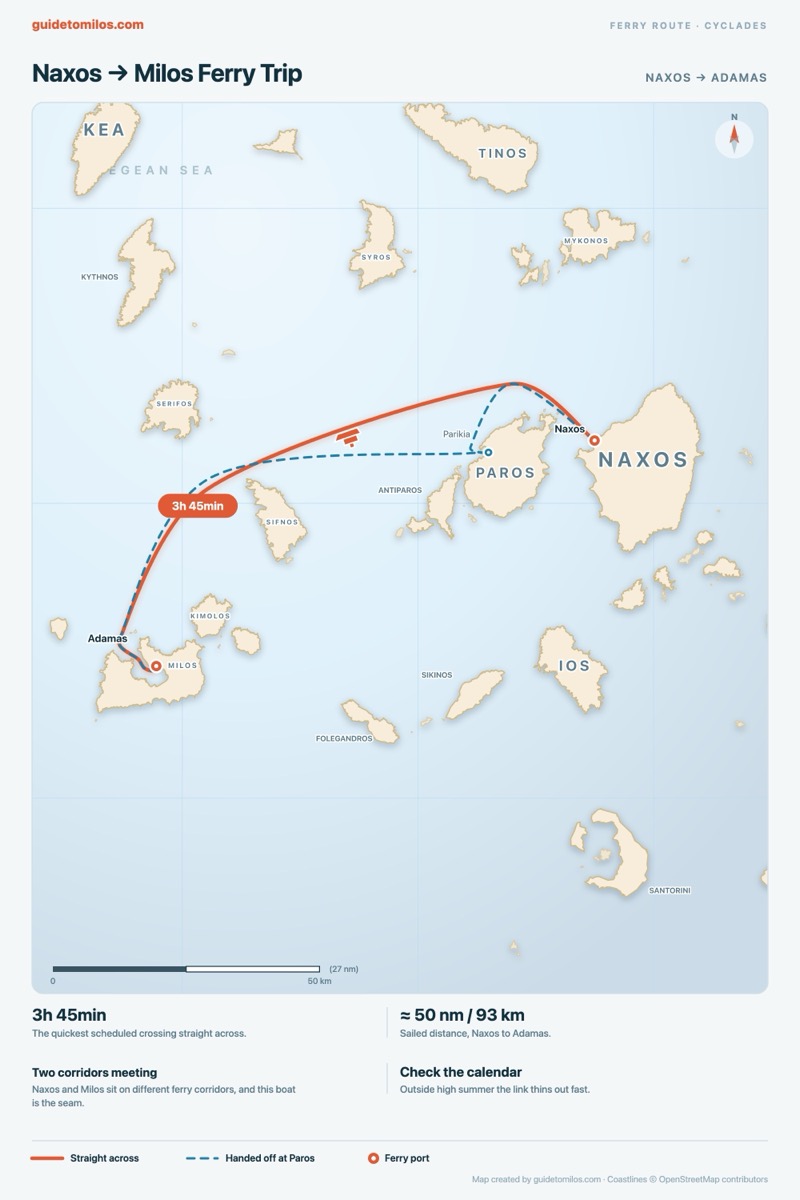
Naxos and Milos sit on different Cyclades ferry lines. A direct sailing runs year-round, roughly four hours on the fast boat and six and a half or more on the conventional ferry; Paros is the practical fallback when the direct link is thin, and Piraeus remains the year-round backstop. All large ferries arrive at Adamas.
Planning the rest of your island time? Start with our complete Milos travel guide.
Heading to Santorini? See our guide to the best day trips from Santorini.
Heading to Athens? See our guide to the best day trips from Athens.
Last updated: 7 September 2026