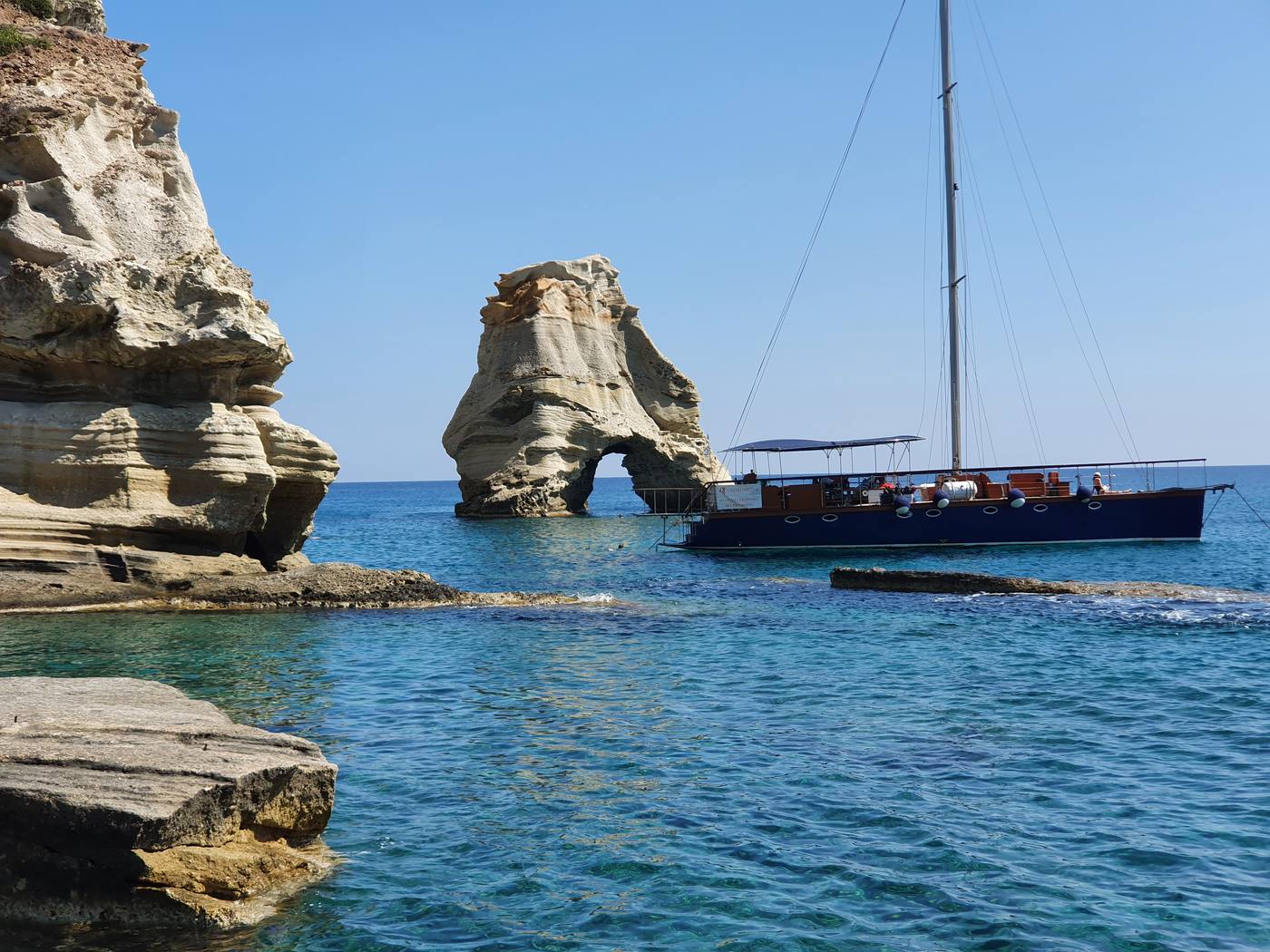
Milos has 125 km of Aegean coastline and some of its best stretches have no road to them at all. A boat tour is how you reach the white arches of Kleftiko, the sea caves and the uninhabited island of Polyaigos. The trips split into full-day sailings from Adamas, shorter cruises from the south coast, and self-drive rentals, and the wind decides which of them runs.
In this guide
Most visitors take one boat trip on Milos and spend the rest of the week on the road. That makes the choice matter more than it would elsewhere. Get it right and you see the half of the island that the hire car cannot reach; get it wrong and you spend six hours on a crowded deck for one swim.
Big motor boats, catamarans, small wooden caiques and licence-free rentals all work the same water and produce completely different days out. What follows is how to tell them apart.
If you are only doing one activity on Milos beyond driving to beaches, make it this one. I would put a Milos sailing trip ahead of the equivalent on almost any other Cycladic island, because the coastline earns it.
Which Route Should You Take?
Three broad itineraries operate, and the difference between them is mostly how far west and how far east the boat goes.
The full-day west-coast circuit (roughly a full day at sea)
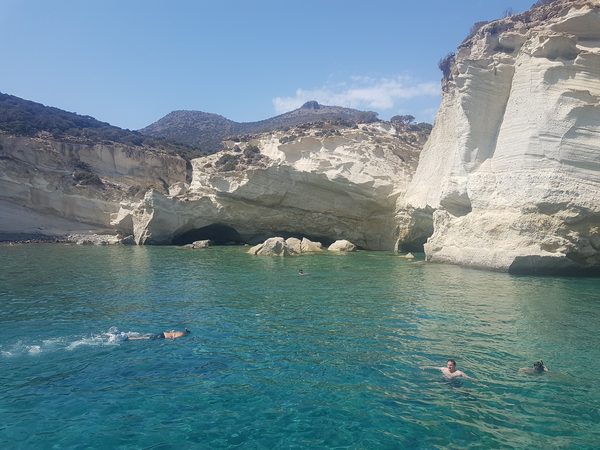
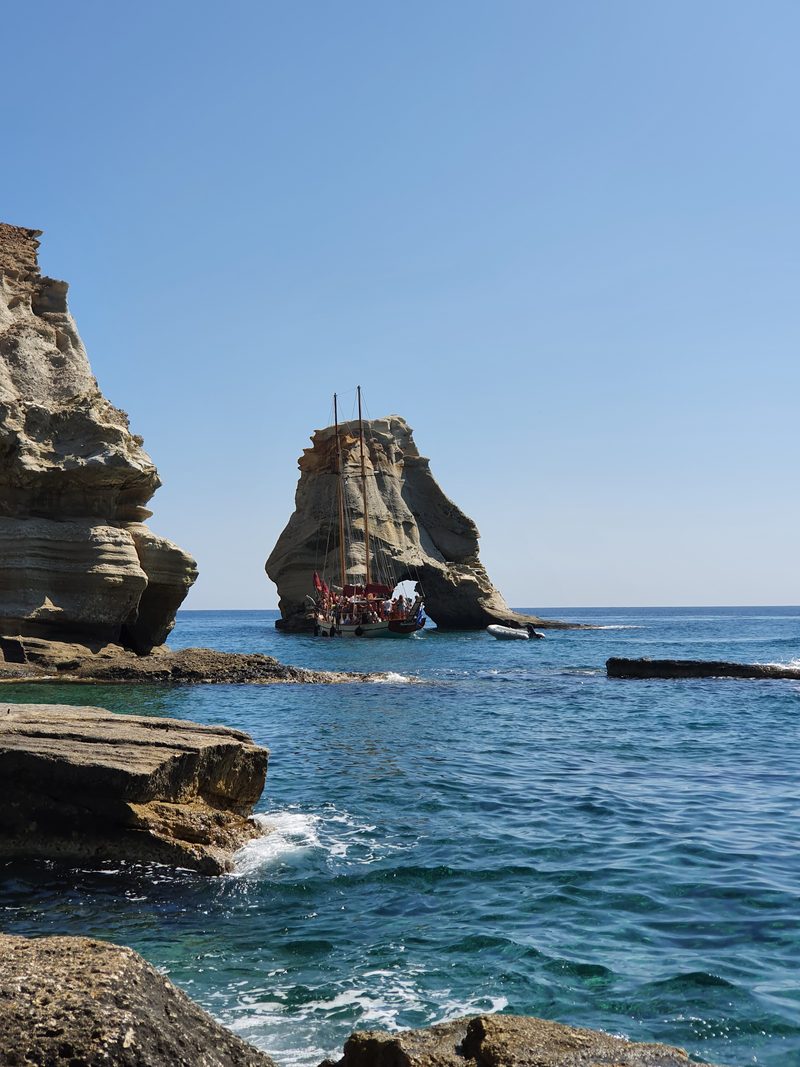
This is the classic Milos boat tour. Boats leave Adamas in the morning and work the south and west coast: Kleftiko with its white rock stacks and caves, the Sikia cave, Gerontas with its arch, and rocky islets including Glaronisia and Arkoudes. Lunch is served on board and there are several swim stops.
The order is not fixed. Skippers set the route by the morning's wind, so two boats leaving the same quay can sail in opposite directions. Do not book expecting a guaranteed sequence of stops.
Polyaigos and Kimolos (full day)
Some full-day sailings head east instead, to the uninhabited island of Polyaigos, often with a short stop at Kimolos. The water out there is the emptiest you will swim in on this trip, and for good reason: Polyaigos is the largest uninhabited island in the Aegean, a status confirmed when the Greek Ministry of Culture declared the whole island an archaeological site in 2025. Several itineraries combine both directions, taking in Kleftiko and Polyaigos in one long day.
If Kimolos itself is what interests you, do not use a cruise stop to see it. An hour ashore is not a visit. Take the Milos to Kimolos day trip on the local ferry instead and give the island a proper day.
Short cruises and sunset trips (half day or a few hours)
Kipos, on the south coast, is where the Delfinia leave from. These small boats run cruises built around two stops, Gerontas and Kleftiko, and not a great deal besides. Agia Kyriaki has the Armi, a wooden boat that has been crossing daily to Kleftiko. Shortest of the lot are the sunset sailings out of Adamas: a couple of hours, one swim stop if any, and the light doing the work.
Short trips suit people who get seasick, families with small children, and anyone who has already lost a day to the wind and needs to fit Kleftiko into what remains of the week. The cost is the long middle stretch of coast, which stays unseen unless you are on a boat that sails the whole way.
What Kind of Boat Should You Choose?
The vessel shapes the day more than the itinerary does.
Large motor boats carry the most people, move fastest between stops and cost the least per head. They usually have proper shade, a toilet worth using and a galley producing a hot lunch. The downside is obvious: you swim when fifty other people swim, and the boat leaves each cove on a schedule.
Catamarans are the comfortable middle. Two hulls means far less roll, which matters when the sea is anything other than flat, and the trampolines at the bow are the best seats on any boat in Milos. Groups are smaller, lunch tends to be better, and the price reflects both.
Small traditional caiques, such as the Delfinia boats, carry a handful of passengers and get into inlets the big boats cannot. They also have the least shade, the most movement in a swell and the shortest range.
Private and skippered charters put you in control of the route and the timing, which is worth a lot at Kleftiko in August. Split between six or eight people the cost per head stops looking absurd; for couples it rarely adds up.
Shade is the thing people underestimate. Six hours on open water in July with nowhere to sit out of the sun is a different experience from the photographs, and no amount of sunscreen fixes it. Ask what the shaded seating actually looks like before you pay.
What Does a Day on Board Include?
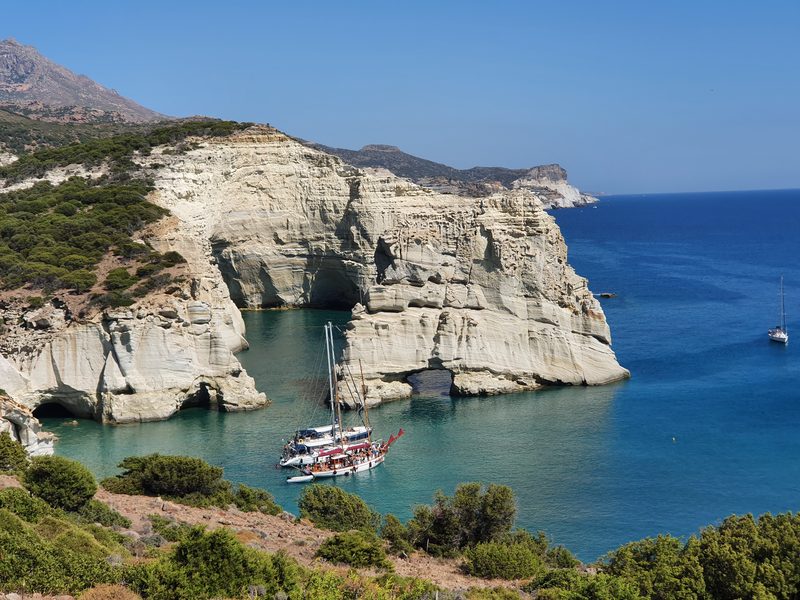
A full-day trip follows much the same rhythm whoever runs it: boarding at Adamas mid-morning, a long run down the coast with commentary on the rock formations and the old mining sites, three or four swim stops, lunch on board somewhere in the middle, and back into port late afternoon.
Most full-day operators include lunch and drinks in the fare. Snorkelling gear is where boats differ, so check whether masks come with the boat rather than assuming.
Swim stops are the point of the day and shorter than you want. There is no landing at Kleftiko. It is an in-off-the-side stop, and the Kleftiko guide covers what that is like in detail. Cave entries depend on the sea state. A swell that looks mild from the deck is enough for a skipper to decide against taking anyone inside, and that call is not negotiable.
Prices vary by boat, season and what is included, and most operators quote on request rather than publish a rate card, so treat any figure you find online as a starting point rather than a fixed price. Ask directly when you book. Confirm whether lunch, drinks and snorkel gear are actually included before you compare two boats on cost alone.
When Do Boat Tours Get Cancelled?
Wind, and more often than you would think.
The meltemi is the north wind that blows through the Cyclades in July and August, and it is why sailings get called off on mornings that look perfect from the harbour. Adamas sits in a deep sheltered bay, so what the harbour feels at breakfast is often no guide at all to conditions around the western capes. The skipper reads the forecast at first light and makes the call; there is no arguing it, and you would not want to.
The bay at Kleftiko lies in the lee of that north wind, so it stays swimmable on days when the north coast is written off entirely. Wind from the south is what ruins it: the water goes cloudy, the clarity that makes the swim worth the sail disappears, and the sailings stop.
This is the single most important planning point on the page: book your boat trip for early in your stay. If the wind takes your sailing on the last day of the holiday, the holiday ends without the trip. Plan it for day two of seven and you have five days of margin. Ask when you book what happens if the day is blown out. The answer varies by operator, and none of them can produce a calm morning to fit your departure date.
When the boats are off, the island is not. Wind days are for the sheltered Milos beaches on the opposite coast to whatever is blowing, or the villages inland.
Should You Book Online or on the Adamas Waterfront?
Both work, at different times of year.
In July and August, book online before you arrive. The good boats fill up, and turning up at the quay hoping for a place on a catamaran in the first week of August is optimistic. Booking ahead also lets you compare inclusions properly rather than under pressure at a kiosk.
In June, September and the shoulder weeks, the waterfront is fine and often better. The agencies and kiosks along Adamas port let you see what you are getting, ask about group size and get a straight answer on the day's conditions. You can also wait for a good forecast rather than committing to a date weeks out.
The same handful of boat names keeps surfacing on the Adamas kiosk boards: Kapetan Giagkos, Zefiros, Thalassitra and Chrysovalandou, with the Delfinia at Kipos and the Armi at Agia Kyriaki filling out the shorter end. All six were still trading as of 2026. Chrysovalandou runs sailing catamarans, Thalassitra is a traditional wooden replica sailboat, Kapetan Giagkos and Zefiros are large motor boats, and Delfinia and Armi are smaller traditional motor boats. Treat that as a list to compare against, not a shortlist to book from. Names come and go most years.
Can You Rent a Boat and Skipper It Yourself?
Yes, and on Milos it is a genuinely good alternative rather than a novelty. Small motor boats are available for hire by the day from Adamas and Pollonia, some requiring a licence and some not, depending on the engine size.
The appeal is control: you stop where you like, stay as long as you like, and reach coves the tour boats skip entirely. It is the best way to see the remote beaches that neither road nor cruise itinerary serves.
The limits are real. A small open boat has no business attempting the run to Kleftiko or Polyaigos in anything but flat calm. Those are long exposed passages, and the Milos–Kimolos strait has shallow spots that catch out people who do not know the water. Stick to the sheltered bays near where you launched, watch the forecast yourself rather than assuming someone will stop you, and get back before the afternoon wind builds. To be under the arches at Kleftiko, take a tour.
In Greece, boats with engines up to 30hp can be driven without any licence at all, though the driver must be 18 or over; anything more powerful needs a recognised powerboat licence. Rental prices, and fuel and deposit arrangements, vary by operator and boat size, so get the full breakdown before you commit rather than assuming a headline daily rate covers everything.
Which Trip Is Right for You?
First visit, one day to spare: the full-day Adamas circuit taking in Kleftiko. It covers coastline you cannot otherwise see and gives you the island's headline sight.
Prone to seasickness: a catamaran over a motor boat, a short cruise over a full day, a seat at the back rather than the bow.
With young children: a half-day trip from Kipos or a sunset sailing. Six hours afloat with one long swim stop tests small children hard.
Returning visitor: Polyaigos, a self-drive rental, or the same coast at a slower pace with sea kayaking and diving.
Photographers: morning light on the white rock at Kleftiko, and a boat small enough to hold position. No operator runs a dedicated photography sailing as a standing product, so if timing matters more than company, a private or skippered charter gives you control over when you leave.
A Milos boat tour is the only way to swim at Kleftiko and the only practical way to reach Polyaigos, in the western Cyclades of Greece. Full-day sailings leave Adamas, shorter cruises run from Kipos and Agia Kyriaki. Catamarans roll less and carry fewer people than the large motor boats; self-drive rentals suit sheltered bays, not the west coast. Wind cancels trips regularly, so book yours for early in your stay and keep days in hand.
Planning the rest of your island time? Start with our complete Milos travel guide.
Last updated: 31 July 2026