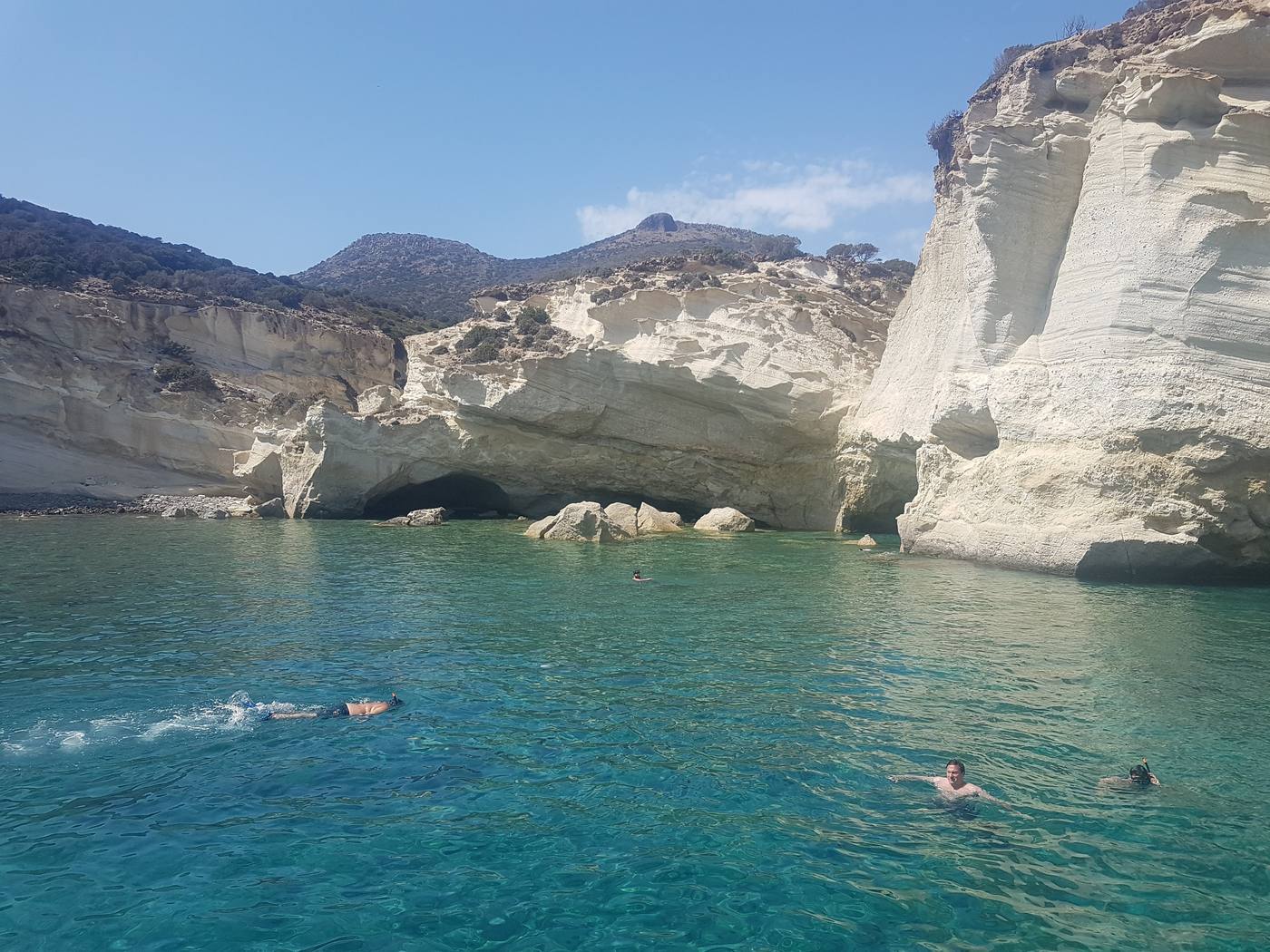
A good share of the Milos shoreline, on the western edge of the Aegean's Cyclades, has no road, no path and no name on the map, and sea kayaking, scuba diving and snorkelling are the three ways to reach it under your own power. This guide covers what each one involves, who it suits, and how the wind decides your day.
In this guide
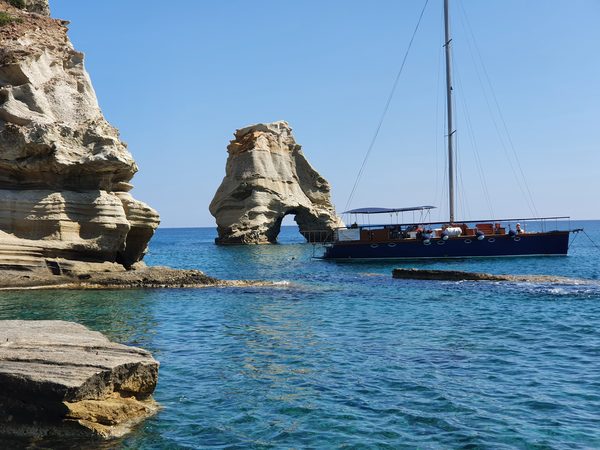
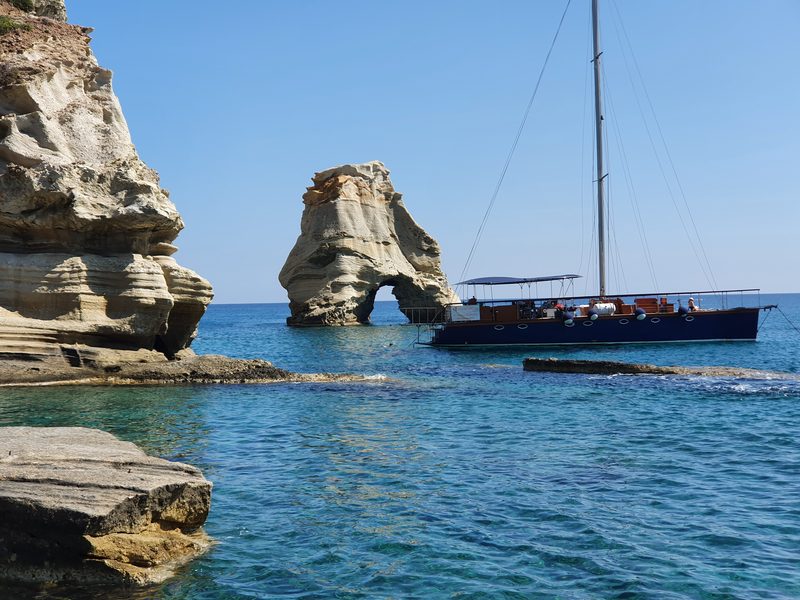
Volcanic rock does interesting things when the sea gets at it for a few thousand years. The Milos coast is a run of arches, half-collapsed caves, tunnels you can float through and cliffs dropping straight into deep water, and none of it photographs the way it feels at sea level with the rock overhanging your head. Boats reach the famous parts of it in numbers, which is a separate subject covered in the Milos boat tours guide. What a kayak, a mask or a tank buys you is the quieter version: the small bays between the landmarks, where nothing is scheduled to arrive. The things to do in Milos guide sets these three against everything else on the island.
Both of my longer stays on Milos ended up organised around the water rather than the road, and the days I remember are the ones where I was in it rather than looking at it.
Why Is the Milos Coastline Built for Sea Kayaking?
Two reasons. The scale is right, since the island is compact enough that one paddling day covers a real stretch of coast rather than a token loop of one bay, with a beach always within reach for lunch.
And the rock rewards small craft. A kayak sits low, draws almost nothing and turns in its own length, so it goes where a tour boat physically cannot: into sea caves, under arches, through gaps between stacks, along the base of cliffs streaked white, rust-red and sulphur-yellow from the island's mining geology.
The south-west coast, the side with the formations around Kleftiko, is the headline paddle and the longest day. The north coast around Firopotamos, Mandrakia and Sarakiniko is shorter and gentler, with more villages and swim stops. Which you get is a wind decision made that morning, not a preference you book weeks ahead.
What Is a Guided Kayak Day Like?
Almost all sea kayaking on Milos is sold as a guided day trip rather than a bare rental, and for open coastline that is the right way round. A typical outing runs most of a day, usually with a briefing, kit and food included, starting from whichever coast the forecast favours. Confirm the details when you book.
You do not need paddling experience. You do need to swim, be comfortable in open water, and be ready for a few hours of sustained low-grade effort in the sun. It is not hard in the way a hike up to the castle is hard, but it is continuous, and people underestimate the glare off the water. Long sleeves beat sunscreen. Half-day and multi-day options exist on and off depending on who is operating in a given season.
Booking platforms typically list a full guided day at somewhere around 65 to 70 EUR per person, though that is booking-platform pricing rather than a fixed rate card, and it moves with the season. Confirm the current price and what is included when you book rather than trusting a figure printed months ago.
What About Scuba Diving in Milos?
Diving here is about topography rather than colour. Greek water is clear, often startlingly so, but it is not a coral sea, and nobody should arrive expecting the fish life of the Red Sea. What Milos has instead is structure: caverns and swim-throughs in the volcanic rock, walls falling away into deep blue, boulder fields, and the outside chance of a monk seal. There is also a modern wreck off the north coast near Sarakiniko, the single most-requested dive on the island; the Sarakiniko beach guide tells that story properly.
Dive centres are based near the harbours and run the usual spread: try-dives for beginners, guided fun dives, full PADI courses, and snorkelling trips for people who want the sites without the tanks. Two PADI-affiliated centres were operating as of 2026: Dive in Milos, a few minutes from Adamas port, and Milos Scubaholics, based in Pollonia. At 2026 prices, a single guided dive runs roughly 55 to 75 EUR, a two-dive day 95 to 130 EUR, a try-dive 85 to 110 EUR, and a full PADI Open Water course 450 to 580 EUR. Treat these as indicative bands rather than a fixed rate card, and confirm with the centre directly.
My one line for a new diver choosing an island: pick Milos for the rock, not the reef.
Where Is the Best Snorkelling in Milos?
Snorkelling costs nothing beyond a mask and is the most underrated activity on the island. Three shore spots stand out.
Firopotamos. A small sheltered north-coast bay, clear shallow water, rock on both sides and an easy scale, all of which makes it good for a first go and good with children. Details on the Firopotamos beach page.
Sarakiniko. The white lunar rock continues underwater, which makes the visibility feel unreal. It is also the busiest place on the island in season, so go early or late rather than at noon.
Agios Konstantinos. Quieter, on the north-coast walking route. The rocky shoreline suggests good underwater terrain, though I have not snorkelled it myself.
Most of the rocky north-coast inlets reward a mask; the sandy south-coast beaches are better for swimming than for looking. Fuller run-through on the Milos beaches guide.
Mask, snorkel and fin rental is generally available at both Adamas and Pollonia through the dive centres and watersports outfits based there, typically for somewhere in the region of 8 to 15 EUR a day. It is worth checking a shop has your size in stock before you commit to relying on it in peak weeks.
Can You Paddleboard or Windsurf?
Yes, in the sheltered spots. Stand-up paddleboarding works well in the calm bays and on the long shallow beaches inside the bay of Milos, and there is plenty of wind for windsurfing when the meltemi is up. Kit appears seasonally on the larger organised beaches rather than through a year-round shop, and which specific beach has it in a given year is not something worth pinning down in print. A paddleboard is a bay toy, not a coastal craft, so do not take one round a headland.
How Much Does It Cost? (2026)
Prices for all three move with the season and with fuel, and the operator list changes between years, so check current rates rather than trusting a figure printed months ago. As a rough shape at 2026 prices: a guided kayak day trip runs around 65 to 70 EUR, a two-dive day 95 to 130 EUR, a try-dive 85 to 110 EUR, and a boat-based snorkelling trip is usually priced as part of a wider boat tour rather than sold on its own. See the boat tours guide for that end of it.
How Does the Wind Change Your Plans?
This is the part that catches people. The meltemi blows from the north through July and August, sometimes for days at a stretch, and on those days the north coast is unusable for small craft and the guided trips move south. When the wind swings round, the reverse happens. That flexibility is most of what you are paying a guide for: somebody else reads the forecast and reshuffles the day.
Two consequences. Put the paddle or the dive in the first half of the trip, so a blown-out day still leaves room to try again. And if a guide cancels, they are right and you are not. The currents around the headlands are stronger than the surface suggests, and this is not a coast to freelance on.
When Is the Best Time of Year?
June. My preference. The sea has warmed enough to be pleasant, the meltemi has not properly set in, and the boats are not yet at full volume.
July and August. Warmest water, longest days, most operators running, and also the windiest, busiest and most expensive weeks of the year.
September. The sea still carries all its summer warmth, crowds thin through the month, the light is better. Trip frequency drops towards the end.
Late October to April. Assume nothing is running. Snorkelling is possible if you own a wetsuit and do not mind the water being cold.
Who Is Each Activity For?
- Sea kayaking. Reasonably fit adults and older children who want a full day and do not mind working for it. The best choice if you want the coast to yourself.
- Scuba diving. Certified divers who like rock structure, plus beginners willing to give half a day to a try-dive.
- Snorkelling. Everyone. No booking, almost no cost.
- Want the famous sea caves with no effort at all? That is a boat day, not a paddle day.
Pair any of them with a day on land: the hiking routes cover the same coastline from above.
Guided sea kayak day trips on Milos run most of the day and need no previous paddling experience. Diving in this corner of Greece is about volcanic caverns, walls and a wreck rather than reef life. The best shore snorkelling is at Firopotamos, Sarakiniko and Agios Konstantinos. In July and August the meltemi decides which coast you paddle, so book early in your stay.
Planning the rest of your island time? Start with our complete Milos travel guide.
Last updated: 1 August 2026