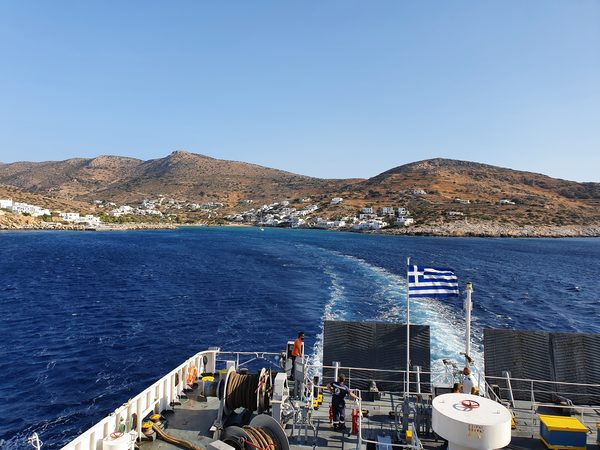
The Milos to Serifos ferry is not really a route of its own. Serifos and Kythnos are scheduled calls on the conventional boats running between Milos and Piraeus, so reaching either island means choosing a sailing that already stops there. The crossings themselves are short. The planning is all in the timetable.
In this guide
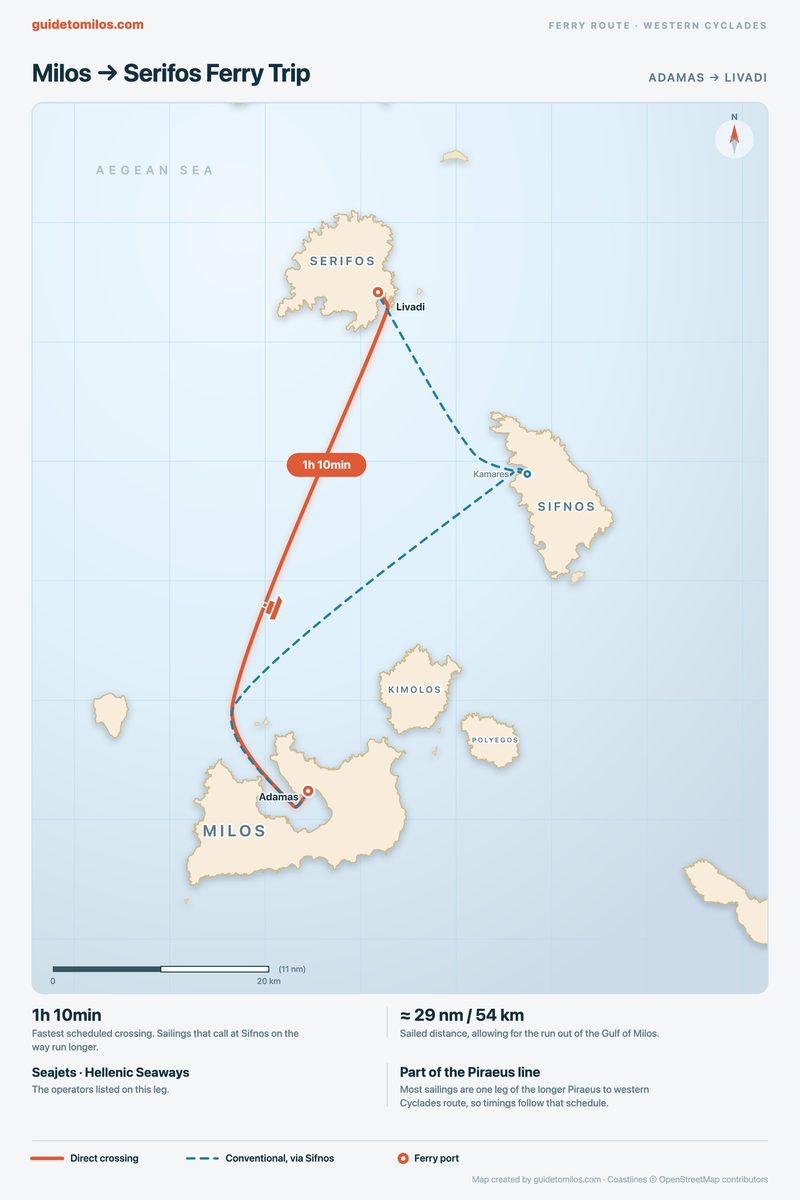
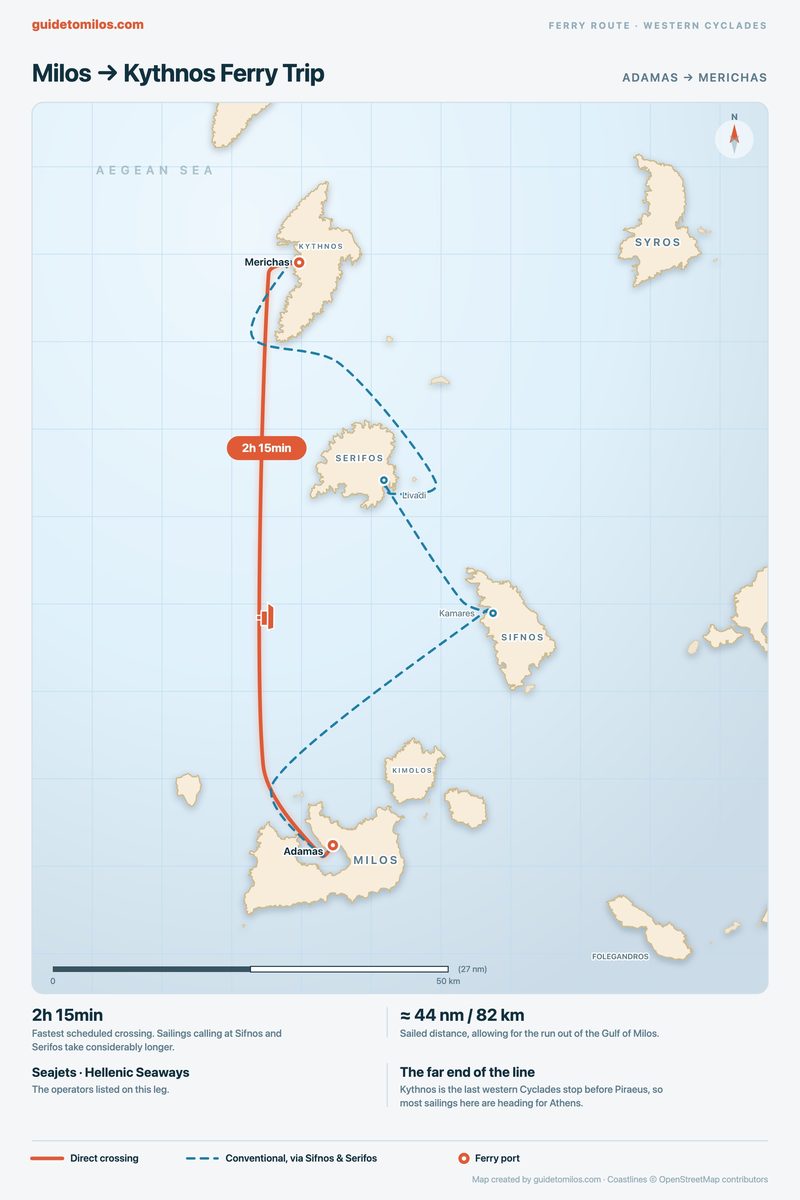
Put Milos at the bottom of a map of Greece and Piraeus at the top, and Sifnos, Serifos and Kythnos sit roughly between them, in that order. A conventional ferry heading north out of Adamas works up that chain, dropping passengers at each port before finishing at the mainland. Nobody sells you a Milos to Kythnos crossing as a product; you are buying a leg of a longer sailing and getting off early.
Check ferry availability and grab your tickets at Ferryscanner.
Sifnos, the busiest of the three stops, has its own Milos to Sifnos ferry guide. Serifos and Kythnos lie beyond it and see a fraction of the traffic.
What Does It Mean That These Are Line Stops?
It means frequency is not yours to choose. A route with its own boat runs several times a day in season; a line stop runs when the through-sailing happens to call, which on this stretch can mean once a day, every other day, or a gap of three days in shoulder season.
The two islands are not equally served, either. Serifos generally gets more calls than Kythnos, which sits close enough to Piraeus that some sailings run straight past it to the mainland. Expect a reasonable chance of a Serifos call on a given conventional departure from Milos, and treat a Kythnos call as something to verify rather than assume.
Blue Star Ferries, Seajets and Aegean Sea Lines are the names to look for on this stretch. Serifos is confirmed as the better-served of the two: it sits on the main stopping pattern most Piraeus–Milos sailings already use, while Kythnos gets fewer, more limited calls. Crossing times run roughly one to three hours for Milos–Serifos depending on vessel and stops, and in a similar few-hour band for Milos–Kythnos when a direct link is running. That direct Kythnos link itself is a summer fixture rather than a year-round one; outside the warmer months, reaching Kythnos from Milos more often means connecting via Piraeus or another island.
The high-speed boats are a separate question. Some work the same chain of ports; others run to Piraeus with one intermediate call or none, because speed is what people are paying for. Read the individual sailing, not the operator's reputation.
Because a call can be added or dropped between seasons, check the specific sailing you want rather than trusting any list of stops, including this one.
One more scheduling point, covered properly in the Athens to Milos ferry guide: the conventional operators publish their summer programmes much later than the fast-boat companies, so an early booking attempt shows a thinner network than actually exists.
I would not commit to a two-night stop on either island until I could see both the outbound and the return sailing in the same timetable. Getting there is rarely the problem on this line. Getting off again on the day you wanted is.
What Makes Serifos Worth Getting Off For?
The port is Livadi, in a deep bay on the south coast with a sandy beach along it and enough tavernas and rooms to work as a base in its own right. What people come for is the view straight up from the quayside: the Chora climbs a bare rock above the bay in tiers of white houses, thinning towards a ruined Venetian kastro at the summit.
Serifos is a mining island, like Milos, and it wears it: scoured, treeless, mineral, with old iron workings and loading gear still standing at the coast. If you like the stripped-back parts of Milos, the ones that look more like a quarry than a postcard, Serifos is familiar territory rather than a change of scene.
You reach the Chora by bus, by taxi from the quay, or on foot up an old stepped path that takes a serious half hour in the heat. The bus is generally timed around ferry arrivals and departures, so a fresh landing should not mean a long wait at the stop by the quay.
Compared with Sifnos next door, Serifos is quieter, cheaper and considerably less interested in food tourism. That is either the appeal or the drawback, depending on why you came.
And What Is Kythnos Like?
Kythnos is the last of the group before the mainland, and the closest of the three to Attica. That proximity shapes it: the visitor mix leans Greek, weekends are busier than weekdays, and the island has never picked up the international profile of its neighbours further south.
The ferry port is Merichas, a working harbour on the west coast that most people leave fairly quickly. Both things worth building a stop around are elsewhere. Dryopida is a tiled-roof village in a valley, more like a mainland settlement than a Cycladic one. Loutra, on the north east coast, has hot springs running down to the shore and mixing with the sea, with a bath house as well as the free outdoor version at the beach.
The arrangement is a settled one: a paid hydrotherapy centre at the Agioi Anargyroi spring for the formal bath-house experience, and a separate free natural hot spring a short walk along the shore, where the hot water mixes with the sea with no facility needed.
Kythnos is low-key to the point of unremarkable if you arrive expecting drama. There is no equivalent of the Serifos Chora silhouette or the Milos coastline. What it has is quiet, thermal water, and beaches that are empty midweek.
Who Gets Off Here, and Who Should Sail Straight Past?
Worth stopping if: you collect islands slowly, you have three weeks rather than ten days, or you want a low-traffic Cycladic island where nothing much is arranged for you. Both also break a long final crossing back to Athens into two shorter ones.
Not worth stopping if: this is a first Greek islands trip, or Milos is the point of it. A stop costs you a day at each end in logistics, and neither island out-performs what you already have on Milos. The wider trade-offs are in the Milos island hopping guide.
What catches people out is the day in transit. Breaking the journey to see an island for six hours sounds efficient, and on this line it usually is not, because the next onward sailing is frequently not the same day.
How Does a Stop Fit Into a Milos Trip?
Sailings for both islands leave from Adamas, and you are simply buying a ticket to an earlier stop on the mainland run. Travel on foot; the case against ferrying a hire car between islands is made in the how to get to Milos guide.
If you are still working out the shape of the trip, the how to get to Milos guide covers the full set of approaches by air and sea, and is a better starting point than a single line stop.
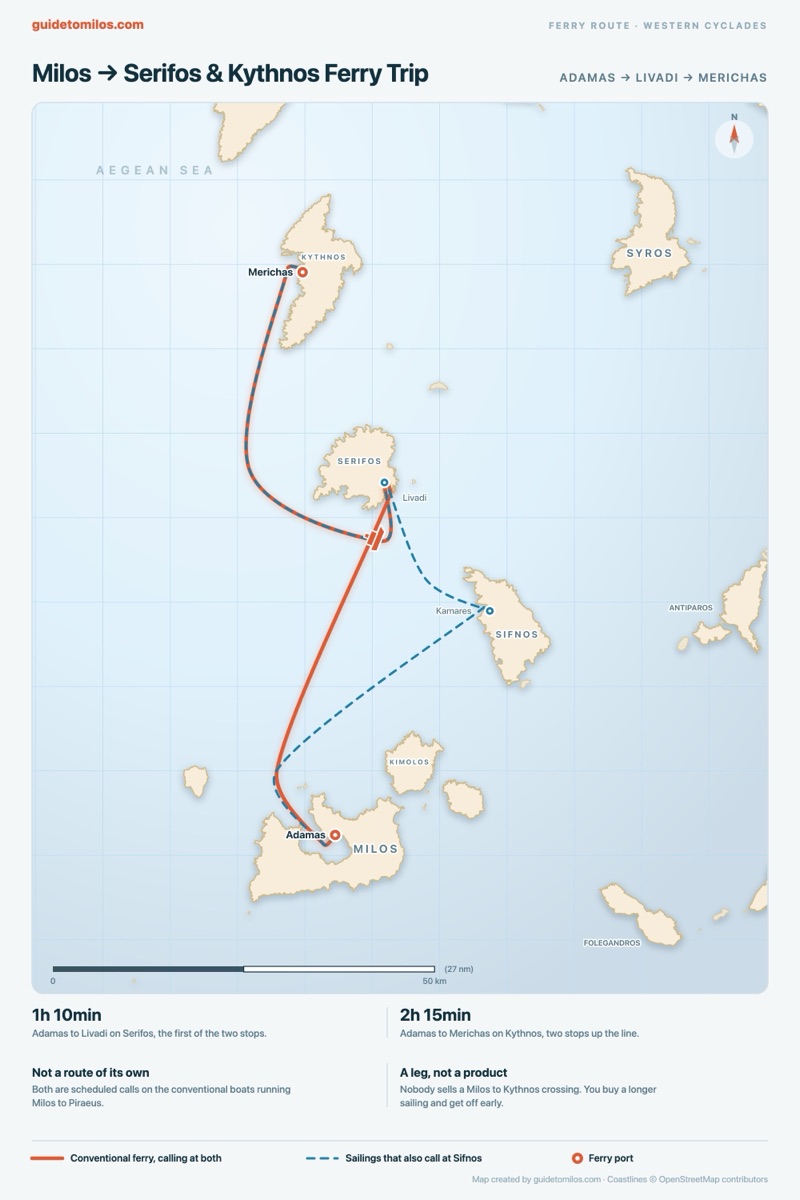
Serifos and Kythnos are scheduled calls on the conventional ferries between Milos and Piraeus on the Greek mainland rather than routes of their own, so the Milos to Serifos ferry runs only when a through-sailing stops there. Serifos gets more calls than Kythnos. Check current sailings for your dates, and confirm your return before committing to an overnight stop.
Planning the rest of your island time? Start with our complete Milos travel guide.
Heading to Athens? See our guide to the best day trips from Athens.
Last updated: 2 August 2026